Turn LinkedIn Hiring Posts Into Pipeline: Confetti Playbook
See how Confetti Recruiting and Rudiment used Trigify, Clay, and HeyReach to catch real-time LinkedIn hiring signals and generate ~$150K in pipeline.


Useful links and tools

"We've been using HeyReach forever. Love it. Great tool. I've seen people try to build everything themselves. And I'm like, why don't you just use an infrastructure that already has it? So I love HeyReach — I've had a great experience with it. Great product, great tool.
How it works
The challenge
Recruiting is a crowded market. Most agencies either specialize narrowly by industry and role, or take a generalist "we do everything" approach. Confetti Recruiting, founded by former Adobe and Recharge sales leader Xan Marcucci, had already carved out a niche: placing sales professionals specifically at tech companies.
The problem was building an outbound engine to support that niche from scratch. Confetti's team tried the standard playbook first: collect open job postings and reaching out to companies with active listings. But job boards lie. Listings stay up long after roles are filled, and companies often mention they've already closed a position by the time an outreach is sent.
The insight that changed the approach: people hire fast. If Confetti could identify a company or individual signaling a hiring need in the moment it happened, they'd have a far better shot at a relevant, well-timed conversation.
The solution: A real-time, signal-based outbound motion
Working with Confetti, Rudiment built an automated pipeline that listens for hiring signals on LinkedIn as they're posted, rather than relying on stale job board data.
How it works:
- Social listening (Trigify): Trigify monitors LinkedIn in real time for posts containing role-specific keywords (AE, SDR, VP of Sales) combined with the word "hiring." When a match is found, the post — author, URL, date, and content — is pushed via webhook into Clay.
⚠️Trigify got acquired by HubSpot and closed it’s operations on 22.10.2026. You can check some of Trigify alternatives to incorporate in your flow instead.
- Intent filtering and enrichment (Clay): Not every keyword match is a real signal. Out of roughly 11,000 raw records, Clay's analysis narrowed the list down to about 190 posts with genuine hiring intent (excluding, for example, posts offering career advice to SDRs rather than actually hiring one).
Clay then verifies the poster's company is an actual tech/SaaS business — filtering out companies that get mislabeled as "software" in third-party databases — and normalizes names and role titles so outreach doesn't read as automated.
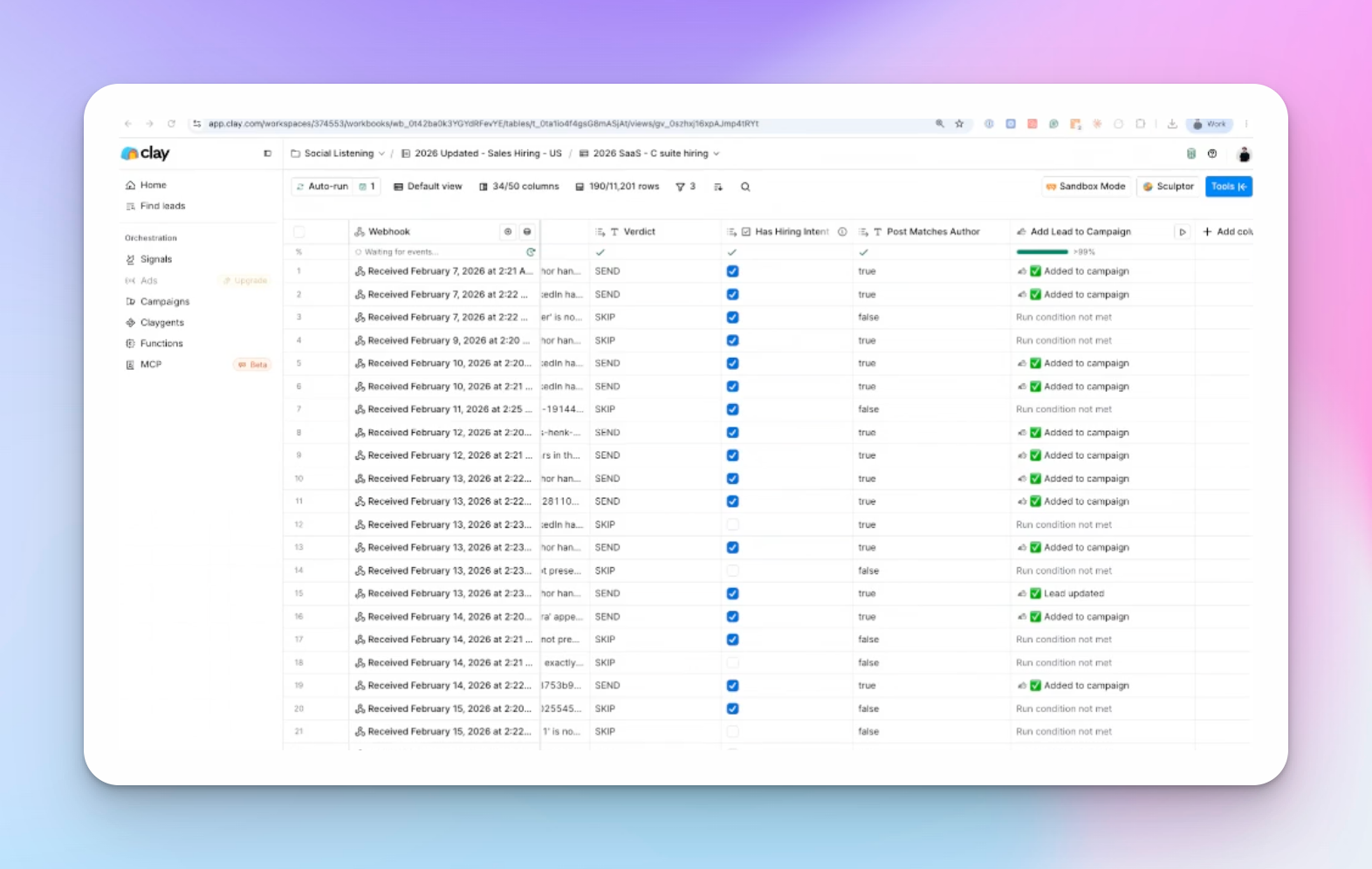
- Outreach (HeyReach): Qualified records flow into HeyReach for LinkedIn outreach, sent from Xan's own profile as the single sender.
The sequence is intentionally minimal: one connection request, one message.
The message references the specific role the person just posted about, acknowledges directly that this is a sales outreach ("I hate being sold to too, but we can help"), and offers a one-pager — including pricing up front, so prospects don't have to book a call just to find out cost.
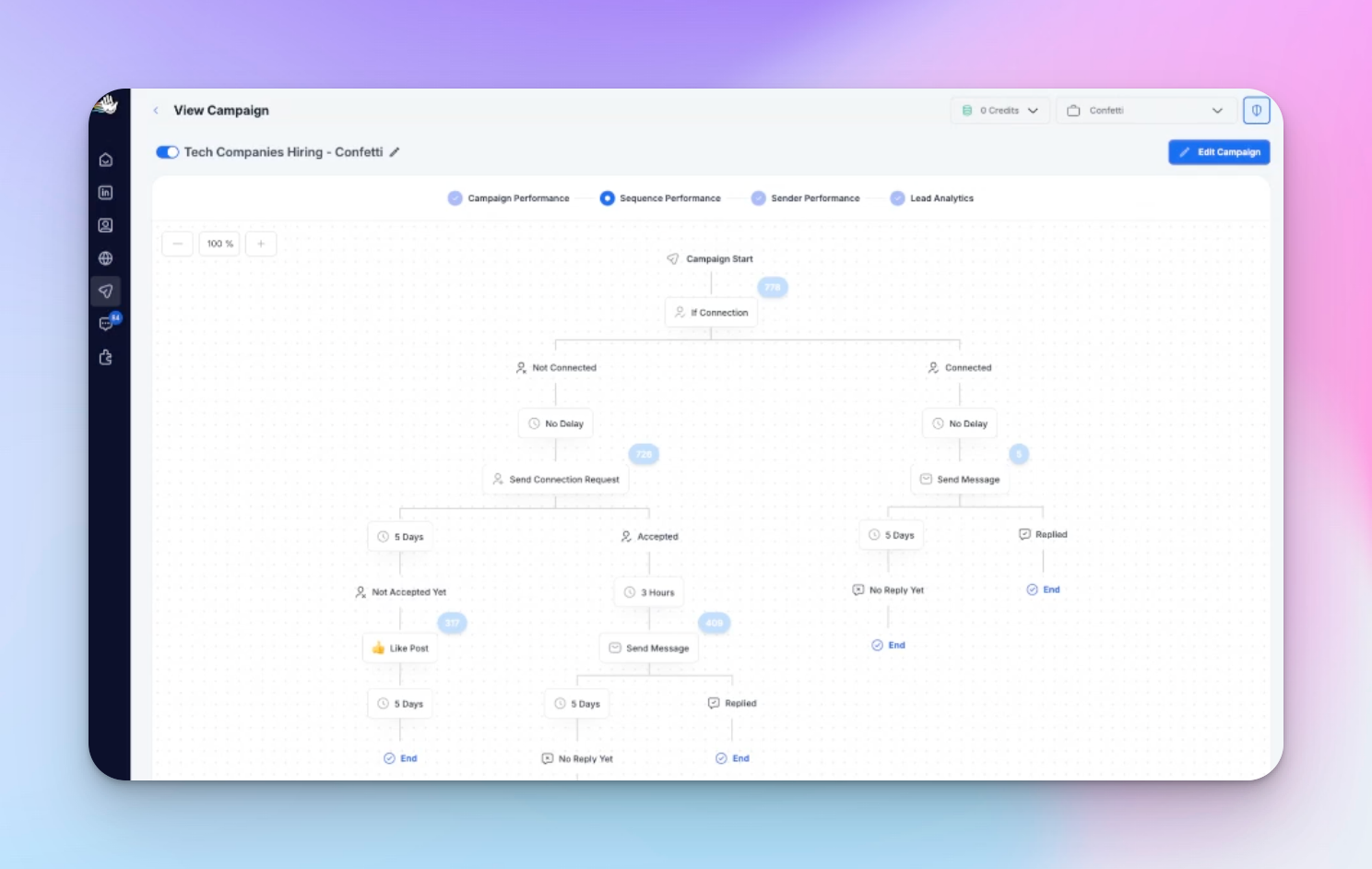
- Qualification and CRM sync (HubSpot + n8n): Replies are pushed into HubSpot in real time via an n8n workflow, which also applies a secondary "interest gate."
This step exists because a simple thumbs-up emoji reaction can get auto-tagged as an interested reply — the team built a check to confirm genuine interest before logging a lead, rather than relying on emoji reactions alone.
- Nurture (Email Bison): Contacts who complete the HeyReach sequence without responding are passed into Email Bison for follow-up nurture via email, so the motion covers both channels without duplicating outreach.
- Alerts (Slack via HubSpot): Rather than routing every connection request or reply into Slack (which floods the channel), only genuinely interested leads trigger a HubSpot workflow that posts a Slack notification with a direct link to the contact record — keeping the team focused on real signal.
The results
Looking at the most recent three months of this specific campaign:
- 40% connection acceptance rate
- 65 interested leads generated from a highly filtered, intent-qualified list — not a spray-and-pray approach
- Meaningful reply quality after filtering out false positives (e.g., emoji-only reactions)
- ~$150,000 in pipeline generated in recent months, including a closed $40K deal and a signed $50K deal
The motion is now running as an evergreen, largely self-sustaining channel – freeing the team to build additional initiatives on top of it rather than continuing to manually manage this one.
Why it works
Two things stand out about this approach:
- Timing over volume. Rather than casting a wide net across every open job posting, the system is built to catch hiring signals within the window they're actually accurate — right as they're posted — and filters aggressively for true intent before a single message goes out.
- Simplicity in the message. Despite the sophistication of the backend (Trigify → Clay → HeyReach → HubSpot → Email Bison), the outreach itself is deliberately restrained: one message, transparent about being sales outreach, personalized only on the role and company — with pricing included up front to reduce friction for senior sales leaders who are used to being pitched.