Email vs LinkedIn message: Which one should you choose?
Published:
March 6, 2026
Updated:
May 11, 2026
Everyone stuck in the LinkedIn-vs-email debate is asking the wrong question.
It's not "which channel performs better?" It's "which channel can absorb your mistakes while you figure out what actually works?".
LinkedIn message and email don't compete. They do completely different jobs at different stages. Lead with the wrong one, and you'll burn accounts, invalidate good ICPs, and waste weeks optimizing tactics when your strategy is fundamentally broken.
I put together the channel sequencing framework you actually need — one that tells you which channel should lead based on ICP validation stage, volume requirements, and social cost of being wrong.
Let’s dive in.
Why does every "LinkedIn vs Email" guide feel useless?
Because it's written by someone managing one account. Not 30.
Most outbound advice comes from sales reps who've never had to juggle multiple clients or rotate senders.
And don't even get me started on the metric comparisons.
Most advice stacks them side-by-side like you're choosing between Coke and Pepsi.
"LinkedIn gets 20% reply rates. Email gets 10%. Winner: LinkedIn."
Cool. Now explain why your LinkedIn campaign with 65% acceptance and 10% replies just burned three weeks and delivered zero pipeline while email (on the same ICP), booked six meetings.
You can't. Because the comparison skipped the part that actually matters: which channel touched them first.
So yes if the advice sounds useless, it's because it probably is. For you, at least.
You need a different playbook.
Which outbound channel should lead your agency's sequencing strategy?
The one that can survive any wrong assumptions.
Instead of asking: "Which performs better in our multichannel outreach strategy?"
Ask: "Which channel should lead based on ICP channel fit, and which one waits until I've earned the right to use it?"
I put together a framework for channel selection criteria that actually works.
Check it out below.
Email-first: when you need volume and forgiveness
Use email first when:
- Your ICP is a hypothesis, not a fact.
You think it's "Directors of Sales at Series B SaaS companies," but you haven't closed a deal yet. That's a guess. A cold email campaign lets you test it without heavy consequences. - Your messaging is untested.
You don't know which pain points land. You don't know if your CTA works. Email gives you iteration room. Test five subject lines in a week. Try different personalized messages. Email tolerates rapid experimentation without torching your sender reputation. LinkedIn's daily limits don't let you move that fast. And if you try, the algorithm notices. - You need a ton of touchpoints to see signal.
Patterns don't emerge from five data points. You need volume and that’s where email thrives. Send 500 emails across four sub-ICPs this week and see which cohort responds. Kill the losers and double down on the winners. - Social risk is high if you're wrong.
If your assumptions are off, you'd rather prospects delete your email than remember your LinkedIn message as proof you don't do homework. - You're testing 3-4 sub-ICPs within one broad category.
New client. New vertical. You're not sure if it's VPs or Directors. Series A or Series B. Email first. Always. Hard bounces tell you the list is bad. Spam complaints tell you the cold message is off. "Not interested" replies tell you the timing's wrong. Email shows you exactly what broke. LinkedIn acceptance with no reply? That tells you nothing.
That filtering logic came up when I spoke with Mark Friend about how his team approaches new segments.
“Based on my years in the field, email is an excellent way of measuring real interest via white paper downloads and link clicks. We use these particular metrics to determine whether a prospect actually suits our IT solutions or whether we should continue on. I wait until we have a 30% percent open rate on our initial email sequences because that's how I know there's a problem that we need to solve. Using social media too early is only a waste of resources on people who aren't in a buying cycle. That's why we use email as a filter, and LinkedIn as the relationship-building for leads that have been confirmed and have a desire for long-term support.” Mark Friend, Director at Classroom365.
What to watch for:
- If email gets 0% reply after 300 sends, your ICP is wrong. Don't touch LinkedIn yet.
- If email gets replies but the same objection every time, your messaging is off. Fix it before LinkedIn sees it.
- If email gets positive replies but no meetings, your offer or CTA is broken. Solve it in email, then bring LinkedIn in.
- Only move to LinkedIn once these are resolved. Otherwise you're just burning a channel that's harder to replace.
LinkedIn-first: when identity is the unlock
Use LinkedIn first when:
- Your ICP is validated and narrow.
You've already closed deals with the target audience. You know they engage. You know the messaging works. Now you need credibility to accelerate. - Relationship dynamics matter upfront.
Consultative sales. Founder-led deals. High-value industries where prospects check your background before they'll even consider replying (legal, finance, M&A advisory, executive coaching). - Volume is deliberately low.
You're targeting 20-50 decision-makers. Not 500. LinkedIn's precision is the advantage here. - Your brand or founder profile is an asset.
Prospects who check your LinkedIn see authority. Mutual connections. Recent posts. Email wouldn't carry that weight. - High-ticket, long sales cycles, named account lists.
$50K+ ACV deals where trust has to exist before the conversation even starts.
When I asked Deepak Shukla how he makes the channel call on a new client, he didn't start with a preference. He started with a diagnostic:
“I ask: Is this persona active on LinkedIn? Are they decision-makers or influencers? Is the problem urgent? Are they overwhelmed with email already? If it’s a budget holder or operational persona, I start with email. If it’s a founder-led, brand-heavy industry, LinkedIn can play a bigger early role. But in most B2B outbound scenarios, email validates faster.” Deepak Shukla, Founder of Pearl Lemon Group.
What to watch for:
- Only use LinkedIn-first if your reply rate hypothesis is >15%.
If you're guessing 6-8%, you're not ready. Default to email. - If acceptance is more than 60% but replies is less than 10%, you're still too early. High acceptance isn't validation. Move back to email.
- If you can't personalize 80% of messages with specific, relevant context, don't use LinkedIn first.
Generic openers get ignored. And now they've seen your profile and filed you under "spam."
LinkedIn-as-fallback: when context has to be earned first
LinkedIn performs best after another signal exists. Premature activation creates silent rejection and false negatives in outreach.
LinkedIn isn't always the opener. Sometimes it's the closer.
I recommend using LinkedIn as a follow-up:
- After email engagement.
Prospect opened your email three times but didn't reply. LinkedIn becomes the "Hey, noticed you saw my note about [pain point], easier to connect here?" move. - After warm signals.
They visited your site. Engaged with your content. Attended your webinar. LinkedIn reinforces interest that already exists. - After a referral or trigger event.
Funding announcement. Job change. Mutual connection intro. LinkedIn rides the wave of context that's already there. - When LinkedIn is validation, not discovery.
You've already confirmed interest via email. Now LinkedIn adds credibility to close the gap.
This works because there is pre-qualified intent, lower rejection risk, and amplification.
The prospect isn't cold anymore, and LinkedIn makes the warmth visible.
When I spoke with Christopher Pappas about how his team sequences channels, I asked him what most people misunderstand about LinkedIn in outbound.
He didn’t frame it as a channel choice but as a risk decision.
“When we onboard a new client, we decide the starting channel based on the buying motion and risk. If the offer requires trust and explanation, we lead with email to deliver a concise narrative and resource. For markets that are small and reputation-driven, we may start with LinkedIn to establish familiarity. However, we keep the tone light and use LinkedIn mainly as air cover. We evaluate three criteria when making this decision. First, we assess how formal the buyer culture is. Second, we consider how many stakeholders need to be involved. Finally, we look at how quickly we can test the message without risking the list. In most cases, email begins the conversation while LinkedIn supports it, and once we see replies, we scale outreach using LinkedIn for follow-ups and social proof.” Christopher Pappas, Founder of eLearningIndustry.
Another common mistake that I’ve noticed is that agencies activate email and LinkedIn simultaneously. Week one, both channels hit the same list.
This feels aggressive. Prospects see your email, then your LinkedIn request, then your email follow-up, then your LinkedIn message.
And now they ignore both.
The question isn't "LinkedIn vs email outreach, which is better?"
It's "which channel should lead based on decision-maker platform usage, and which one waits until I've de-risked the approach?"
Understanding channel performance patterns means recognizing that LinkedIn acceptance rates don't equal buying intent, and that your agency outbound strategy needs sequencing, not simultaneous activation.
How agencies accidentally burn LinkedIn by using it for volume
You're treating a scalpel like a sledgehammer.
Solo reps can skate by with aggressive LinkedIn tactics. Agencies? You're managing 12 clients. Each client has 3-5 team members with LinkedIn accounts. If you activate all of them simultaneously with aggressive pacing, LinkedIn sees 40-60 accounts doing similar stuff from the same IP range.
Say bye to your accounts.
Recognizable symptoms (check how many apply to you)
- Polite ignores.
Prospects accept your connection but never engage. Not to your message. Not to your follow-up. Radio silence. - Reply rate degradation.
First 50 connections: 12% reply.
Next 100: 6%.
Next 200: 2%. You didn't change anything. LinkedIn just stopped amplifying you. - Volume ceiling.
You can't send more than 20-30 requests a day without triggering warnings. - Multi-client pattern.
Same failure across different industries. Different verticals. Different ICPs. If it's happening everywhere, it's not the market. It's you. - "LinkedIn doesn't work in this niche."
This is the final stage. You've given up. Blamed the channel. Moved on.
Except the channel wasn't the problem. The sequencing was.
The real cost of burning LinkedIn
It's not just the account restrictions or the wasted time.
It's the false negatives.
You touch an audience with LinkedIn too early, they ignore you, and then you conclude the ICP is cold.
During my conversation with Pavankumar Kamat, he mentioned that this was a mistake he had made before.
“We ran a LinkedIn pilot against an enterprise engineering ICP, saw near-zero replies, and almost dropped the segment. A later, hyper-personalized three-step email sequence produced meaningful meetings and a healthy reply rate — a clear false negative from the LinkedIn-only test. I advise that before discarding an ICP, run an orthogonal micro-pilot (cold email or intent-based list), enforce minimum touch thresholds (≥200 qualified touches), and measure replies-to-meetings, not just impressions. Channels are complementary; use them to triangulate, not to adjudicate, ICP validity.” Pavankumar Kamat, Co-founder of Panto AI.
Stop treating LinkedIn like high-octane email.
It's not.
It's a credibility amplifier that works after you've de-risked the approach.
Five questions prevent you from burning your LinkedIn
The ones you answer before you launch, and not a minute after.
The framework tells you the logic and this checklist tells you the answer. Four questions. Eight minutes. Copy them into your Linkedin campaign planning doc and run them before every new client.
Q1: Is this ICP validated, or are you still guessing?
Validated: 10+ replies from this exact persona. Consistent objections. Booked meetings.
Testing: Titles and industries in a spreadsheet. No proof they engage.
Decision rule:
- Validated: LinkedIn outreach is safe (if other criteria check out)
- Testing: Cold email first. Mandatory.
Q2: Does identity matter before relevance?
Two types of buyers:
Identity-first: They check your LinkedIn profile before reading your message. If your credentials don't land, they're gone. Think consultants, high-ticket B2B, executive buyers.
Relevance-first: They care about the offer. Can you solve the problem? Who you are is secondary.
Quick test: "If the prospect saw our LinkedIn profile vs. our cold email copy, which makes them more likely to engage?"
Profile means LinkedIn first. If the answer is offer then cold email first.
Q3: Will you need volume in week one?
High volume (200+ touchpoints to see patterns.)
New ICP. Broad audience. You're testing multiple segments simultaneously.
Low volume (<50 highly-targeted prospects.)
Named accounts. Niche verticals. Founder-led outreach.
If you ever want to see panic spread through an agency Slack channel, just watch what happens when someone says:
“Uh… the LinkedIn account’s restricted.”
When I asked Chris Kirksey about volume decisions in week one, he didn’t start with theory. He started with a scar.
“We pushed LinkedIn too hard for a new dermatology client and got their account restricted within three weeks. While we waited five weeks for this restriction to be lifted, we nearly lost our client during that period of time. This happened because we thought we could run the same numbers on LinkedIn that we do through email.” Chris Kirksey, CEO at Direction.
And that’s the decision rule hiding inside this story:
If you need 200+ touchpoints in week one to see patterns, email should lead.
If you’re working 20–50 named accounts and precision is the game, LinkedIn becomes viable.
Question 4: What’s the social cost if the message is wrong?
Email wrong:Prospect ignores it or unsubscribes. Private failure. No future penalty. You can re-engage later with better messaging and they won't remember the first attempt.
LinkedIn wrong: Prospect sees bad targeting, doesn't respond, and now associates your brand with irrelevance. Public failure. That perception sticks.
Decision rule: Ask yourself: "If this message is off-target, would I rather the prospect forget me (email) or remember me as someone who didn't do their homework (LinkedIn)?"
Run through all four questions. Then slot yourself into one of three buckets:
- Email-First
Use when testing ICPs, messaging, or volume. LinkedIn follows only after email proves engagement.
When: ICP unvalidated, high volume needed, or social cost of being wrong is high.
- LinkedIn-First
Use when ICP is validated, volume is deliberately low, and credibility matters upfront.
When: Identity-first buyers, narrow target lists, founder profile is an asset.
- LinkedIn-Later
Use LinkedIn only after context exists—email engagement, warm signals, referrals, or trigger events.
When: Discovery needs to happen first, and LinkedIn's job is to reinforce what email already started.
This checklist works because it forces you to think about channel roles instead of channel performance.
Performance metrics (higher response rates, open rates, acceptance rates) only matter if you're using the right channel at the right stage.
Now it’s definitely possible to scale LinkedIn outreach across 50+ clients. But only if you respect the channel's mechanics. For more on how to do effective Linkedin outreach, read this article.
How to execute multichannel outreach strategy without burning LinkedIn accounts
Most LinkedIn automation tools are built for solo operators. One account. One campaign. One quota.When I spoke with Pavankumar about this, I asked him why so many agencies struggle once they move beyond five or six LinkedIn accounts.
He didn’t blame the operators. He blamed the tooling.
“Reporting is rarely built for portfolio-level decision-making. Agencies need lineage (which template, which step, which account), SLA-driven dashboards, and clear attribution across LinkedIn and email so they can optimize across dozens of concurrent campaigns. Example mental model: think “campaign operations platform” not “automation widget.” You need a control plane that manages policy, enrichment, sequencing, and health across clients, not just a queue that sends messages.Vendors that win will expose strong tenancy, programmable throttles, and true cross-channel orchestration — features agencies will demand as volume and risk scale.” Pavankumar Kamat, Co-founder of Panto AI.
Here's how HeyReach can help with that.
- Campaign isolation: One bad ICP doesn't kill everything else
If Client A's LinkedIn campaign tanks because the ICP was wrong, it shouldn't torch Client B's deliverability or sender reputation.
How HeyReach handles it:
Separate campaigns per client, per sub-ICP, with independent pacing and sender pools.
Client A targets SaaS founders. Client B targets marketing directors. Client C targets CFOs. Each gets its own isolated campaign. Zero cross-contamination.

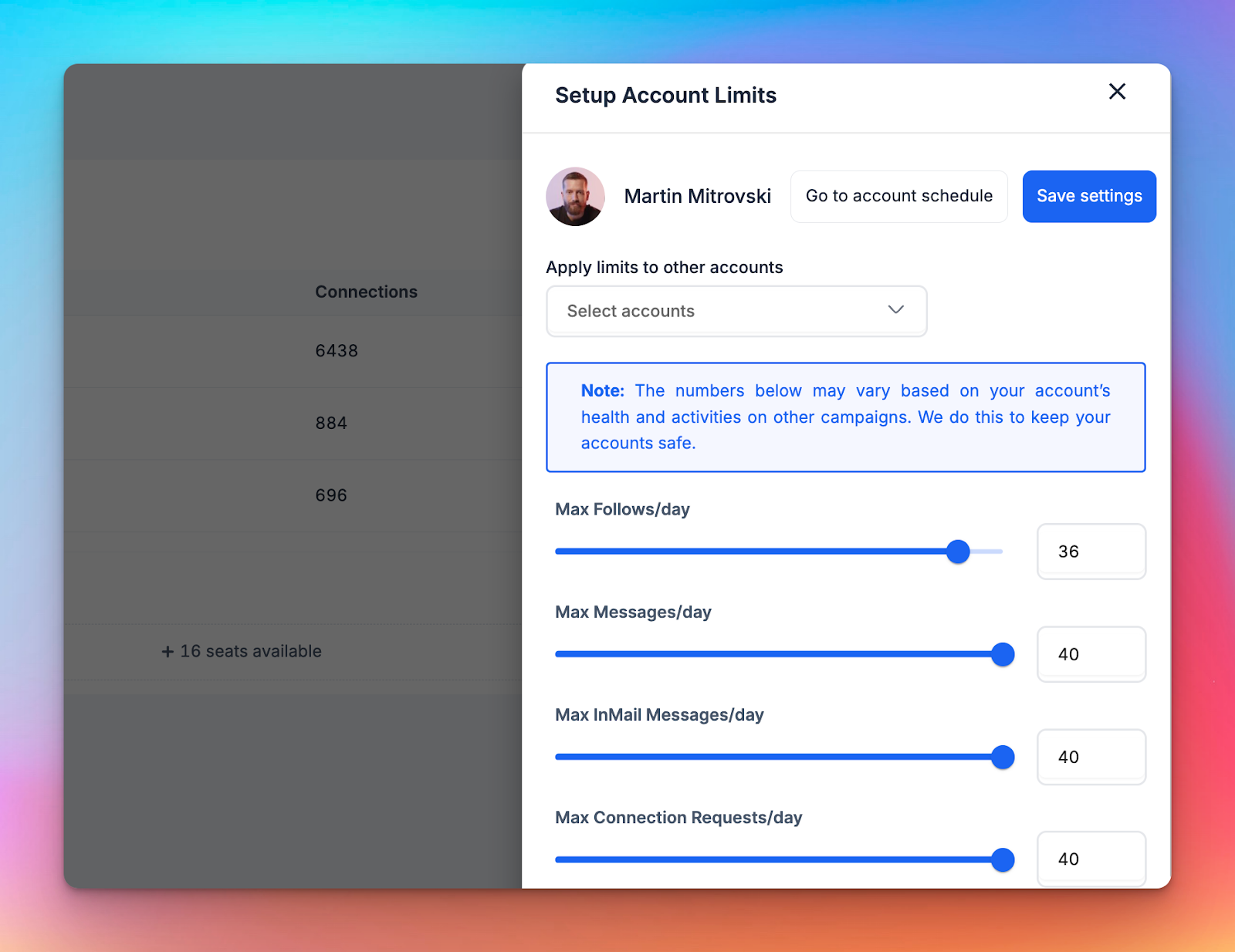
- Sending limits & pacing controls: LinkedIn stays in validation mode
LinkedIn-first requires conservative volume (20-30 connections/week). If you can't control pacing, you'll either over-push LinkedIn.
How HeyReach handles it:
With HeyReach, you can Set daily limits per account and cap weekly volume at safe thresholds.
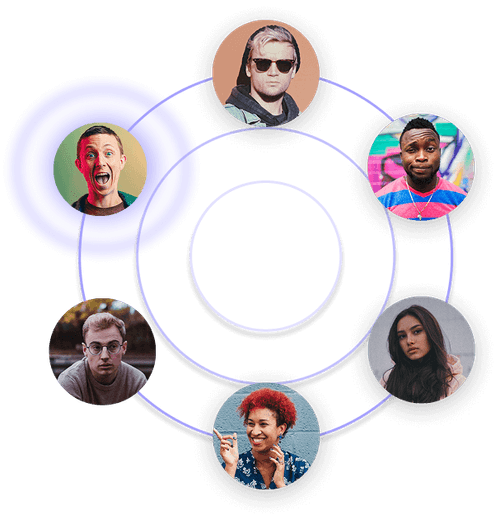
- Sender rotation: Distributed volume without distributed risk
Agencies need 200+ LinkedIn touches per week to keep pipeline moving. But pushing 200 connections from one account triggers restrictions in 48 hours.
How HeyReach handles it:
Rotate sends across multiple LinkedIn profiles within one campaign.
You've got 4 sender accounts for Client A. Each sends 25 new connections per week. Total volume: 100/week. LinkedIn sees 4 accounts behaving normally, not 1 account behaving suspiciously.
- Proxies per account: LinkedIn doesn't see coordinated behavior
LinkedIn monitors IP patterns. If 10 accounts send connection requests from the same IP within minutes of each other, that's coordinated behavior. Flagged.
How HeyReach handles it:
Unique residential proxy per LinkedIn account. Each sender routes through a different ISP. LinkedIn sees 10 individual users in different locations doing normal outreach.
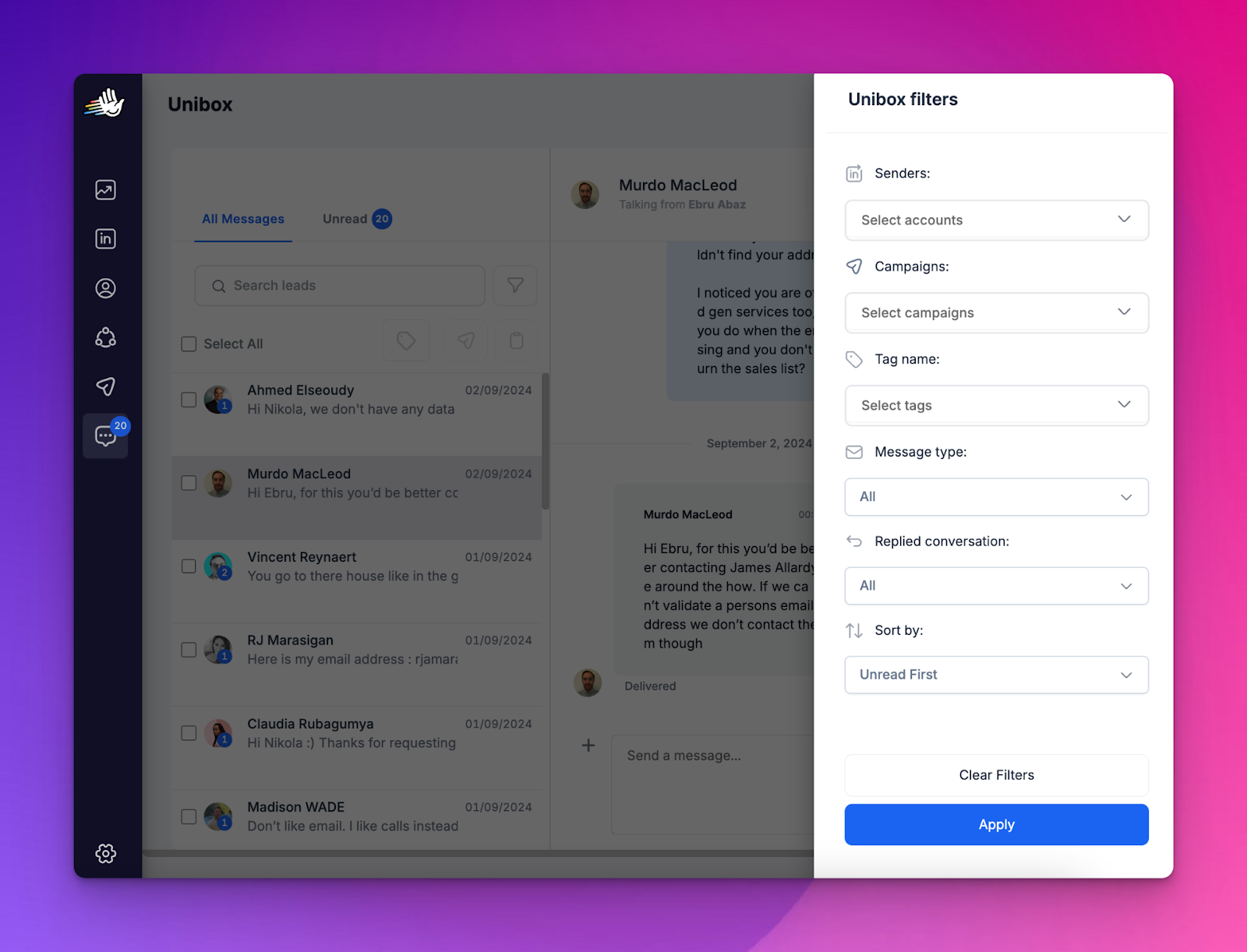
- Unibox: One inbox for all your Linkedin conversations
When you are managing multiple Linkedin accounts, it can get difficult to keep track of all your Linkedin inmails and messages.
How HeyReach handles it:
All LinkedIn conversations across senders land in one unified inbox. Tagged by campaigns and senders. You see everything in one view.
Strategy first. Infrastructure second.
Get both right, and multichannel outreach becomes sustainable, not a grind that burns accounts faster than you can replace them.
So which channel wins: LinkedIn or Email?
Neither. Because they're not competing.
You might read this and think 'we kind of knew this.' Then you'll go back to activating LinkedIn on day one because it feels more like real outreach. Email feels boring while LinkedIn feels visible. That instinct is exactly what burns accounts, kills good ICPs, and sends teams down six-week copy optimization rabbit holes. The framework is simple. The discipline to follow it is the harder part.
Use the pre-launch checklist. Audit your campaigns. Fix the sequencing errors before you fix the copy.
And if you're running a multi-channel approach for multiple clients, remember: the goal is to activate the right channel at the right stage, and let each channel do the job it was designed for.
Email absorbs uncertainty while LinkedIn amplifies alignment.
Sequence them right, and both will do wonders.

Try it for free
Frequently Asked Questions
Should I use email or LinkedIn messages for cold outreach?
It depends on your ICP validation stage. If you're still testing assumptions about your target audience, lead with email — it gives you volume, fast iteration, and low social cost if your messaging is off. Use LinkedIn once you've validated your ICP and messaging through email engagement signals.
When should LinkedIn lead instead of email in outbound sequencing?
LinkedIn should lead when your ICP is already validated, you're targeting a small list of 20–50 decision-makers, and your personal or founder brand adds credibility. This works best for high-ticket, consultative sales where prospects check your profile before engaging.
Can I run email and LinkedIn outreach at the same time?
Simultaneous activation on the same list often backfires. Prospects see your email, connection request, and follow-ups stacking up, and they tune out both channels. Instead, let one channel lead and use the other as a follow-up once you have engagement signals.
How do I know when to move from email to LinkedIn in my outbound sequence?
Move to LinkedIn once email has given you clear signal: consistent reply rates, validated objections, and booked meetings. If email is still getting zero replies after 300+ sends, your ICP needs work — adding LinkedIn won't fix that.
How can I tell if my ICP actually uses LinkedIn for buying decisions?
Check profile activity (posting, commenting), connection behavior (open vs. curated network), and role type—executives and consultants live on LinkedIn, IC-level ops roles don't. Quickest shortcut: ask your sales team if closed deals ever mention seeing you on LinkedIn. If yes, it's part of their buying process. If no, it's probably not.