Scaling personalized LinkedIn outreach with automated pitch decks (44% higher reply rate)
Published:
April 30, 2026
Updated:
May 26, 2026
While 99% of people are sending the same text-based LinkedIn messages, I built a system that delivers fully personalized pitch decks at scale — and it's completely automated.
And when I deployed this for one client, their response rates jumped by 44%. In this article, I'll walk you through the entire outreach strategy, workflow, the psychology behind why it works, and exactly how I set it up from scratch.
Why personalized LinkedIn outreach with pitch decks crushes text DMs
Most cold outreach sends a generic message into the void. There's no wow factor, no proof of research, and no value delivered upfront. A personalized pitch deck flips all of that. It signals genuine interest in their business, not just their wallet.
Here's what I send in the first message: a landing page analysis tailored specifically to the prospect, built around the meta ad they're currently running.
The deck includes a customized product image scraped from their actual ad, a breakdown of what's working well on their landing page, clear areas of improvement, recommended changes, expected results, and a CTA block with a direct booking link to my calendar.
That's value delivered before they've said a word to me.
The contrast with email outreach matters here. With cold email, you can't reliably drop links in a first message without killing your deliverability and damaging your sending infrastructure. You have to ask for permission first, which adds friction and kills momentum.
On LinkedIn, none of that applies. The link goes in the first message. The deck does the talking immediately.
Three psychological levers make this work.
- First, it's a genuine pattern break — nobody else is doing this.
- Second, it hits real pain points: if someone is running meta ads, they care about conversion rates, and improving a landing page is the lowest-hanging fruit for better ad performance without touching the creative.
- Third, I'm not asking for anything. There's no CTA in the message itself. That absence of pressure creates a completely different dynamic from the standard "can we jump on a 15-minute call?" approach that floods every prospect's inbox.
The tool stack: Clay, Gamma, and HeyReach
The full workflow runs across three tools.
- Clay handles all prospecting and data enrichment. It pulls the raw data, enriches it, and feeds structured content into the deck-building prompt. Without Clay, none of the hyper-personalized output would be possible — it's the connective tissue of the whole system.
- Gamma is the AI presentation platform that takes that structured content and generates the actual pitch decks via API. The consistency it produces across wildly different niches genuinely surprised me.
- HeyReach is the LinkedIn automation tool that streamlines everything at scale — connection requests, the pitch deck message, and follow-ups — while keeping activity within safe limits.
Building the prospect list with meta ads data
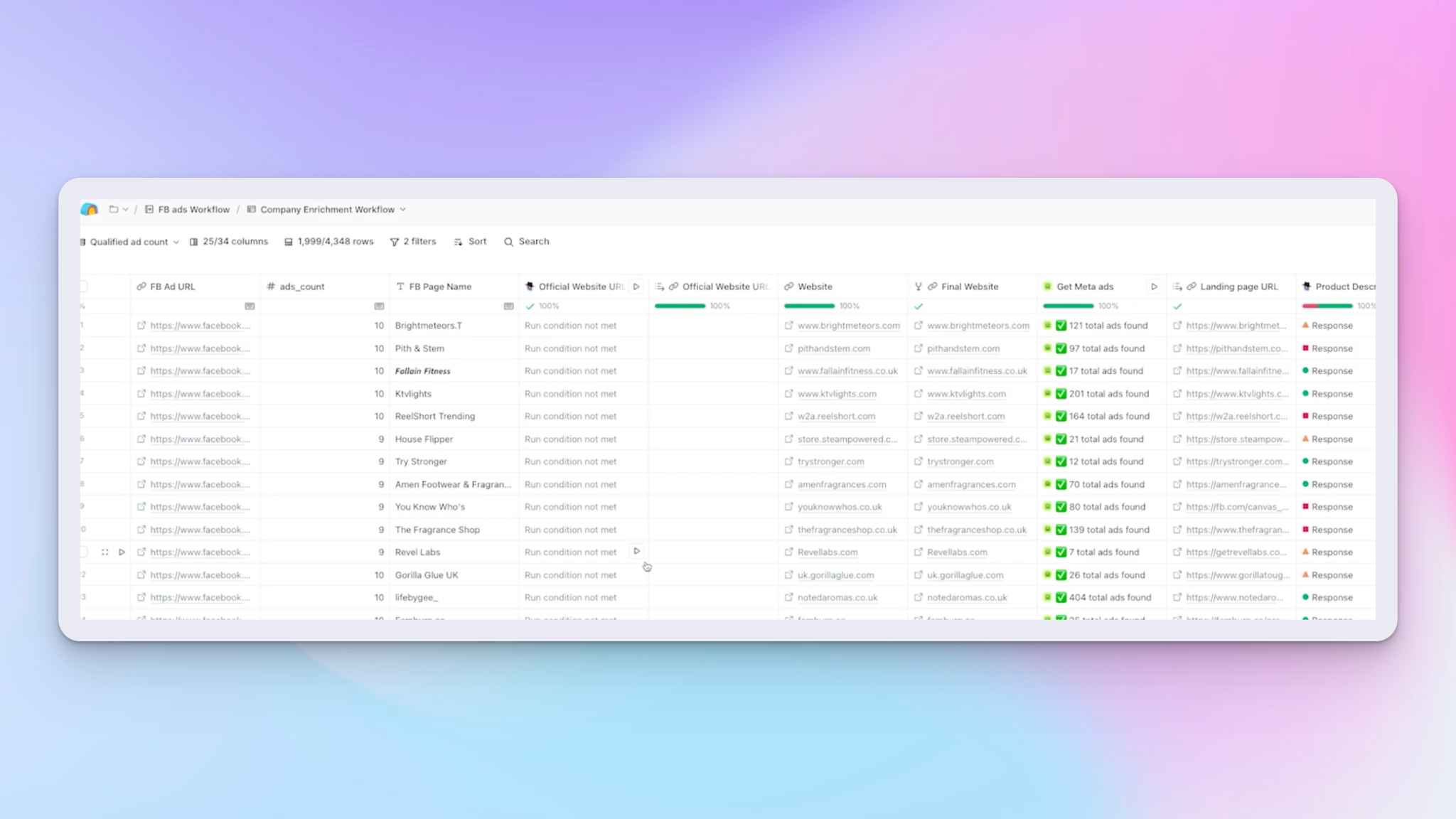
I source prospects using Ampify, which scrapes the Meta Ads Transparency Suite via keyword searches. After the initial scrape, I clean the dataset and remove irrelevant columns.
Each row enters Clay with a Facebook ad URL, the FB page name (which maps to company name), their website, their ad copy, and a handful of other useful data points. From there, I run a meta ads enrichment step — the ad count from the raw scrape is unreliable, so I rerun it to get accurate qualification data.
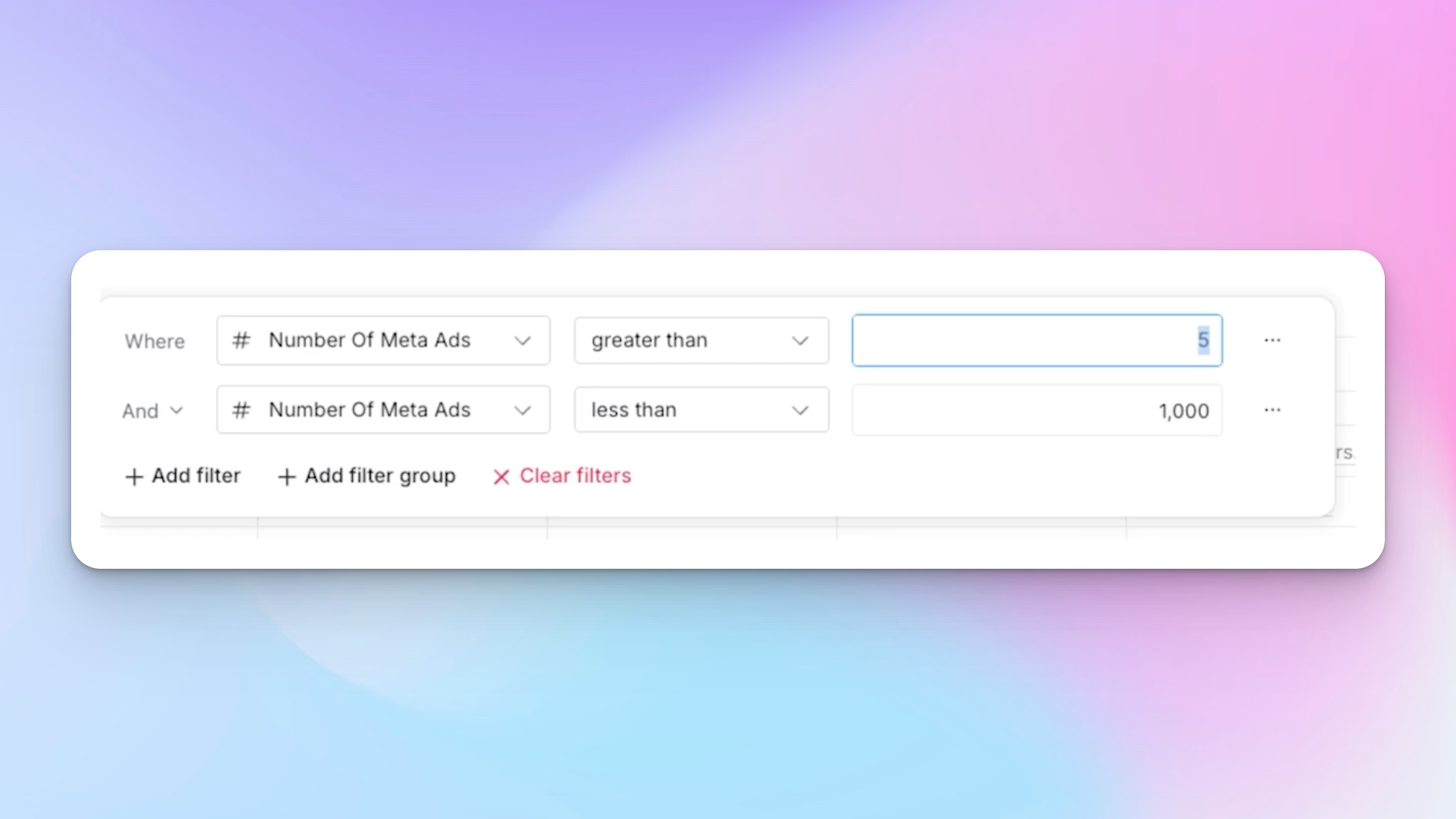
My filter: between 20 and 1,000 active ads. Anything below 20 suggests they're barely testing. Anything in that range tells me they're actively spending budget and will care about optimizing that spend. This is essentially my ideal customer profile filter for this campaign — ad spend is a direct proxy for seriousness.
The meta ads page also gives me a landing page URL from an example ad. That URL becomes the foundation for the automated analysis and is where the ai-powered part of the workflow begins.
Automated landing page analysis with AI
This is where the system starts to generate real leverage.
I run a Clay/AI prompt that hits the prospect's landing page and analyzes it against Meta's own best practices. The prompt returns data in a specific format: a summary of the creative, what's working well, what could be improved, and recommended changes for better performance.
The "what's working well" section is deliberate. Prospects optimize their pages — most are doing some things right. Leading with pure criticism is a bad look.
A balanced analysis builds credibility, and that balance is exactly what makes personalized outreach feel legitimate rather than canned. You're not showing up with a generic pitch.You're showing up with evidence that you actually looked at their business — almost like referencing a recent post or a shared experience, except the signal here is their live ad data.
The output lands in a JSON object with separate values for each section. That structure is critical because I pull each value into the corresponding slide in the Gamma prompt. Dump unstructured data into the AI and the output degrades immediately.
On model choice: I use GPT-4.1 for this step. It's more expensive, and the token load per row is heavier — roughly £0.02 per row — but the reasoning quality genuinely matters here. For high-quality analysis aimed at high-value prospects, cheaper models produce noticeably weaker output.
Generating personalized LinkedIn outreach decks with the Gamma API
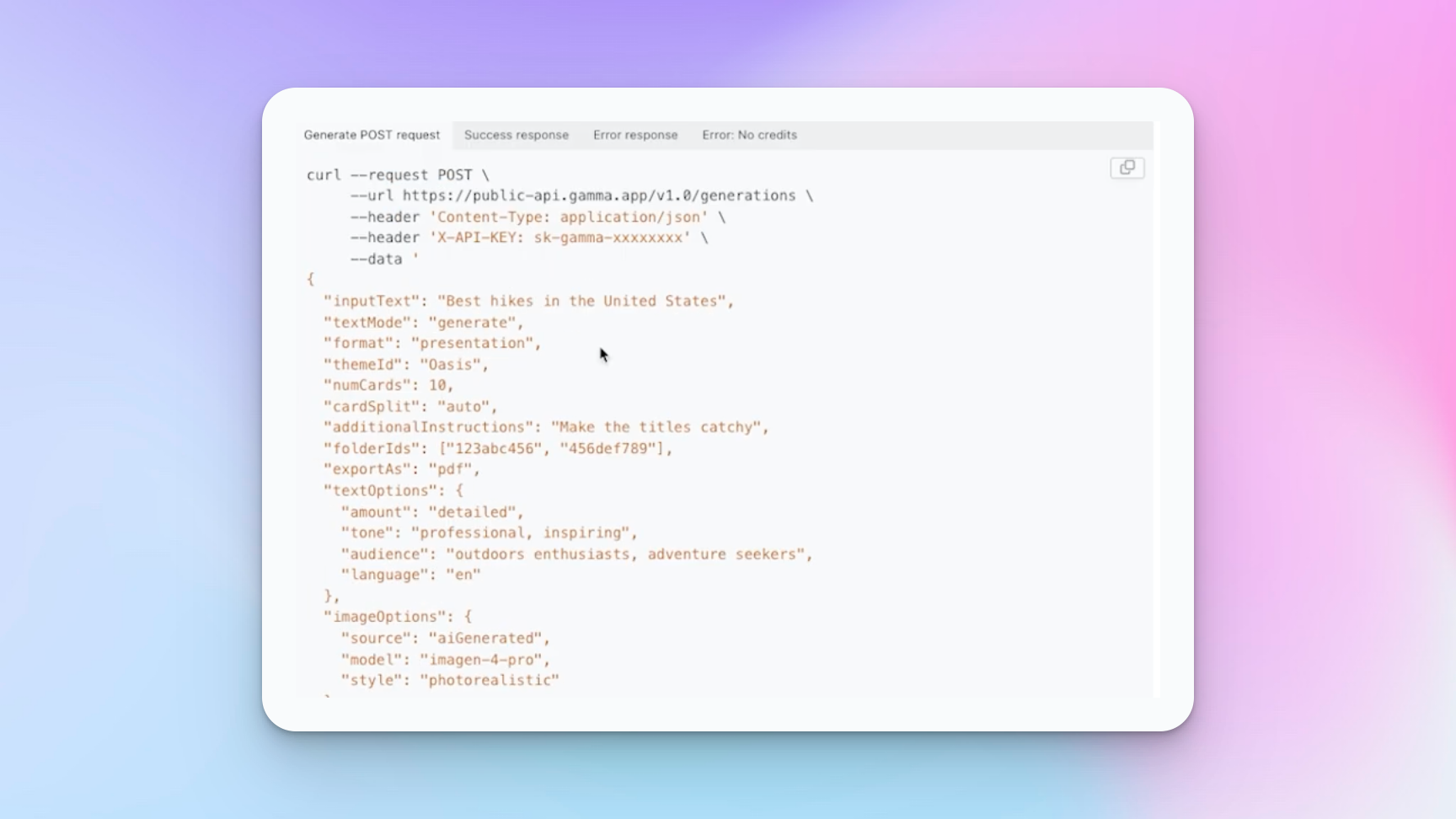
The Gamma API request is a POST call from Clay. The body contains the input text for each slide, broken out using Gamma's card-splitting syntax.
My deck structure:
- Title slide (with a web-searched product image personalized to the brand)
- Summary of the creative
- What's working well
- What could be improved
- Recommended changes for better performance
- CTA slide with my calendar link
The title image works by setting the image source to "web all images" and passing in the prospect's Facebook page name plus product name as the search query. Gamma searches the web and places a matching image on the title slide. In one example deck, it pulled the exact t-shirt the brand was selling in their ads.
That level of real-time personalization is what makes this feel like a bespoke analysis rather than an automated template.
For non-title slides, I instruct Gamma to stick to icons, vector shapes, and callout elements. Photo-realistic AI images across a full deck hallucinate too often. Keeping it to simple graphical elements produces consistent, professional output slide after slide.
I set text mode to "preserve" — Gamma uses the content I've provided and makes only minor adjustments — and specify roughly seven cards aligned with the structure above.
One important design decision: I run the deck generation per company, not per person. Multiple decision-makers might work at the same company, and generating five identical decks for the same brand wastes credits and adds no value. I generate one deck, then in a separate Clay table I find the relevant people at each company and link that shared presentation URL to each of them.
Sending personalized LinkedIn outreach at scale with HeyReach
Once the Clay table has prospect data plus presentation URLs, I push everything into HeyReach via the API. Each lead gets imported with standard fields — first name, last name, LinkedIn profile URL — plus a custom field for their unique presentation URL.
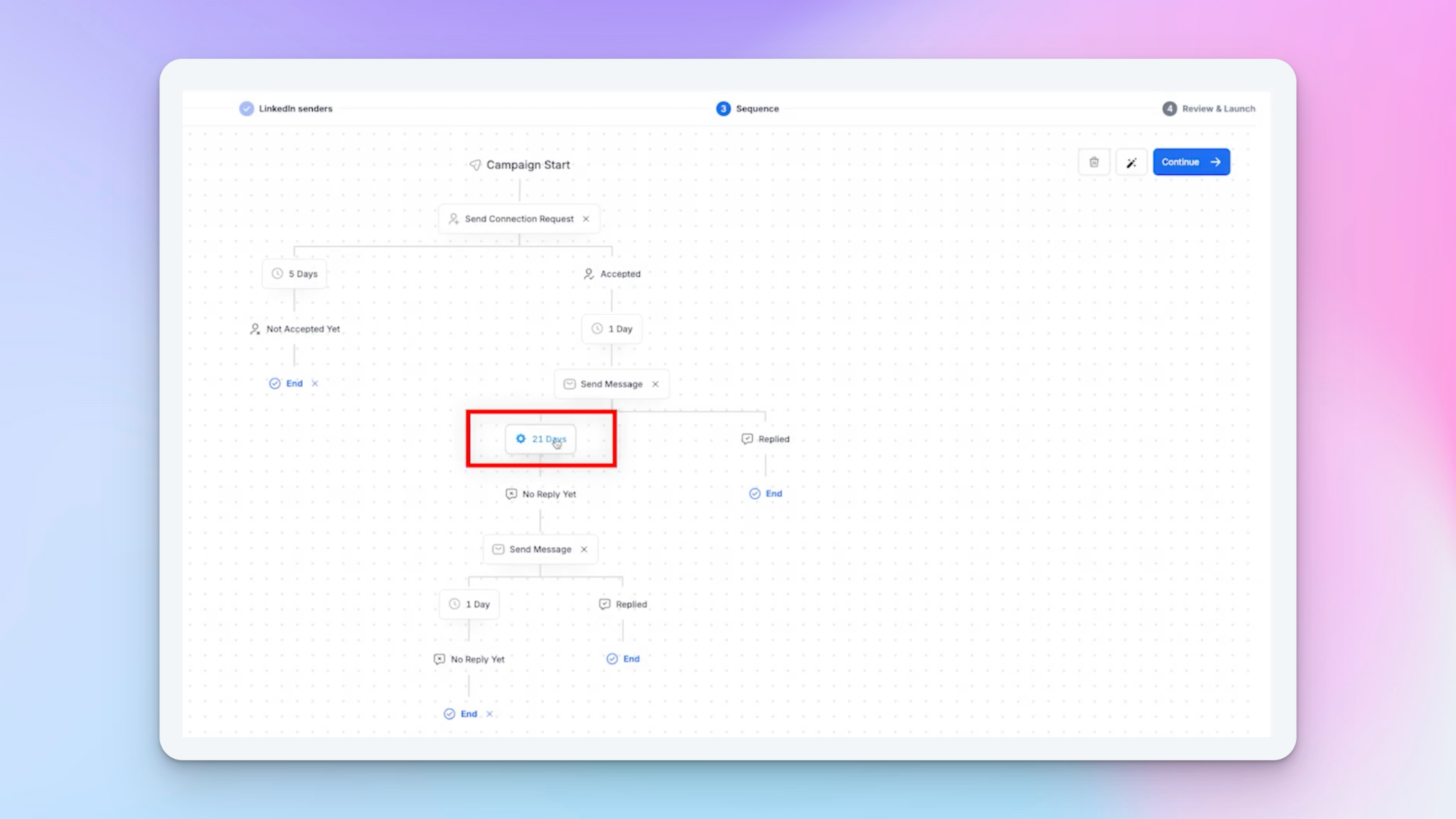
The outreach campaign itself is intentionally minimal. I send a blank connection request — no note. Once connected, the first message is just:
"[First name], ran a performance analysis on one of your meta ad landing pages. Cheers, [First name]."
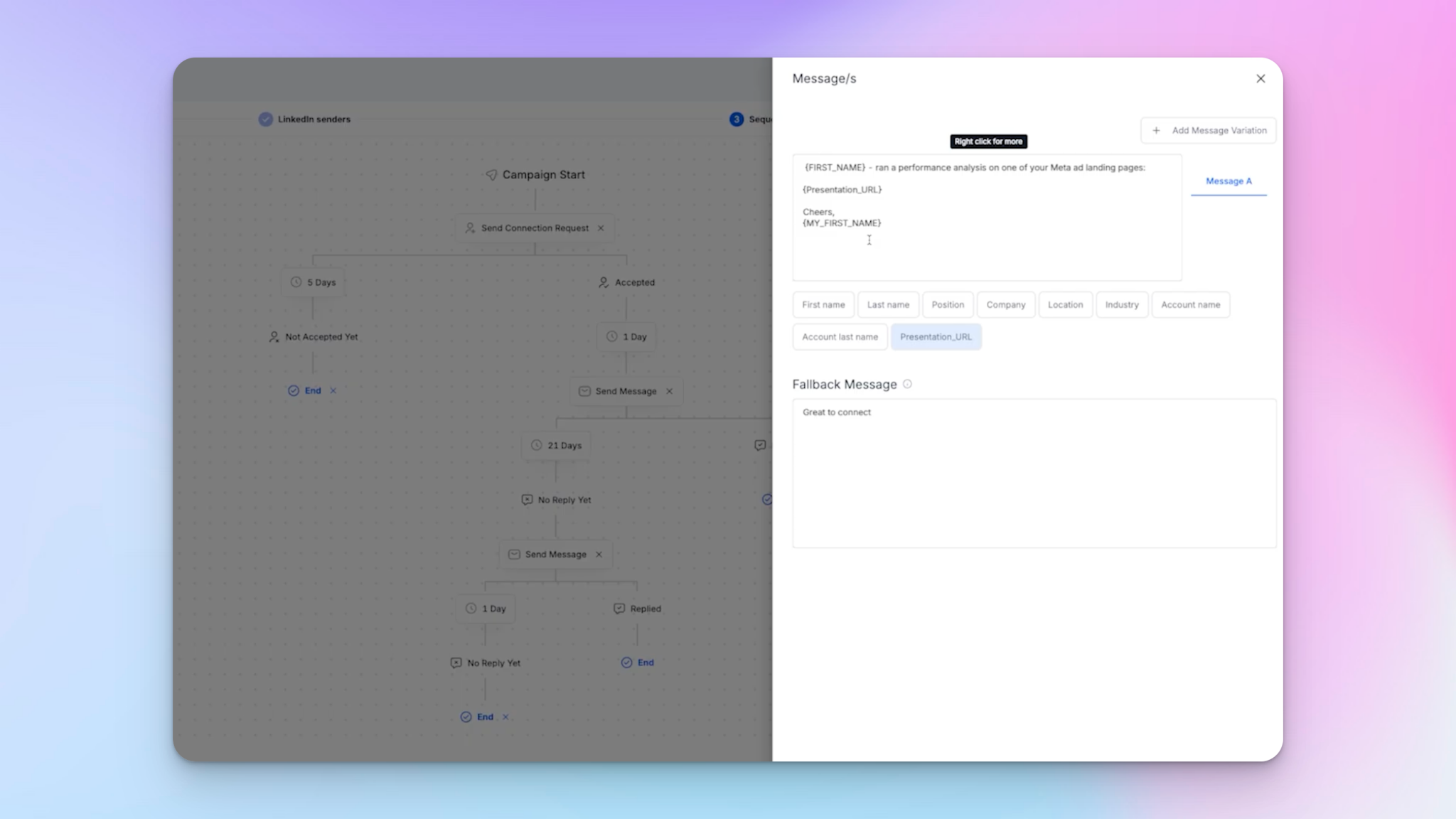
That's it. No pitch. No ask. The presentation URL is embedded and does all the talking. The absence of a CTA in the message signals confidence — the subtext is: I've already done the work, if you want to act on it, here's how. That framing consistently outperforms anything that leads with a meeting request.
I also set up a fallback message for cases where the presentation URL fails to populate. Without the URL, the message makes no sense, so the fallback is a completely different, generic connection note. This triggers less than 1% of the time, but it's essential to have.
For follow-up messages, I wait three weeks before sending a single touchpoint with an intro like: "Managed to take a look?" One follow-up. Minimal. The deck has already done the heavy lifting.
HeyReach's automated LinkedIn messaging keeps all of this running without manual intervention — LinkedIn connection requests, message delivery, and the delayed follow-up all fire on schedule.
I manage all inbound conversations through HeyReach's unified inbox, which handles replies across multiple sender accounts without losing context. Any lead that replies positively gets synced into the CRM — I run this with HubSpot and Salesforce depending on the client — so no warm conversation falls through the cracks.
Messaging strategy and why pattern breaks drive the acceptance rate
Most LinkedIn outreach fails because it's structured the same way as every other message in a prospect's inbox. Standard connection request → pitch → follow-up → harder follow-up. Prospects recognize the pattern immediately and tune it out.
This workflow breaks the pattern at every stage. A blank connection request is unusual. A first message with no ask but a full personalized analysis is very unusual. A three-week gap before a minimal follow-up is almost unheard of. Each choice is deliberate, and together they add up to a sequence that feels completely different from standard outreach messages.
The campaign works because it treats prospects like adults who can see value for themselves. SDRs often over-engineer sequences to push for commitment at every step, which creates resistance. This approach steps back and lets the work speak — and in doing so, it genuinely builds trust from the very first touchpoint.
For your LinkedIn Sales Navigator targeting, this matters too — the strategy only performs well when the prospect genuinely cares about landing page conversion. Sending it to people not running paid ads, or running them at too small a scale, wastes budget and produces irrelevant decks.
For sales teams running multi-channel outreach, this deck-first approach also works well as the LinkedIn leg of a broader sequence, with email outreach picking up anyone who doesn't respond on LinkedIn.
The HeyReach + Instantly integration makes that handoff automatic — if a LinkedIn message goes unanswered, the lead routes directly into your email sequence without any manual work.
If you want to build lead generation that doesn't feel like lead generation, this is the model. You're delivering something genuinely useful first, then letting the conversation happen naturally.
Costs, QA, and scaling safely
Gamma costs around £20/month for approximately 4,000 credits — enough for 500–600 decks. GPT-4.1 adds roughly £0.02 per row for the analysis prompt. At these cost levels, this workflow is best reserved for a focused, high-quality segment of your ICP — the kinds of accounts where the deal size justifies the extra production cost per lead.
Running it across 10,000 undifferentiated leads makes no economic sense. Use company size and ad spend as your primary qualification filters so every deck goes to someone who can actually benefit from the analysis. A/B testing different deck formats or messaging angles on a smaller cohort first, tracking metrics, then scaling what works, is the smarter path.
Before scaling, review the first 200 decks manually. Turn off Clay's auto-update feature before you push to HeyReach so the data stays frozen during review. Once you've confirmed the error rate is very low — and it will be, if the prompt structure is clean — you can let the full workflow run autonomously with the AI tools handling execution end to end.
One thing I borrow from the HeyReach + Attio integration playbook: routing accepted connections by tag straight into a priority follow-up list. Once someone opens the deck and replies, that signal should immediately route them into a more responsive sequence — not leave them sitting in the general campaign queue. Real-time routing based on engagement is what separates a scalable system from a batch-and-blast approach.
The key to consistency throughout is structure. Messy, unstructured data fed into the AI without slide-level context will degrade the output every time.
The Clay enrichment pipeline exists specifically to prevent that — each data point has a designated place in the prompt, and the AI always has clean, contextualized inputs to work from.

Try it for free
Frequently Asked Questions
How is this different from normal LinkedIn automation?
Because it’s hyper-personalized LinkedIn outreach at scale. This workflow generates a fully unique, multi-slide analysis document for each prospect, built from live data scraped from their actual ads and landing page. The personalization is substantive, not cosmetic, and that’s what turns outreach efforts into replies.
Do I need coding skills to set this up?
No. Clay's interface is no-code. The Gamma API request is built inside Clay using their HTTP request feature, and you can copy the exact body structure from Gamma's documentation. HeyReach's API integration is equally straightforward. If you can follow a structured guide section by section, you can build this without any prior technical knowledge.
What industries does this work best for?
Any prospect actively running paid ads who cares about landing page performance. In practice, that covers most e-commerce brands, SaaS companies, and direct-response advertisers. The meta ads angle is the entry point — the analysis is meaningful because the prospect has real money tied to the landing page you're analyzing.
How long does it take to generate and send 100 decks?
Once Clay has enriched the data, generating 100 decks via the Gamma API takes a few minutes. The manual QA pass — reviewing the decks before launch — is the only time-intensive step. Budget around 20–30 minutes for a first pass on 100 decks until you're confident in the error rate.
What's the right audience size for this campaign?
A focused, high-quality segment — think 500 to 2,000 prospects rather than a mass-market list. The cost per deck and the value of the analysis both argue for precision over volume. Use this where the deal size justifies the extra production cost per lead, and where the prospect is actively spending money on the exact problem you're solving.