How to build a customer retention strategy for your outbound agency and prevent churn
Published:
January 27, 2026
Updated:
May 26, 2026
Your best client just crushed it. 40% response rates. Fifteen demos booked. Pipeline looking fantastic.
Three weeks later: "We've decided to bring this in-house."
What happened? They Googled your tool's pricing, saw $99/month, did the math against your $3,000 retainer, and convinced themselves an intern could "just run the software." This isn't about bad service or poor results. It's about a structural flaw killing agency retention rates industry-wide.
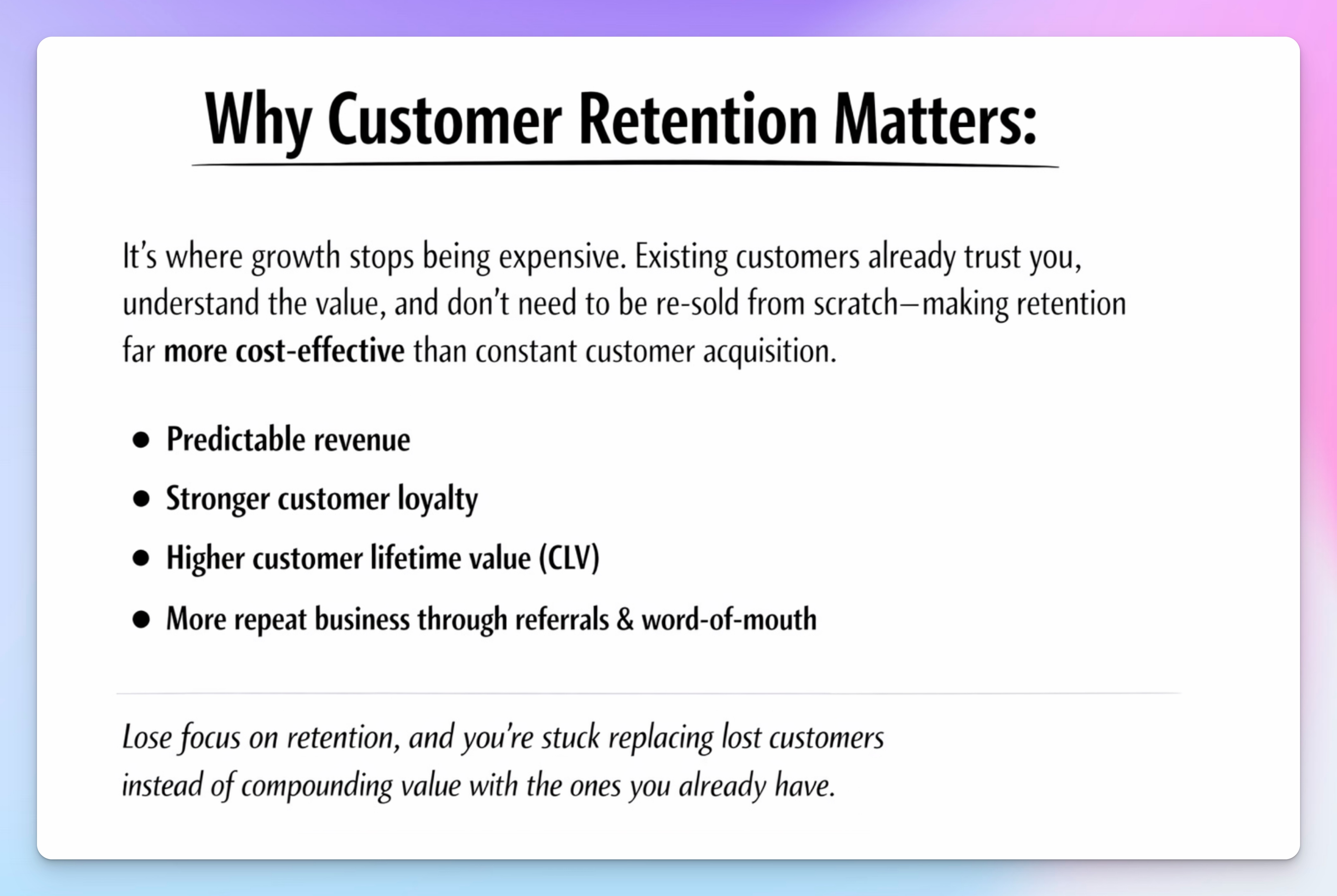
The uncomfortable truth is retention is the real battleground. It is where the bottom line is protected. It drives customer lifetime value (CLV), repeat business, referrals, word-of-mouth, upsells, and cross-selling. Ignore it, and you’re stuck constantly replacing lost customers instead of compounding value with existing customers. Focus on it, and growth gets cheaper, calmer, and far more predictable.
You’ll learn how to turn visible tools into invisible infrastructure, reposition your service around strategy, design customer retention strategies that protect revenue, increase customer loyalty, and keep your best clients from ever thinking, “We’ll just do this ourselves.” Walk with me.
Why your best clients are self-servicing their way out
If your best clients can see the tool behind your service, they’ll eventually Google it, price-check it, and decide they can do it themselves. Success and visible tools means churn risk. They start believing the how is simple. That’s the moment “This looks easy, we’ll just do it ourselves” enters the chat.
And the moment they think execution is the value, not strategy, positioning, and ownership, churn is just a matter of time.
Not because your results are bad, but because your value looks replaceable.
KPI Highlight: Calculate your agency’s true churn cost
Let’s put numbers on this before it hits your bottom line.
Customer Retention Rate (CRR):
[CRR = ((E - N) / S) \times 100]
- E = clients at the end of the period
- N = new customers acquired
- S = clients at the start
If your CRR is under 80%, you might have a retention leak.
And here’s the part most agencies avoid looking at:
Lose an existing customer after 4–6 months and your customer acquisition cost is gone forever. That’s sunk CAC, zero payoff.
In agency terms:
- Short retention = broken CLV
- Broken CLV = constant pressure to acquire new customers
- Constant acquisition = fragile revenue and stressed teams
This pain point starts manifesting the moment clients recognize the tool behind your service and realize they could replace you.
That’s a positioning and ownership problem.
And if your agency can be replaced by a login, are you really a partner or are you a temporary subscription? People, it’s time to stop operating tools and start owning outcomes.
The foundation of indispensable outbound agency value; From tool operator to strategic partner
If your clients stop believing you are essential, then the fix is becoming strategically irreplaceable.
The three value layers that actually retain customers
Layer 1: Client selection (retention starts before onboarding)
You can’t fix churn at the end of the customer journey if you broke it at the beginning.
I worked with a founder obsessed with lowering customer churn rate. He kept shipping upgrades, adding features, tweaking pricing.
The whole time the real issue was wrong customers. They signed up from a misleading ad and were never going to be happy.
Fixing churn didn’t require more work.
It required better filtering. Who knew?
Layer 2: The living strategy engine (what tools can’t do)
Tools execute.
Agencies think.
When LinkedIn shifts:
- Tools keep sending messages
- Agencies spot the dip, test fast, pivot before NPS drops
When markets saturate:
- Tools burn the same ICP
- Agencies expand customer segments and protect customer lifetime value
When competition heats up:
- Tools stay blind
- Agencies adjust positioning based on customer feedback and real conversations
Continuous strategic adaptation is where customer engagement and retention programs are actually built, not static automations.
- Weekly optimizations.
- Monthly strategy resets.
- Quarterly ICP reviews.
- Annual lifecycle rethink.
That’s customer success infrastructure.
Layer 3: Relationship architecture (your churn insurance)
Single-threaded relationships kill retention.
Build three levels:
- Execution level – day-to-day trust and delivery
- Strategic level – VPs and heads of growth tied to business outcomes
- Executive level – founders who see you as part of the company’s bottom line
If one contact leaves and the account stays, you’ve done it right.
Positioning your agency so walking away feels risky is just good client management.
This is how you move from vendor → partner → infrastructure.

The white-label advantage: Churn-proofing your service with HeyReach
White-labeling does more than just “hide tool name”. It eliminates the mental trigger that causes clients to think they don’t need you. When clients can't Google your infrastructure, they can't cost-compare it. When they can't cost-compare it, they are more likely to stay.
The Google search (what white-labeling actually prevents)
Picture this: Your client logs into the dashboard for their weekly performance check. Top left corner: "HeyReach" logo. They think nothing of it, until month 6 when the quarterly budget review happens and someone in finance asks, "What tools are we paying for through this agency?"
Cue the Google search.
Five minutes later, they found the pricing page. HeyReach: $79-1999/month depending on the plan. They're paying you $4,000/month. The mental math is instant and brutal, and the churn countdown has begun.
Within two weeks, you get the email: "We're exploring bringing LinkedIn outreach in-house. Can you send over documentation on how you've set everything up?"
In other words: "Thanks for training us on the tool. We'll take it from here."
I've watched this exact scenario play out several times across outbound agencies I've consulted with. Same pattern. Same timeline. Same outcome.
White-labeling with HeyReach breaks this pattern by removing the trigger entirely.
The three retention mechanisms with HeyReach and how this actually stops churn
Mechanism 1: Eliminating the DIY temptation
The client's mental journey without white-labeling:
- Sees tool branding → "Hmm, what's this HeyReach thing?"
- Googles "HeyReach pricing" → Finds $999/month
- Does the math → "$4,000/month vs. $999/month = $3000 markup"
- Rationalizes → "I could hire a junior marketing coordinator for $2,000/month to run this"
- Decides → "Let's bring this in-house"
- Churns → Gone in 30-60 days
I call this the "Six-Step Churn Cascade." Once it starts, it's almost impossible to stop because you're arguing against their own math.
I was talking to Chris Kirksey, Founder of Direction.com, and he described this exact moment hitting them mid-renewal. Procurement had spotted the tooling and used it as leverage:
“We also invested in creating a branded portal experience and standardized scorecards after procurement began using our tooling as a bargaining chip to lower rates. In one renewal call, the procurement representative stated, ‘Since you are using off-the-shelf tools, you are essentially a services wrapper; so we need a rate reduction.’ As a result, we provided a branded portal experience and standardized scorecards, which allowed us to keep the focus on the outcome, versus the tooling.”
You're not hiding information. You're correctly positioning that they're buying a strategic partnership and proprietary infrastructure, not renting access to someone else's SaaS tool.
Mechanism 2: Brand elevation (from service provider to HeyReach partner)
There's a pricing phenomenon in B2B services that nobody talks about: perceived technology ownership unlocks premium positioning.
Perception matters:
- Tool-led agency → easy to replace
- Proprietary system → harder to leave
When clients perceive you as owning the technology, you inherit the credibility and pricing power of software companies. Software companies can charge premium prices because development costs justify ongoing subscriptions. You're literally providing development (your white-labeled infrastructure), so the same logic applies.
If you are more a visual type, go through a walkthrough with Ilija Stojkovski, CRO at HeyReach to get a better look on how you can benefit from HeyReach white-labeling solution. 👇🏼
That perceived ownership+ you get with HeyReach white-labeling boosts customer loyalty, justifies higher fees, and increases customer lifetime value without touching pricing.
Same service, completely different retention math.
Mechanism 3: Operational superiority that HeyReach supports (what clients can't replicate)
HeyReach lets you manage unlimited client accounts, senders, and reporting from one place. Clients see clean dashboards and you see the full customer base.
To recreate that in-house, they’d need:
- Multiple tools
- A CRM setup
- Automations
- A support team
- And a lot of trial-and-error churn
Most won’t bother. Switching suddenly feels expensive, risky, and annoying. Exactly what retaining customers looks like in practice.
The switching cost multiplier (why clients won’t leave)
Another advantage of white-labeling is it creates compounding switching costs over time.
Month 1-3: Learning curve investment
- Client learns your branded platform interface
- Gets comfortable with your reporting dashboards
- Understands where to find specific data
- Switching cost: Low (they could still leave without much pain)
Month 4-6: Workflow integration
- Your platform data feeds into their Monday/weekly sales meetings
- Sales team uses your reports to track pipeline
- Executive team references your ROI dashboards in board meetings
- Switching cost: Medium (leaving would disrupt established workflows)
Month 7-12: Organizational embedding
- Multiple stakeholders now rely on your platform
- Historical data comparisons depend on your reporting
- Other tools/processes have been built around your outputs
- Switching cost: High (leaving would require rebuilding multiple processes)
Month 13+: Infrastructure dependency
- Your platform is "just how we do LinkedIn outreach"
- New employees are onboarded to your system
- Annual planning uses your historical data and projections
- Switching cost: Prohibitive (leaving would require massive organizational change management)
This is how SaaS companies achieve 100%+ net revenue retention. You're replicating the same mechanism.
Now the thing is retention isn’t only saved at renewal. It’s locked in during onboarding, reinforced through ROI reporting, and protected by showing clients you’re already planning their future. White-labeling is just the lever. This is how you pull it.
Implementation: How to weaponize HeyReach white-labeling for retention
This is the exact 3-step playbook that can help you turn HeyReach white-labeling into a retention machine.
Step 1: Onboarding isn’t admin. It’s expectation engineering.
Think of client onboarding like walking into a new restaurant. If there's no host, no menus, no explanation of how ordering works, you're probably not going back. Doesn't matter if the food is incredible. The chaos of the first moment killed the relationship.
A recent study showed that 61% of consumers said they’d switch to a new company after a poor experience, which means that it’s more important than ever to be hyper-focused on your customer’s experience.
Good retention isn't only about stopping people from leaving, it's about giving them a powerful reason to stay from the very beginning.
The onboarding narrative (exact script)
Steal this language for your kickoff calls:
Positioning the Platform: "What you're looking at is the [Your Agency Name] Platform, our proprietary outreach system that orchestrates LinkedIn automation, email sequences, AI personalization, and CRM integration. This self-service dashboard is your strategic command center."
The Two-Way Street Conversation: "One more thing: if at any point you're unhappy, not seeing enough value, or feel like something's off, please tell us immediately. Long-term success here is a two-way street. We need honest feedback to optimize your campaigns. If things are going sideways, we'll put a resolution plan in place right away and you'll participate in it. If things are going great, we'll want to do a case study with you (we'll throw in some free widgets or upgraded support as a thank-you). Sound fair?"
Why this matters: You've just established that feedback is expected, problems will be solved collaboratively, and success will be rewarded. This reduces the chance clients silently stew over small issues until they explode into churn.

If your clients are unhappy, unsatisfied, or not receiving enough value for their financial commitment to the solution you're providing, they should feel comfortable communicating this to you and they should understand that long term success is a result of reciprocal communication.
In my opinion, this is a fundamental truth of a successful relationship with another person or group of people.
This kind of framing move sets customer expectations for the entire customer lifecycle and dramatically increases customer satisfaction early, when churn risk is highest.
At HeyReach, we give our users a variety of resources in our help center, so they can learn about our product based on their needs. From product release notes and support articles to social media posts and youtube videos, we help customers fully understand our products’ features no matter how you prefer to learn.
The process of churn reduction doesn’t happen by accident. The more guidance you’re able to give customers, the better.
Step 2: Show value through ROI reporting
Vanity metrics don’t retain customers. Outcomes do.
Nobody renews because of “1,247 connection requests sent.”
They renew because of:
- Qualified leads booked
- Pipeline created
- Cost per lead vs benchmarks
- ROI tied to the bottom line
White-label reporting lets you translate customer data into business language. Suddenly your reports aren’t “activity updates.” They’re revenue reviews.
That’s the moment upselling, cross-selling, and repeat business become natural.
Step 3: Retention accelerates when you plan their future.
I’ve got an underrated retention move for you:
Ask this around month 6.
“Where do you want your pipeline to be in 12 months?”
Then show them the path using their own data:
- What’s working
- What’s plateauing
- Where expansion makes sense
- What upgrades unlock the next level
This question does three things simultaneously:
- Shifts conversation from past performance to future potential
- Positions you as long-term strategic partner, not short-term vendor
- Creates a roadmap that requires your continued involvement
When you're planning their next 12 months, canceling you means abandoning their growth strategy. It creates a psychological lock-In. When you present a 12-month growth strategy backed by their own performance data, you create cognitive commitment. They start thinking about next quarter's ICP expansion, Q3's multi-channel launch, Q4's competitive displacement campaigns.
Canceling you now means abandoning that future vision. And humans are psychologically wired to avoid abandoning plans they've mentally committed to.
Bonus: retention isn’t just defense, it’s offense.
Launch loyalty programs and encourage repeat purchases.
Listen to lost customers.
Curate personalized experiences.
Set expectations you can actually keep.
Keep customers in the loop with real updates.
By doing this, happy customers become brand advocates. Brand advocates bring referrals. Referrals bring cost-effective growth.
That’s how effective customer retention strategies quietly outperform acquisition every time.
Strategic differentiation (HeyReach features that drive retention)
White-labeling with HeyReach prevents the churn trigger, and strategic infrastructure HeyReach has is what keeps clients satisfied long-term. Workspaces give clients premium isolation. Roles & permissions provide transparency without anxiety. MasterView gives you intelligence to improve all clients simultaneously. These aren't just technical features, they're retention mechanisms.
Keep reading to see how each HeyReach features translates into a specific retention benefit.
HeyReach Roles & permissions without anxiety
Clients want total transparency (they're paying $3K/month, they deserve to see everything). But they also fear breaking something technical that ruins their sender reputation or screws up campaigns.
With proper roles and permissions, clients can see everything that matters without being able to accidentally nuke a live campaign at 11:47 PM. They get read-only access to performance, messaging, and results. You keep execution locked down.
Net effect:
- Higher customer satisfaction
- Stronger customer trust
- Fewer “can I just tweak this?” Slack messages
Transparency builds confidence. Guardrails protect results.
HeyReach Workspaces: full isolation, zero cross-contamination
Even with multiple Linkedin accounts, every client lives in their own Workspace.
Separate campaigns, senders, inboxes, reporting, customer data.
No accidental leaks, no mixed metrics, no “how did this message end up there?” moments.
Clients feel safe. You stay compliant and get to retain customers at scale without stress.
HeyReach MasterView: agency-level insight (finally)
What it is: A dashboard that shows performance across ALL your client workspaces at once. You see every client's metrics, campaigns, and performance in a single unified view.
Here’s why this matters for retention:
Problem without MasterView:
- You're managing 15 clients
- Client #7's response rates drop 18% over two weeks
- You don't notice until the monthly report
- Client notices before you do
- Client emails: "Response rates are down, what's going on?"
- You're reactive, defensive, scrambling to explain
- Churn risk: High
Solution with MasterView:
- You see all 15 clients' performance in one dashboard
- You spot Client #7's declining metrics early
- You proactively investigate (LinkedIn algorithm change? ICP saturation? Competitor using similar messaging?)
- You email the client BEFORE they notice: "Heads up, we detected a performance dip this week. We've already identified it's a platform-wide algorithm shift affecting response rates. We're testing three new messaging approaches and expect to recover by next week."
- Client reaction: "Wow, they're on top of this."
- Churn risk: Minimal
One approach is reactive damage control. The other is proactive strategic management.
Workspaces create premium isolation. Roles & permissions build trust through transparency. MasterView enables proactive management. Unified inboxes improve response times. Dashboard analytics provide autonomy.
None of these features "wow" clients during the sales process. But all of them quietly reduce churn after the contract is signed.
That’s strategic differentiation, and that is what builds agency value over time.
The final step: Secure your client base for the long term with HeyReach
If your clients can see your tools, churn is already baked into your customer journey. Tool visibility turns strategic partnerships into cost comparisons, and cost comparisons always end the same way: “We’ll take it from here.”
HeyReach White-Label fixes this structurally. By removing tool visibility, you eliminate the DIY urge, increase switching costs, and reposition your agency as a SaaS-powered growth partner, not a replaceable operator. Clients log into your platform, see your brand, and evaluate success through pipeline generated, ROI, and revenue impact. That shift alone improves customer trust, retention rates, renewal probability, and long-term customer relationships.
Stop hoping clients stay loyal and start building infrastructure that makes leaving expensive. Configure HeyReach's white-label platform, redesign your onboarding narrative, shift your reporting to business outcomes, and present strategic roadmaps that position you as an irreplaceable growth partner. Your retention rate will climb, your LTV will double, and your agency will finally stop bleeding revenue.
Ready to churn-proof your agency? Try HeyReach White-Labeling free and transform client retention from a hope-based strategy into an infrastructure-based inevitability.

Try it for free
Frequently Asked Questions
What is customer retention?
Customer retention is how many existing customers keep paying you over time instead of quietly churning. High retention means loyal customers, repeat business, and growing customer lifetime value (CLV). Low retention means lost customers and constant pressure to replace them.
How do you calculate customer retention rate?
Use this formula: Customer Retention Rate = ((Customers at End of Period − New Customers Acquired) ÷ Customers at Start of Period) × 100 It shows how well you’re retaining current customers over a set time period.
What are the 4 C’s of customer loyalty?
The 4 C’s are the building blocks of customer loyalty and long-term customer relationships: Consistency – Deliver the same (or better) customer experience every time. Communication – Clear, proactive, personalized communication across the customer journey. Convenience – Make it easy to get value, support, and answers (self-service helps here). Care – Actually listen to customer feedback and act on it. Radical idea, I know.
What are the four levels of retention strategies?
Think of retention as a stack, not a single tactic: Product/Service Level – Does the core thing actually solve customer needs? Experience Level – Onboarding, customer support, omnichannel engagement, and responsiveness. Relationship Level – Trust, customer interactions, account ownership, and human connection. Infrastructure Level – Switching costs, automations, CRM, white-label systems, and lifecycle design.
What are the three types of retention?
Most businesses play only one. The smart ones play all three: Transactional retention – Discounts, rewards programs, pricing incentives. Easy to copy. Behavioral retention – Habits, workflows, onboarding processes, and daily usage. Harder to break. Strategic retention – Deep integration into how the customer operates.