How to hire a GTM engineer in 2026: The complete guide
Published:
March 26, 2026
Updated:
March 26, 2026
As we move through 2026, the market has shifted from volume to velocity. From noise to architectural precision. The “scattershot outreach” era is replaced by signal-led GTM engines.
At the heart of this revolution is a new breed of talent: the GTM engineer.
The title is hot. The hiring? Tricky. Who’s the right person behind it? What skills should they have?
This guide brings together insights from me – Tim Yakubson, founder at UnlockClay and B2B Boosted – a guy who trains professionals to become GTM Engineers, and my friend Noëmie Jacquemin, founder at The Clay Headhunter, a recruiter focused specifically on hiring GTM talent.
Between training and hiring, we’ve worked with 100+ GTM Engineers across different teams and industries, giving them a clear view of what actually separates the top candidates from the rest.
What’s coming up:
- Why the GTM Engineer role is your most critical hire in 2026.
- The 5 specific roles required to build a modern revenue engine.
- How to use "sniff tests" and "whiteboard challenges" to filter the top 1%.
- 5 warning signs that a candidate will break your deliverability.
- Real-world 2026 salary data and the “agency vs. in-house" debate.
The "ops-first" wave: Why hire #1 in sales team is no longer an SDR
The technical barrier to entry for outbound has skyrocketed. Now your first hire needs to be a GTM operator to streamline your go-to-market motion.
In the old playbook, your first sales hire was usually a hungry SDR or a "full-cycle" AE.
Between stricter SPAM filters, the necessity of custom sales orchestration, and the need for multi-channel coordination), a human can no longer do this manually at scale.
However, the term "GTM Engineer" is often misunderstood. If you look at most job descriptions on hiring GTM engineers, you'll see a mess of conflicting requirements.
To hire correctly, you must separate the:
- The table builders who can follow a YouTube tutorial on how to use Clay. They live in the "import/export" world and mostly rely on sourcing from a single database. When the API breaks or the data is dirty, they’re almost completely stuck.
- The system builders who can understand data architecture. They don't just "enrich a list". They build a scalable GTM automation system that syncs LinkedIn signals to the CRM, handles lead routing, triggers a Slack alert for the AE, and updates the lead score in real-time.
The modern GTM pod: 5 roles you actually need
Think one person can run your entire GTM tech stack? Think again.
A true GTM strategy requires a pod:

1. The Head of GTM (The Revenue Owner)
- Role: The TAM/SAM architect.
- Mission: Responsible for identifying market opportunities during the early stages of growth. They map the market, own the messaging, and define the ICP. They don't just send messages, but decide who gets them and why.
2. The Head of Strategy (The Intentionality Owner)
- Role: The bridge between the tech and the client/market.
- Mission: They turn campaigns into high-performing outreach machines, transforming raw data into resonating LinkedIn ABM.
3. The RevOps Engineer (The Foundation Owner)
- Role: The CRM hygienist.
- Mission: They own revenue operations, CRM health, and forecasting. If the GTM engineer builds the car, the RevOps engineer builds the highway (Salesforce/HubSpot) and the data-driven dashboard.
4. The GTM Engineer (The System Builder)
- Role: The implementation specialist.
- Mission: This is the "Data Scientist of Sales", aka The Growth Engineer. They handle advanced scraping, waterfall enrichment, and complex personalization flows.
5. The Automations Engineer (The Efficiency Expert)
- Role: The "repetitive task" killer.
- Mission: They own the "glue" – the LinkedIn automation via n8n or Make workflows that keeps every lead moving through the system
Core skills: The 1% "sniff test" for talent
When interviewing a GTM Engineer, look beyond the tools. Anyone can learn Clay in a weekend, but not everyone can think in logic gates.
You need to verify technical skills like SQL or deep API knowledge.

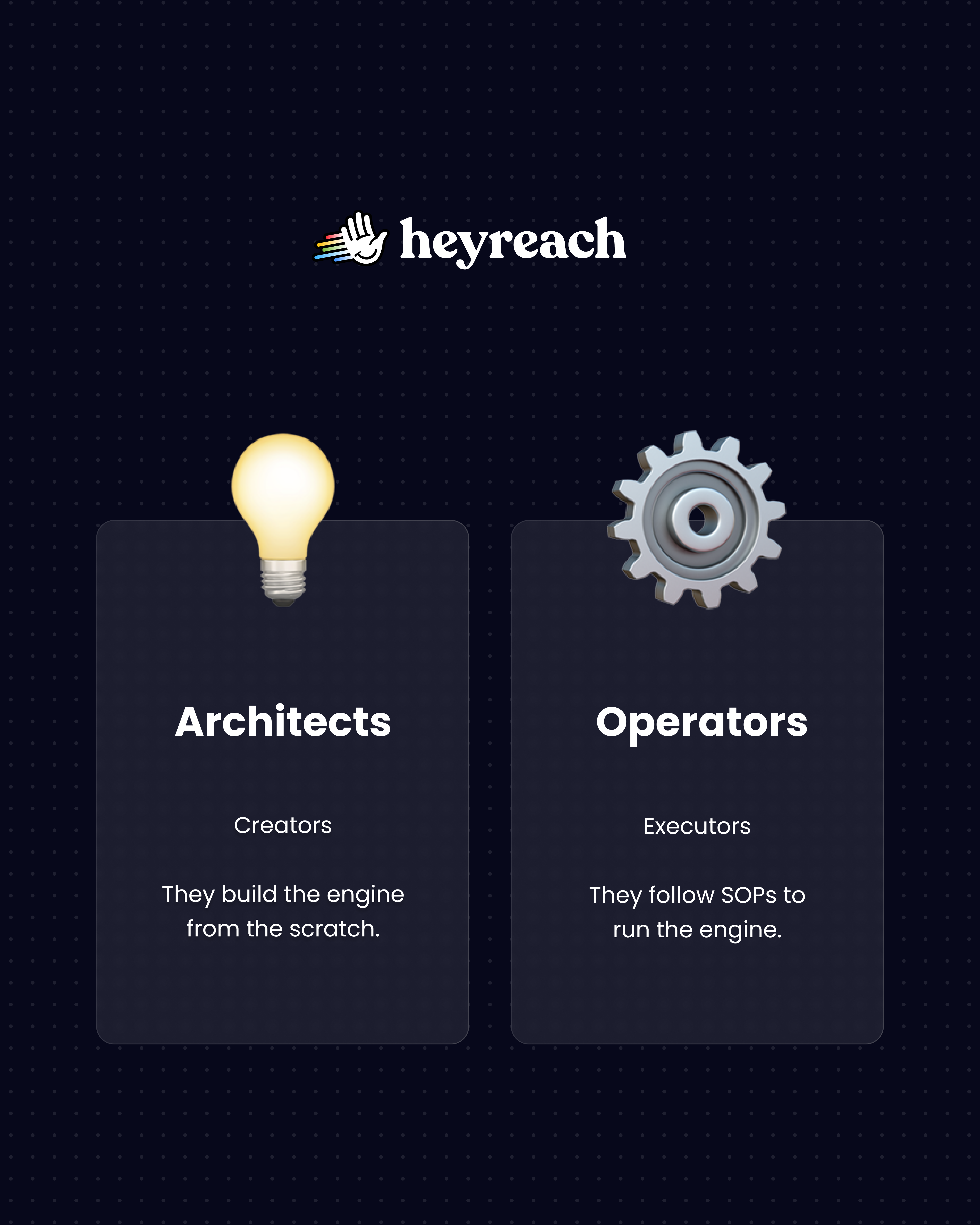
Visual workflow planning (architect vs. operator)
In a super complex GTM stack, your biggest enemy is "hidden logic." If an engineer builds a sequence of 15 Zaps and 3 Clay tables without a map, your revenue engine becomes a black box that no one can fix when it breaks.
- The sniff test: Ask them to show you a previous workflow.
- The standard: A top-tier hire uses Miro, Lucidchart, or Figma to map the data path (where it lives), the logic gates (if/then branches), and the fail-safes (what happens if an API returns an error?).
- Example: "If a prospect's LinkedIn is found but their email is unverified, the system should route them to a 100% LinkedIn-only sequence in HeyReach rather than just stopping the automation."
Business acumen (revenue vs. vanity)
A "tool guy" cares about open rates. A GTM Engineer cares about unit economics. They need to understand that a 5% reply rate is a failure if those replies come from companies with a $0 LTV.
- The sniff test: Ask: "How would you optimize a campaign that has a high reply rate but zero booked meetings?"
- The standard: They should discuss ICP tightening and how the entire sales process aligns with messaging. They should ask about your ACV to determine how much you can afford to spend on data enrichment per lead.
Email & LinkedIn deliverability depth
Deliverability today is a constant arms race against AI-driven spam filters.
- The sniff test: "We need to scale fast. Should we buy 50 domains on GoDaddy and start sending tomorrow?"
- The standard: If they don't mention DKIM/SPF/DMARC (email authentication protocols that help prevent spoofing), sender rotation, subdomain strategy, and ESP diversification (mixing Google/Outlook), they are a liability. For LinkedIn, they must explain how to distribute volume across multiple sender profiles to mimic human behavior and stay under the radar of LinkedIn's "Commercial Use" limits.
The 2026 toolbox (the interconnected stack)
Tool proficiency is about orchestration, not just usage.
- n8n/Make.com: Can they handle "Webhooks" and "JSON" to connect tools that don't have a native integration?
- Clay: Can they build "Waterfalls" that prioritize the cheapest data first and only use expensive AI credits for Tier-1 prospects?
- HeyReach: Do they know how to sync LinkedIn intent into a cross-channel sequence?
The GTM engineering interview: 3 "live build" whiteboard challenges
Ideally, your GTM Engineer should be able to map these 3 logic-heavy scenarios:
- The "waterfall" logic test: Give them a scenario where a primary data provider (e.g., ZoomInfo) fails. Ask them to take you through the solution process.
- The "error handling" challenge: Ask: "What happens to the lead in the CRM if the n8n webhook fails halfway through?" You are looking for them to mention error branches or Slack alerts.
- The "signal-to-action" mapping: Ask them to design a workflow for a "job change" signal. A junior says, "Send an email." A Senior Architect says, "Find the old contact, mark as 'Left Company,' find the new person in that role, and find the original person’s new work email.
🎖️The "final boss" interview question
To wrap up the interview, ask this:
"Our reply rates just dropped by 50% overnight. Walk me through your first 60 minutes of troubleshooting."
The red flag checklist: 5 signs they aren’t a 2026 GTM engineer
1. The "tool-first" vocabulary
If you ask how they solve a deliverability crisis and their first answer is "I’ll buy [new tool]," run.
- The red flag: They have a "legacy sales ops" mindset → they define their value by the software they use, not the logic they build.
- The reality: In 2026, tools are commodities. If they can’t explain the underlying protocol (e.g., how a Catch-all email verification actually works or how LinkedIn’s rate limits trigger "Commercial Use" warnings), they are just a configuration clerk.
2. The "CSV porter" mentality
Ask them: "How do you move data from our scraping tool to our sequencing tool?"
- The red flag: "I export a CSV, clean it in Excel, and upload it."
- The reality: Manual imports are the death of velocity. A real GTME builds a persistent data pipe. If their workflow requires a "human-in-the-middle" for basic data transfer, they aren't an engineer. They’re more like an expensive virtual assistant.
3. Ignoring the "downstream" disaster
A junior GTM hire loves "burning through leads" to get a quick win.
- The red flag: They don't ask about your domain reputation or CRM health.
- The reality: If they suggest blasting 1,000 leads a day from your primary company domain without mentioning Inbox rotation or subdomain isolation, they will get your entire company blacklisted by Google/Microsoft within a week. An engineer protects the infrastructure. A "hustler" burns it down for a one-week spike.
4. Zero error-handling logic
Ask them: "What happens if our LinkedIn automation tool returns a 429 Error (Too Many Requests)?"
- The red flag: A blank stare or a shrug.
- The reality: In a complex stack, things will break. And that’s fine. A pro builds "fail-safes." They should mention retry logic, Slack alerts for failed runs, or a "fallback sequence". If they don't plan for failure during the onboarding of new tech, their "automation" is a ticking time bomb.
5. "Prompt-engineering" without data-cleaning
Everyone claims to be an "AI expert" now.
- The red flag: They show you a 500-word prompt for an LLM but have no plan for data normalization.
- The reality: Even the best AI can't personalize an email to "GOOGLE CLOUD SERVICES LLC." If the candidate doesn't mention using regex or "cleaning steps" to turn raw scraping data into human-readable text BEFORE hitting the AI, your outbound will look like a ChatGPT wrote it.
How much GTM Engineers cost in 2026?
The market for GTM talent is officially global, but "cheap" is the most expensive mistake you’ll make. Seniority is measured in outcomes, not years of experience.
.jpeg)
⚠️ Note: Do not mistake "3 months of Clay experience" for seniority. A senior architect builds a scalable GTM automation system that functions without them; an operator just runs the manual imports.
The SaaS divide: Why agency talent often fails in-house
Founders love hiring from lead-gen agencies because they "know how to move fast." That’s usually the problem.
- Chaos velocity vs. predictability: Agencies can “send more” because their infrastructure, client volume, and warmed domains allow them to scale quickly. In-house teams usually run leaner operations, so the focus is on “sending smarter” to protect domain reputation and long-term results.
- Data governance: Agencies often optimize around lead volume, supported by systems built for that scale. In SaaS, teams take a broader view, managing the full funnel (attribution, product usage signals, and churn risk), so every lead translates to meaningful growth.
- Experimentation: Agencies can run multiple experiments per client, often at once, to see what works across their portfolio. In-house teams usually focus on experiments that can scale across internal teams without disrupting systems, balancing speed with stability.
Hire for revenue mechanics, not shiny tools
To build a truly signal-led GTM engine, you need:
- Hire for logic over tools because software is a commodity while system architecture is an asset.
- Build a specialized pod to support your sales team, rather than creating a bottleneck with a single hire.
- Prioritize system resilience – have your engineer build fail-safes and alerts for every automation.
- Protect your infrastructure by hiring operators who value domain reputation over raw volume.
- Measure the unit economics of your pipeline by tracking cost per meeting rather than activity metrics.
🎯 Build a self-scaling engine = the more you grow, the more you get, without having to double your headcount.

Try it for free
Frequently Asked Questions
What is the main difference between a GTM Engineer and a RevOps Manager?
A GTM Engineer focuses on the active "pipes" of outbound execution, such as advanced scraping, waterfall enrichment, and automated workflows. A RevOps Manager builds the "highway" those pipes run on, focusing on CRM health, data governance, and overall revenue forecasting.
When is the right time to make my first GTM Engineering hire?
This should be your first revenue hire in 2026.You need an operator to build the automated infrastructure for your perfect GTM motion. If you wait until you have 10 SDRs, you’ll spend more money fixing "spaghetti tech" than you would have spent building it correctly from day one.
Can a Junior GTM Operator eventually become a Senior Architect?
Yes, but the transition requires moving from "tool proficiency" to "logic proficiency." A junior knows how to use Clay or n8n; an architect knows how to design a system that handles API failures, data normalization, and cross-channel orchestration without manual oversight.
How do I justify the high salary of a GTM Engineer compared to an SDR?
Look at the unit economics. While an SDR costs roughly $400–$600 per meeting when factoring in salary and tech overhead, a well-engineered GTM system can drop that cost to $150–$250 by automating the heavy lifting and reducing data waste.