From ICP to ROI: Your step-by-step LinkedIn ABM playbook
Published:
February 13, 2026
Updated:
March 6, 2026
Traditional outreach alone rarely moves the needle when you’re selling to enterprise-level accounts. You can have solid copy, decent reply rates, and even booked meetings, but still struggle to build a predictable pipeline.
The reason is simple: enterprise buyers don’t convert off a single touchpoint. Nobody signs a five-figure contract because of one clever DM.
What does work is an ABM strategy where paid ads, organic content, and outreach reinforce each other over time.
If you have this in place, you aren't just "reaching out" anymore. You’re becoming the only logical choice in their feed. And by the time you hit their inbox, the deal is already half-closed because they’ve been seeing your value for months.
Get to know your target audience
This system isn't for seed-stage startups. It’s built for high-stakes B2B plays where the deal cycles are long, the stakes are high and the demographic is specific.
- B2B enterprise software: Companies with an ACV of $15k–$20k+. If the deal isn't worth at least five figures, the level of personalization required for ABM won't scale.
- B2B service agencies: Marketing, event design, or high-end consulting firms with $2M+ in annual revenue. All these businesses thrive on large, time-sensitive contracts that require deep trust.
Your target accounts don’t buy impulsively. Decisions are layered, involve a committee of stakeholders, and require multiple "yeses" (heavily influenced by company size and internal hierarchy).
Biggest challenges:
- Enterprise prospects don’t convert through outreach alone
- Ads, outreach, CRM, and reporting all live in separate systems
- Multiple vendors, sales & marketing teams working in silos
- No clear way to connect spend to pipeline impact
The awareness gap
Most clients don’t come in with a clearly defined problem. They rarely say, “Our attribution model is broken.”
Instead, they say, “Something isn’t working and we need help fixing it.”
They know results are missing, but they need help identifying the real pain points. That’s where structured account-based marketing comes in.
The buyer journey in ABM
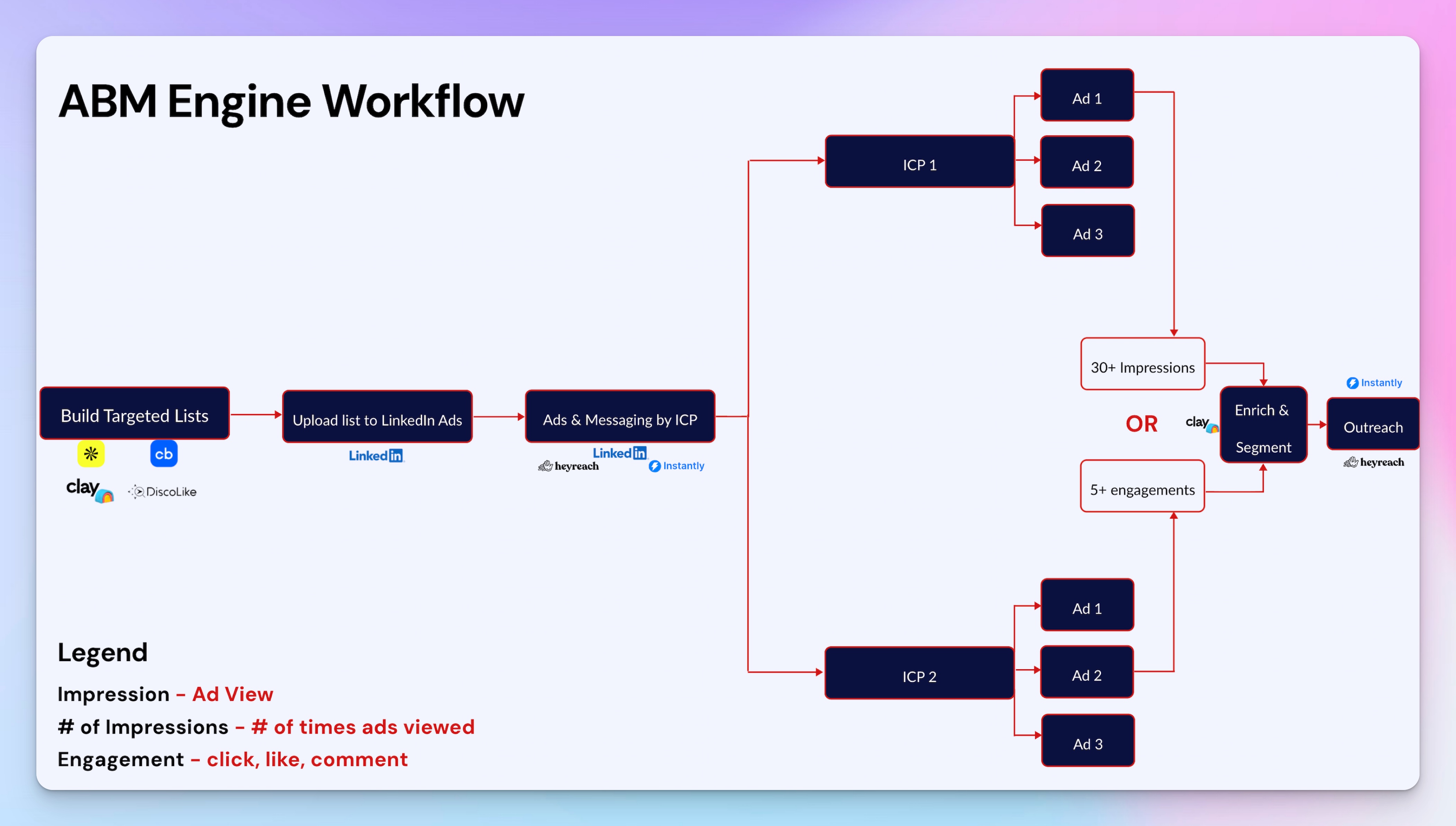
Enterprise buying journeys are fragmented, non-linear, and, frankly, annoying to track.
The typical path looks like this:
- They see your LinkedIn ad three times while scrolling at breakfast.
- Two weeks later, they visit your site after a Slack recommendation.
- They read a blog post, get distracted by a meeting, and leave.
- They see more targeted ads that reinforce your core message.
- You send a LinkedIn message; they read it, but don't reply.
- A month later, a "Why now" event happens, they Google your brand, and finally book a demo.
There is no single "hero" click in this journey. This is why omnipresence is the only way to win.

Account mapping and target list creation
ABM lives or dies by the quality of the list. If the data is garbage, the smartest content in the world won't save the campaign.
Shift your mindset from “traditional lead generation” to mapping the entire market, so you own the conversation in your niche.
Step 1: Define your addressable market
Don't go broad. Go deep. You want to identify a universe of 500 to 5,000 ideal companies.
- The filter: Don't just stop at "SaaS" or "Agency." Look for buying context. Are they expanding into new territories? Are they using a specific tech stack that makes them a perfect fit?
- The volume: Bigger lists are fine, but only if they are relevant. If you include companies that might fit, you’re just burning ad spend.
Step 2: Identify key decision-makers
In this world, nobody buys alone. If you're only targeting the VP of Sales, you’re missing the other five people who can kill the deal.
- The committee: Identify and map every key stakeholder – from the "end user" who feels the pain to the "C-suite executive" who signs the check.
- Multi-persona targeting: You need to surround the account. When the VP mentions your name in a meeting, you want the Director of Ops to say, "Oh yeah, I’ve been seeing their stuff."
The 4 personas:
- Champion (Director) → Needs case studies
- Decision Maker (VP/CFO) → Needs ROI & results
- Blocker (IT/Legal) → Needs security & specs
- End User (Manager) → Needs ease of use

Step 3: Upload lists to LinkedIn Ads Manager
Once your account list is refined, you move from research to execution. This is the point where LinkedIn ABM starts working.
By serving personalized ads, you install a permanent presence inside your target LinkedIn accounts.
⭐ The North Star: Radical frequency
Attention is the scarcest resource. To break through, you need to be consistent, but not too loud. Trust isn't built in a "burst", but through a steady drip of value.
- Frequency, please: You’re aiming for 10–15 impressions per person. One ad doesn't stick. Ten ads create a reputation.
- The 6-month horizon: ABM is a marathon. You need to maintain this visibility for at least 6 months. Short bursts of ads are seen as "noise." Continuous visibility is seen as "authority."
- Trust at scale: By the time your sales team reaches out via email or LinkedIn, the "stranger danger" is a thing of the past. You’ve already done the hard work of proving you understand their world through their feed
Multi-channel strategy: The surround sound effect
Success happens when your ad campaigns, organic content, and outreach all tell the same story at the same time.
Paid ads: Pre-selling the account
Here we talk about psychological familiarity.
- The "face" of the brand: When setting up your LinkedIn campaign, run ads from personal profiles (Founders/Execs) alongside the Company Page. People trust a face over a logo every time.
- Content mix: Balance "heavy" thought leadership with "light" human content. Carousels, insights, and even strategic memes work. If they don't find you relatable, they won't find you credible.
Organic content: The compounding interest
Organic visibility is the proof that you aren't just "buying" your way into the feed. You actually belong there.
- Employee advocacy: When your team engages with the content, it signals authority to the prospect.
- The feedback loop: Organic engagement compounds your paid exposure. The more they see you in their natural feed, the more "organic" your ads start to feel.
Outreach: Scaled but surgical
In this model, outreach is triggered by readiness (not volume). If you haven't warmed the account up, don't even try to knock on the door.
LinkedIn:
- The "blank" invite: Start with a blank connection request. It’s the highest-converting move because it doesn’t scream "Let me sell you something."
- The follow-up: Short, direct, and personalized messaging. No 5-paragraph pitches.
- The "burn" rule: If they don't respond, recycle the account. Don't burn the bridge with aggressive chasing. Put them back into the "Awareness" phase and try again in 3–6 months with fresh insights.
Email: Used only when a verified work email is available. Limit sequences to 2–3 high-value touches.
Data centralization and real-time tracking
Without centralized data, ABM campaigns collapse under their own complexity. Here’s how to make it work:
📍Clay as the central hub
Clay acts as the system’s brain:
- Syncs LinkedIn ad engagement data
- Tracks company-level impressions
- Updates engagement scores in real time
Signal layering
High engagement alone isn’t enough. Additional signals are layered on top:
- Mergers and acquisitions
- Fundraising
- Strategic expansions
- Industry-relevant events
Only when engagement + signal + ICP fit align does outreach begin.
Lead scoring
Use a 1–5 scoring model to filter for qualified leads and the "hottest" opportunities. This prevents lead fatigue and no one will be chasing a prospect who isn't ready.
- Score 1–2 (monitoring): Perfect ICP fit, but zero intent. Keep them in the "Awareness" loop with ads and organic content. No direct outreach.
- Score 3–4 (warming up): They’re leaning in – clicking ads or visiting the landing pages. This triggers a "soft" touch, like a blank LinkedIn invite or a low-pressure email.
- Score 5 (high intent): The "Triple Threat." Great ICP fit, high engagement, and a real-world trigger (like a new hire or funding). This is a priority-one lead for immediate, personalized follow-up.
Attribution and pipeline measurement
Forget last-click attribution. It doesn’t reflect reality. Nobody clicks a single ad and buys a $20k solution on the spot. Shift to holistic measurement.
Don’t ask: “Which channel converted this deal?”. Ask: “Which activities influenced this deal over time?”

CRM connection
Tie ad engagement and outreach directly to CRM deals. Track:
- Influenced pipeline
- Deal creation timing
- Closed-won impact
Measure over 6–12 months, not weeks. The result is a blended CAC and a realistic view of ROI.
The ABM content strategy: Opening doors at scale
Data might find the right door, but content is what gets you invited inside. In a high-stakes ABM motion, content is the entire reason a prospect decides to engage.
The collaboration model
Whether the work happens in-house or outsourced, the goal is execution over ego.
- In-house: Your subject matter experts provide the "secret sauce" and technical depth.
- Outsourced: Specialized creators handle the high-volume production.
If the content isn't laser-focused on the ideal customer profile and formatted for every channel, it’s a waste of resources
Content use cases: Putting the message to work
Don't create content for the sake of "activity." Test different formats and create it for specific points of impact.
- Paid LinkedIn ads: Targeted visibility that puts your best ideas in front of decision-makers before you ever send an email.
- Organic posts: Building a digital footprint so when a prospect looks you up, they see authority.
- Outreach personalization: Using specific insights to turn a cold script into a warm conversation.
- Proof points: Case studies, webinars and ROI calculators that help your champion sell you internally.
- AI snippets: Using technology to bridge the gap between "generic" and "personal" at scale.
The AI strategy: Scaling intelligence
Smart B2B marketers use automation to do the homework that humans don’t have time (or will 🙃) for:
- Dynamic opening lines: Using data to reference a recent 10-K, a podcast appearance, or a specific company milestone.
- The hybrid messaging: A human-written value proposition that never changes.
- The hook: AI-generated context that explains exactly why you are reaching out today.
- The result: The message stays human, but it scales intelligently.
Avoid:
- Talking about company growth for the sake of ego
- Content that’s interesting , but irrelevant to the ICP
- Chasing virality instead of relevance
To further enhance targeting precision and data-driven personalization, integrating account-based intelligence can provide deeper insights into buying signals and account-level intent.
The tech stack: Modular & connected
A functional ABM system is a series of "best-of-breed" tools that work together to identify and engage targets:
- LinkedIn Ads Manager: Surgical visibility.
- Clay: The "Brain" for data enrichment and account orchestration.
- HeyReach: LinkedIn outreach automation and multi-account campaign management.
- Instantly: Email outreach and automated cold email delivery.
- RB2B / Snitcher: Identifying the "anonymous" accounts visiting your site.
- HubSpot: The central source of truth for all account activity.
- Slack: Instant alerts so the team can jump on positive replies or high-intent signals immediately.

☑️ Why integrations matter
When tools talk to each other:
- SDRs act faster
- Context isn’t lost
- Humans focus only on high-intent conversations
AI supports the system, but people close the deals.
ABM with HeyReach: Operationalizing signal-based LinkedIn outreach
Enterprise outreach almost always fails because of timing. HeyReach fixes that by sitting at the execution layer of your LinkedIn ABM system.
Let me take you through a simple flow:
1. Only signal-qualified accounts enter outreach
HeyReach doesn’t work from static lists. It activates contacts that already meet your ICP and engagement thresholds.
If the account hasn’t shown intent, it stays in awareness.
If it has → it moves.

2. Distributed connection requests across multiple sender accounts
Instead of relying on one LinkedIn profile, outreach is safely distributed across multiple accounts.
This keeps activity natural, protects sender health, and maintains consistent daily volume without triggering limits.

First touch? A clean, frictionless connection request. No pitch. No links. No noise.
3. Context-driven follow-ups triggered by acceptance
Once connected, HeyReach triggers a short, relevant follow-up. Not a five-paragraph sales script – just a tight message anchored to context:
- Recent funding
- New hires
- Expansion signals
- Engagement with your content
Signal-based. Role-aware. Timed correctly.
4. Replies create momentum. Silence resets the loop.
Positive response? Immediate handoff to sales.
No reply? The account is recycled back into the awareness phase instead of being chased.
This keeps your brand positioned as precise. Not desperate.
Because outreach runs at the account level, multiple stakeholders inside the same company can be activated in parallel. Champion. Decision-maker. End user. All moving through coordinated sequences.
The outcome isn’t higher volume.
It’s controlled activation of warm enterprise accounts – exactly when they’re most likely to engage.
Scoring & continuous optimization
There’s no such thing as a "universal" scoring model. Every client has a different definition of what a "win" looks like, so the system has to be built from the ground up to find it.
Defining “ideal”
Firmographics are just the cost of entry. They don’t open any doors. They just tell you which house to knock on.
To open them, you need to score for context:
- The “why now" factor: Is the company hiring for a specific role? Did they just pull a fresh round of funding? Did they just get mentioned in the news for a pivot?
- Technographics: Are they already using tools that make them a perfect fit for your solution?
- The buyer profile: Scoring the department, not just the company.
Weighting engagement: Clicks vs. intent
Not all activity is created equal. If you treat an email open the same as a pricing page visit, your sales team is going to waste hours on "looky-loos."
- Noise: Email opens and social media likes (low score)
- Interest: Multiple clicks on a case study or downloading a specific guide (medium score)
- Intent: High-value website visits (Pricing, Demo) or positive replies (high score)
The optimization loop
A high-performing system requires constant eyes on the data to see what’s landing.
- Keep an eye on the key metrics: Keep a pulse on reply, open, and conversion rates.
- Pivot quickly: If a certain "Why this matters" angle isn't hitting, kill it. If a specific signal (like a new hire) is leading to more meetings, double down on it.
- Adjust the thresholds: If the sales team is getting too many low-quality leads, tighten the scoring. If the pipeline is dry, look for broader signals.
Practical execution
- Week 1-2: Baseline testing. See which hooks get the best response.
- Month 1: Audit the "quality of conversation." Are the meetings actually good?
- Month 3: Complete system overhaul. Take everything you learned from the closed-won deals and bake it back into the "ideal" profile.
Crack the ABM code
Enterprise ABM works when you stop chasing shortcuts, unify your marketing efforts and start building systems.
The core principles:
- Put real faces forward
- Use multiple channels with one consistent message
- Measure the big picture, not individual clicks
- Play the long game
- Time outreach using real signals
- Keep humans where it matters most
When you own the system, hitting your numbers isn't a miracle. It’s an inevitability.

Try it for free
Frequently Asked Questions
What is LinkedIn ABM and how does it work?
LinkedIn ABM (Account-Based Marketing) is a strategic approach that combines paid ads, organic content, and personalized outreach to target high-value enterprise accounts. It works by surrounding decision-makers with consistent brand visibility across multiple touchpoints over 6+ months, building familiarity before direct sales contact.
How long does it take to see results from a LinkedIn ABM strategy?
LinkedIn ABM requires at least 6 months to show meaningful results. Enterprise buying cycles are non-linear, involving multiple stakeholders and touchpoints. The strategy focuses on building trust through 10-15 ad impressions per person and continuous visibility rather than quick conversions.
What is the minimum deal size for LinkedIn ABM to be profitable?
LinkedIn ABM is most effective for deals worth $15,000–$20,000+ in annual contract value. The strategy requires significant personalization and multi-channel coordination, making it unsuitable for lower-value transactions where the cost of acquisition would exceed the return.
How do you score and qualify leads in an ABM campaign?
ABM lead scoring uses a 1-5 scale combining three factors: ICP fit, engagement level, and real-world signals (funding, hiring, expansion). Score 1-2 accounts stay in awareness mode, 3-4 trigger soft outreach, and score 5 (high intent with trigger events) receives immediate personalized follow-up.
What tools do you need to run a LinkedIn ABM campaign?
A complete LinkedIn ABM stack includes LinkedIn Ads Manager for targeting, Clay for data enrichment, HeyReach for LinkedIn outreach automation, Instantly for email sequences, RB2B/Snitcher for website tracking, HubSpot as the CRM hub, and Slack for real-time alerts.Thank