LinkedIn authority building: How to 5x your outreach acceptance
Published:
May 30, 2026
Updated:
June 1, 2026
You can spend hours refining a message – testing subject lines, adjusting tone, personalising the first line – and still get ignored. More often, the issue is what sits behind the message.
Before someone replies, they check who you are. They click on your profile, scan your headline, maybe glance at your recent activity. That takes a few seconds, but it’s often enough to decide whether your message is worth engaging with or not.
Most outbound strategies don’t account for that moment. They treat the message as the starting point, when in reality it’s closer to the final step. By the time it lands in someone’s inbox, the judgment has already begun. There’s a growing disconnect between how much effort teams put into outbound messaging, and how little attention they give to the context surrounding it. A well-written message coming from an empty or inconsistent profile feels automated, and that perception is hard to recover from.
This is where LinkedIn authority building starts to matter. What’s changing is not just the volume of outreach, but how it’s evaluated. Prospects are quicker to filter, quicker to dismiss, and more sensitive to signals that suggest credibility or the lack of it.
Building authority on LinkedIn is less about “creating content” and more about making sure that when someone looks you up, there’s enough substance to support the conversation you’re trying to start. If you want your outreach to land, the work starts there.
LinkedIn authority building: from “who I am” to “who I help”
Most LinkedIn profiles still read like summaries of past experience.
They list roles, companies, responsibilities. That format works in a hiring context, but it doesn’t translate well to outbound. When someone lands on your profile from a message, they’re not trying to understand your career. They’re trying to decide whether what you do is relevant to them. If that’s not clear within a few seconds, they move on.
The fixer vs. the seller
A profile built around “who I am” tends to describe. It focuses on titles, years of experience, and past roles.
A profile built around “who I help” does something different. It makes it easier for someone to recognise themselves in what you do.
That distinction changes how you’re perceived. One reads like a seller introducing themselves. The other feels closer to someone who understands a specific problem and works within it.
The 3-second scan
People don’t read profiles line by line, they scan them. Most of that happens in the top section: your profile picture, your headline, and your banner. If those elements don’t quickly signal what you do and who it’s for, the rest of the profile rarely gets the chance to fill the gap.
The headline carries most of the weight. It’s where people look to understand your relevance. Generic titles or internal language slow that down. A clearer line —one that reflects the kind of problems you work on or the context you operate in— makes it easier for someone to place you.
The banner can reinforce that positioning. It’s often left blank or treated as decoration, but it’s one of the few places where you can make your focus explicit without adding friction. When it aligns with the headline, the profile becomes easier to read. When it doesn’t, it creates small inconsistencies that add up.
The featured section as a trust layer
From there, the rest of the profile only needs to confirm what’s already clear.
This is where the featured section plays a role. Instead of acting as a repository of links, it can work as a small layer of proof: case snippets, short posts, or anything that shows how you think and what you’ve done. It gives people something concrete to anchor that first impression.
None of this is about polishing a profile for its own sake. It’s about making sure that when someone clicks through from your message, they don’t have to work to understand why you reached out in the first place.
Why people follow you (it’s not just expertise)
There’s no shortage of people sharing useful information on LinkedIn. Tips, frameworks, step-by-step guides. Most of it is technically correct, and a lot of it is easy to agree with. But that doesn’t necessarily make it memorable.
Expertise explains what to do. It doesn’t always explain how you see the problem. A clear point of view makes your content easier to recognise and easier to recall. It gives people a way to place you, not just learn from you. Without that, content tends to blend in (even if it’s accurate) and LinkedIn authority building becomes much harder to sustain.
This is why “teaching” on its own often falls short. When everything is framed as neutral advice, there’s very little to react to. No tension, no contrast, nothing that invites a second look.
A perspective doesn’t need to be extreme, but it does need to be visible. Instead of explaining how something works, it helps to show what you think about it. What tends to be overvalued, what gets overlooked, where teams usually get it wrong. That shift makes the content feel more grounded in real experience.
You can see the difference in how ideas are framed.
A generic version might say:
→ “Personalise your outreach to increase reply rates.”
A more opinionated version might say:
→ “Most ‘personalisation’ doesn’t work because it’s based on surface-level signals.”
The first is useful. The second is easier to engage with.
Over time, that kind of framing builds familiarity. People start to recognise how you think, not just what you share. And when that happens, your profile carries more weight before you even reach out.
Content formats that build authority in 2026
Not all content contributes to authority in the same way, and that’s where many teams lose focus. Some posts generate engagement but don’t really change how you’re perceived, while others are less visible yet gradually shape a clearer picture of how you think and what you’ve actually done.
A few formats tend to do that work more consistently:
- Contrarian takes challenge assumptions people already hold. They don’t need to be provocative for the sake of it, but they do need to question something that’s widely accepted. This is often where perspective becomes visible, because it gives people a reason to pause, react, or reconsider what they’ve been doing.
- Build-in-public posts make your work more tangible. Sharing what worked, what didn’t, or what you’re testing reduces the distance between you and the reader, and signals that your ideas come from actual use rather than abstraction.
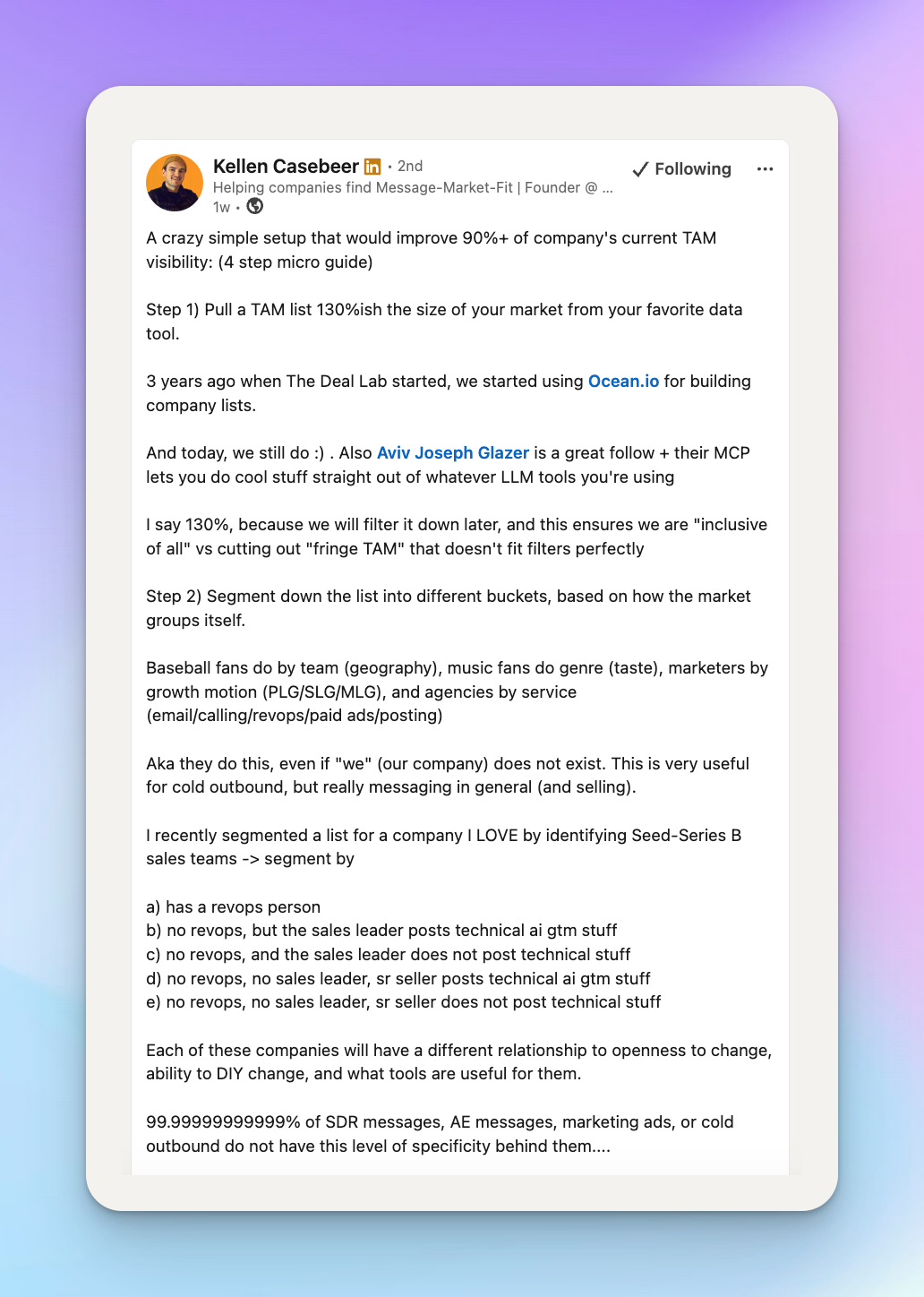
- Micro-proof content reinforces credibility in a quieter way. Screenshots, short results, small wins, or fragments of real work don’t need to be turned into full case studies. What matters is that they show something concrete, something that supports what you’re saying without overexplaining it.
These formats serve different roles, but they tend to work best together. One creates attention, another builds familiarity, and the third adds credibility. Combined, they make your profile easier to trust before you ever reach out.
It’s also worth considering activity beyond posting. Being present in comments —especially in conversations that are already relevant to your space— adds another layer of visibility. It places your name in context, not just on your own profile.
A high volume of content isn’t required here. A smaller number of posts, aligned with a clear point of view and supported by visible activity, is usually enough to create that sense of consistency.
The orchestration: using HeyReach for invisible touches
Up to this point, everything happens on your profile and through your content. The next layer is how you show up before the message is sent.
Most outreach still starts cold. A connection request appears out of nowhere, with no prior interaction. From the receiver’s perspective, there’s no context, just a name and a message asking for attention.
A different approach is to introduce small touchpoints before that moment. Viewing a profile, liking a post, interacting with something the person has shared. On their own, these actions are minor. But they change how your name is perceived when it appears again. It’s no longer completely unfamiliar.
This is where tools like HeyReach come in. Instead of relying on one account and one interaction, they allow teams to coordinate these signals across multiple sender profiles.
For example, a lead might see your name once through a profile view, then again through a like or comment, and only later receive a connection request. By that point, the interaction doesn’t feel like a cold start. It feels closer to a continuation.
This effect is subtle, but it matters. Familiarity reduces resistance. It gives the impression that the interaction is happening within an existing context, even if that context is minimal.
At a team level, this becomes more visible. When several people from the same company appear across a prospect’s notifications —engaging with similar content or operating in the same space— it creates a sense of presence. Not in an aggressive way, but in a way that makes the company feel more established within that niche.
The key is to keep these interactions aligned with real activity. If the profiles involved are inactive or inconsistent, the effect breaks. Each sender needs to have enough visible presence for these touches to feel natural.
This is also where restraint matters. Adding more interactions doesn’t necessarily help if they feel disconnected. A small number of well-timed signals is usually enough to shift how the outreach is received.
Leveraging activity signals for hyper-relevance
One of the simplest ways to improve response rates is to focus on people who are already active. If someone has posted, commented, or engaged recently, they’re more likely to notice new interactions. They’re already in that mindset.
Tools like LinkedIn Sales Navigator make this easier by highlighting leads who have been active in the last 30 days. That alone changes the baseline. You’re no longer reaching out into silence, you’re stepping into an environment where the person is already present.
That activity also gives you something to work with. Instead of relying on generic personalisation, you can anchor your message in something the person has actually said or shared. A recent post, a comment, a point of view they’ve expressed. This makes the outreach more specific, but also more credible, because it’s tied to something real.
Some teams use tools like Clay to systematise this. By analysing a lead’s recent content, they can generate a first line that reflects what the person is currently thinking about, rather than pulling from static data points.
The difference is noticeable. A message based on job title or company information often feels interchangeable. A message that references a recent idea or post feels more deliberate.
That’s why reaching out to a smaller number of active leads, with context that reflects what they’re actually doing, tends to outperform broader campaigns built on outdated or generic signals. It’s a shift in focus rather than an increase in effort.
Scaling the human fingerprint
As soon as outbound starts to scale, the risk is losing the very thing that made it work in the first place. The more messages you send, the easier it is for patterns to appear: repetition in wording, timing, behaviour. From the outside, that’s what makes outreach feel automated, even when the intention is to personalise it.
One way to avoid that is to distribute the activity. Instead of relying on a single sender account, teams spread outreach across multiple profiles. Each one interacts, posts occasionally, and engages in a way that reflects normal LinkedIn behaviour.
Tools like HeyReach make this possible by coordinating activity across accounts while keeping the interactions consistent with how real users behave. The goal is not to simulate humans, but to avoid creating patterns that clearly don’t match how people use the platform.
There’s also a practical aspect to this. Once replies start coming in, the dynamic changes. What began as outbound quickly turns into a conversation, and at that point automation needs to step back. Systems that stop sequences as soon as a reply is detected help preserve that shift. It keeps the interaction from feeling scripted once a real exchange has started.
The same applies to platform safety. High volumes of repetitive actions —profile views, connection requests, messages— can trigger restrictions if they don’t align with typical usage patterns. Working through cloud-based tools that manage pacing and distribution reduces that risk and allows teams to scale without drawing unwanted attention.
Taming the chaos: managing the inbound flow
At this stage, attention starts to concentrate in one place: your inbox. Messages come in from different profiles, across different threads, often at the same time. Some are quick acknowledgements, others are clear buying signals, and a few sit somewhere in between.
This is where a unified view of conversations starts to matter. Tools like HeyReach bring replies from multiple sender accounts into a single inbox, so teams can see what’s happening without jumping between profiles.
It also makes it easier to prioritise. Not every reply requires the same level of attention, and not every interaction should move forward. Being able to identify which conversations show real intent helps keep the focus where it matters.
When a conversation shows interest, it often needs to move beyond LinkedIn. Syncing those contacts into a CRM like HubSpot allows teams to track the interaction, follow up in a structured way, and avoid losing momentum between touchpoints.
This is where the earlier work pays off. The profile, the content, the initial interactions, they all contribute to making that first reply more likely. What happens next determines whether that attention turns into something more.
Let them trust you
There’s a visible difference between outreach that gets ignored and outreach that opens a conversation. In one case, it comes across as a request out of nowhere. In the other, it reads as a continuation of something the person has already seen or recognised. The message itself might not be radically different, but the context around it is.
That context is what makes a message worth engaging with. When your profile, your activity, and your content all point in the same direction, you’re not approaching someone as a stranger trying to get a response. You’re showing up as someone who already has a place in that space. The interaction becomes easier to engage with.
You can refine scripts, test sequences, and optimise timing, but without that layer of trust, the impact is limited. With it, even simple outreach tends to land differently. That’s the closest thing to an advantage on LinkedIn: being recognised as someone worth paying attention to before you ask for it.

Try it for free
Frequently Asked Questions
What is LinkedIn authority building?
LinkedIn authority building is about creating enough visible context around your profile so that people can quickly understand what you do, how you think, and whether it’s relevant to them. It’s not limited to posting content. It includes how your profile is structured, how active you are, and how consistently your presence shows up in the right conversations. When those elements align, your outreach doesn’t arrive in isolation; it’s supported by signals people can already see.
How does profile optimisation impact connection rates?
Before someone accepts a connection request, they usually take a quick look at your profile. That scan shapes their decision more than the message itself. If your headline, activity, and overall positioning make it easy to understand who you work with and what you do, the request feels more relevant. If not, it’s often ignored, regardless of how well the message is written.
Can I automate engagement without looking like a bot?
Yes, but it depends on how the automation is used. When interactions follow rigid patterns —same timing, same actions, no visible activity behind the profile— they stand out quickly. On the other hand, when automation supports behaviour that already looks natural (profile views, occasional engagement, consistent activity), it becomes much harder to distinguish from normal usage. Tools like HeyReach are designed to work within those patterns, helping teams coordinate activity without creating obvious signals of automation.
What tools are best for LinkedIn authority building?
There isn’t a single tool that covers everything, but a few tend to work well together: HeyReach for coordinating outreach and engagement across multiple accounts. LinkedIn Sales Navigator for identifying active and relevant leads. Clay for analysing lead activity and generating context for outreach. The value comes less from the tools themselves and more from how they’re used together to support a consistent presence.
How often should I post?
Frequency matters less than consistency. Posting occasionally is enough, as long as there’s some visible activity on your profile and your content reflects a clear point of view. Combined with engagement in relevant conversations, this creates enough presence for your outreach to feel contextual.