GTM strategy for product-led growth: Turning free users into outbound targets
Published:
August 4, 2026
Product-led growth and outbound used to live in separate worlds. PLG teams built self-serve funnels and waited for free users to upgrade on their own. Outbound teams built cold lists from firmographic data and hoped a title and headcount range meant something. In 2026, the teams pulling ahead aren't choosing one motion over the other — they're merging them.
The idea is simple: product usage becomes the ICP signal. Instead of guessing who's a fit based on a static list, you watch what free users actually do inside your product, and you reach out the moment their behavior tells you they're ready for a human conversation.
The old way vs. the new way
The old way looked like this: a PLG team lets free users self-serve indefinitely, only escalating to sales when someone manually requests a demo or hits a hard paywall. Meanwhile, the outbound team works from a completely separate list — cold prospects who've never touched the product, targeted by title and company size alone. Two motions, two lists, almost no overlap.
The best way treats product usage as a live signal feed. The moment a free user crosses a specific threshold — invites three teammates, connects an integration, hits a usage cap — they move from "anonymous free user" to "warm outbound target." Not cold. Not passive. Warm, because they already know your product exists and already found enough value to keep using it.
The logic here matters more than it sounds: "what is this person doing in the product right now" is a far better targeting signal than "what plan tier are they on" or "how many employees does their company have." Usage tells you intent. Firmographics just tell you fit.
The PLG-to-outbound bridge: why free users are your best outbound list
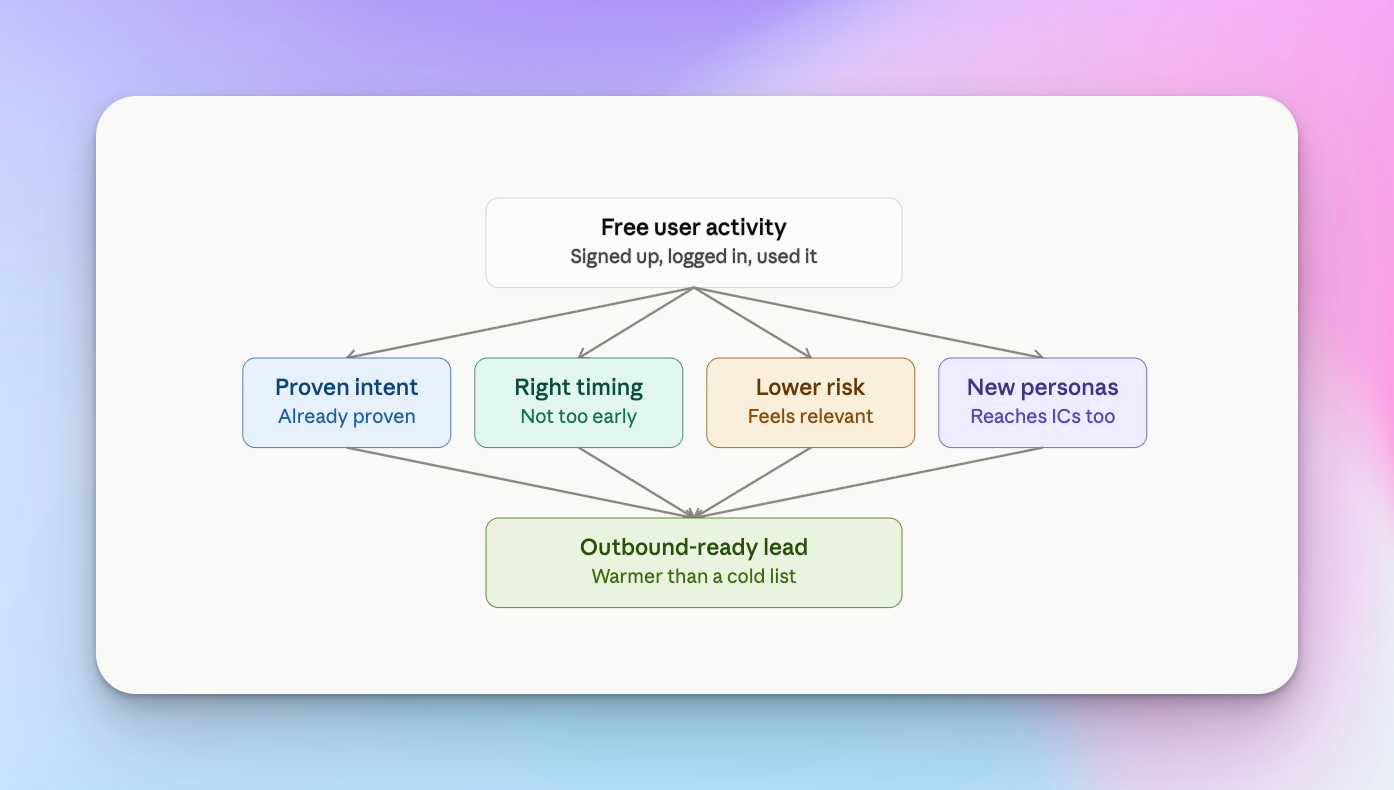
Free users make an unusually strong outbound list, for a few reasons.
The intent is already proven. They signed up. They logged in. They used the product enough to generate a signal. That's a categorically different starting point than a cold prospect who has never heard of you.
The timing is built in. Usage thresholds tell you exactly when to reach out — not three months too early, not after they've already churned or found a competitor.
The risk is lower. A message that references something a person actually did in your product reads as relevant, not intrusive. Compare "I saw you're a VP of Sales at [Company]" to "noticed your team just connected [integration] — most teams at that stage run into [specific problem]." One is a guess. The other is a conversation starter.
The persona opens up. PLG unlocks buyer types that outbound alone rarely reaches — individual contributors, team leads, technical champions who'd never respond to a cold LinkedIn message from a stranger but who will engage when the message clearly shows you understand what they're doing.
Identifying product usage signals inside HubSpot
Before any of this works, you need a clear view of which in-product events actually matter. Not every login is a signal. A useful starting list usually includes:
- Feature adoption — did they use a feature associated with higher retention or paid conversion?
- Seat invites — did they bring teammates in? Multiplayer usage is one of the strongest PLG-to-paid predictors.
- Integration setup — connecting a tool like HubSpot or a CRM usually means they're planning to stick around.
- Usage frequency — daily or weekly active use versus a single login that never returned.
- Hitting a plan limit — this is often the single clearest "ready to talk" signal there is.
HubSpot is a natural home for this because it can track lifecycle stage, custom properties, and workflow-based scoring all in one place. Set up custom properties for each event you care about, then build a simple scoring model on top so a single login doesn't get treated the same way as a user who invited five teammates and connected an integration in the same week. The goal is to track the handful of actions that consistently show up before someone converts.
Enriching free user profiles with Clay
A usage signal on its own only tells you what happened. To act on it, you need to know who it happened to. That's where Clay comes in.
Once HubSpot flags a free user as having crossed a threshold, Clay takes over: pulling a work email or LinkedIn URL and building out a full profile — role, seniority, company size, and any additional company-level signals worth layering in. This is the same enrichment approach we cover in our guide to buyer intent signals, applied here to your own product data instead of external triggers.
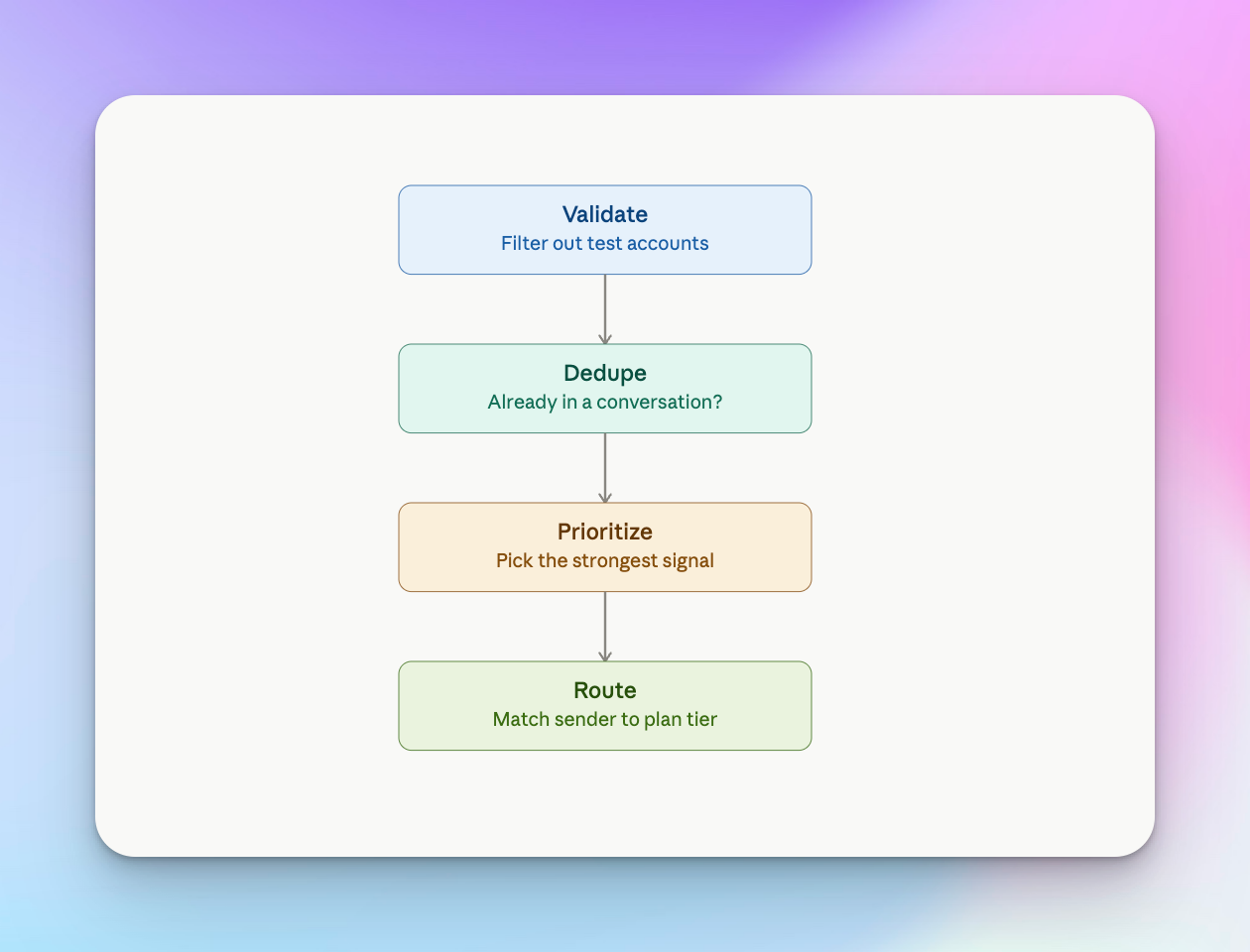
This step also acts as a filter. Not every free signup is a real business user — personal email addresses, students, and clearly non-ICP accounts should get filtered out here, before they ever reach an outbound sequence. Clay can also help write a custom icebreaker based on the specific in-product action that triggered the signal, so the first line of outreach references something real instead of a generic template.
Setting usage-based triggers for LinkedIn outreach
With signals identified and profiles enriched, the next step is execution — and this is where HeyReach comes in.
Step 1: the integration. Connect HubSpot workflows to Clay, and Clay to HeyReach, so that a usage threshold automatically kicks off a sequence without anyone manually pulling a list.
Step 2: the routing logic. Not every PLG lead should land in the same campaign. Route based on plan tier, use case, or territory, so the message and the sender both match the context.
Step 3: the safety layer. As PLG-triggered volume grows, distributing leads across multiple HeyReach sender accounts keeps deliverability safe — the same "relay team" approach covered in our piece on automated LinkedIn messaging, just applied to a warmer, product-sourced list instead of a cold one.
Before any of this scales, though, there's a gatekeeper layer worth building in:
In HeyReach, we ran research on reply rates across signal-triggered sequences versus static list-based outbound, and found that messages tied to a specific, recent action consistently outperform generic templates.
Messaging framework for warm vs. cold PLG users
Not every free user is equally warm, and the messaging should reflect that.
Warm PLG users — the ones who've clearly gotten value, invited teammates, or connected an integration — can be messaged directly about the specific action they took. There's no need to "sell" the product itself; they already know what it does.
Cold(er) PLG users — signed up but barely touched the product — need a different angle. The message here should focus on activation and helping them get to their first real value, not on upselling something they haven't experienced yet.
A simple formula works for both, just with a different emphasis: [the usage signal] + [the relevant next step] + [the low-friction ask].
Example: "Noticed your team just hit [X] in HeyReach — most teams at that stage start running into [specific problem]. Want me to show you how others solved it?"
This mirrors the approach detailed in our guide to how to follow up on LinkedIn, where the follow-up cadence adjusts based on how engaged the recipient already is.
The PLG-to-outbound handoff motion
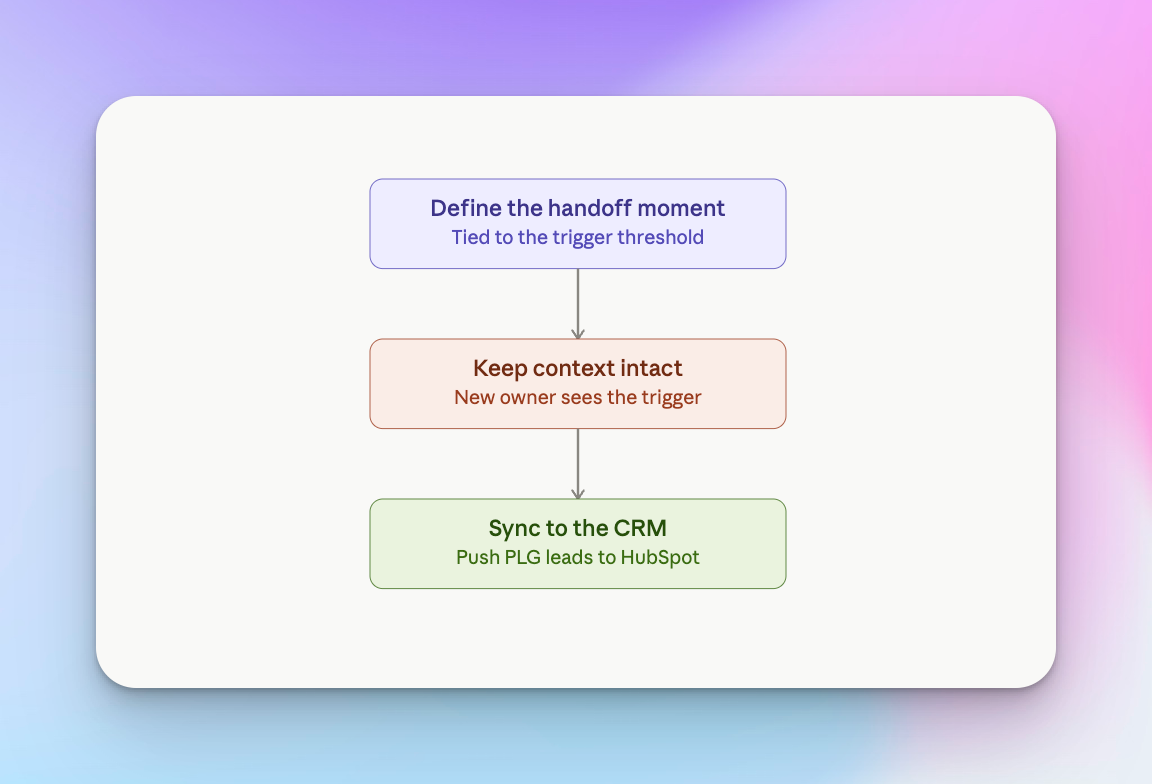
The final piece is making sure the handoff between product and sales doesn't lose context along the way.
- Defining the handoff moment. Decide explicitly when a lead moves from "product-qualified" to "sales-ready." This should be tied to the same thresholds used to trigger outreach in the first place, not a separate, subjective judgment call.
- Keeping context intact. Whoever takes over the LinkedIn conversation — an SDR, an account exec, a founder — needs to know exactly which signal triggered the outreach. Losing that context turns a warm conversation back into a cold one.
- CRM sync. Push "PLG-triggered" and "PLG-converted" leads back into HubSpot so marketing and sales stay aligned on what's actually working. This closes the loop and lets you refine which signals are worth acting on over time.
Why PLG + outbound beats either motion alone
A PLG motion without outbound leaves value on the table — plenty of free users who'd convert with a nudge simply never get one. An outbound motion without PLG data is working blind, guessing at fit instead of measuring it.
Blending the two means every outbound message is grounded in something real: an action the person actually took, at a moment when it's actually relevant to them. That's what separates GTM teams that scale efficiently from ones quietly burning through cold lead lists hoping something sticks.

Try it for free
Frequently Asked Questions
What is a GTM strategy for product-led growth?
It's an approach where product usage data — not just firmographic fit — determines who your team reaches out to and when, blending self-serve growth with targeted outbound.
How do you turn free users into outbound leads?
By tracking specific in-product usage signals (feature adoption, seat invites, integration setup, usage limits), enriching the profiles of users who trigger them, and reaching out through a channel like LinkedIn at that exact moment.
What product usage signals matter most for outbound?
Signals that consistently precede conversion — commonly seat invites, integration connections, and hitting a usage or plan limit — tend to be the strongest indicators.
Can this workflow be fully automated?
Most of it, yes. HubSpot can flag the trigger, Clay can enrich and filter the profile, and HeyReach can execute and route the outreach — with a light validation layer to catch edge cases.
Is outreach to free users different from cold outbound?
Yes. Because the recipient already knows your product, messaging can reference something specific and real, which tends to feel far less intrusive than a fully cold approach.