How to scale a lead generation agency: From LinkedIn outreach to allbound
Published:
April 27, 2026
Updated:
May 14, 2026
Growth feels like progress until it doesn’t.
The first few clients are easy to explain. You did good work. You got results. Word spread.
Then more clients come in. Revenue goes up, and on paper it looks like everything is working.
But behind the scenes, things get heavier, slower, and harder to control.
You start spending more time managing delivery than improving it. More time fixing campaigns than building better ones.
And at some point you realize that sure, you might be growing your agency, but you are also outgrowing the system that makes it work.
What I want to walk you through is the full growth path – five stages, from solo LinkedIn outreach to a full allbound operation.
At each stage, I'll show you:
- what the outreach system needs to look like
- where things typically break
- and how to build the setup that holds.
If you know how to scale a lead generation agency properly, you stop firefighting and start compounding.
The 5-stage agency growth framework
Every agency I've seen build real scale went through some version of the same five stages. They didn't all move at the same speed, and some stumbled into the next stage before they were ready. But the underlying pattern is almost universal.
The key insight (and the one most founders miss), is that you can't separate the service you're selling from the system you use to deliver it. When you try to sell Stage 3 services on Stage 1 infrastructure, something always breaks. Usually at the worst possible moment.
In my experience, lead generation agencies don’t move through these stages cleanly. Most are operating in two or three at the same time. But the pressure points are consistent, and that’s what this framework captures.
Stage 1: Solo outbound operator
The goal isn't to scale. It's to prove the model works without burning your account in the process. You're doing everything yourself. One or two clients, a Sales Navigator filter you've saved, and a message sequence you've refined about fifteen times. It's messy, but it's working.
At this stage, most of what you should build shouldn’t be about automation, but about not destroying your account before you get the chance to scale it.
“When we started, the setup was lean — Clay for data and enrichment, and HeyReach for execution. Our campaign flow was simple: post engagement, profile visit, connection invite, follow-up message. Early on, the biggest challenge was LinkedIn limits. That pushed us to adapt — we started scoring accounts and only used LinkedIn for high-relevance leads, while lower-intent segments were handled via other channels. This helped us stay within limits while improving overall efficiency and response quality.” — Faraz Ahmed, Zycus
That last point matters more than most people realize at Stage 1. LinkedIn limits aren't a wall you hit and panic about. They're a constraint that, if you respect them early, teaches you to be strategic about who gets your best channel.
Stage 2: The LinkedIn agency
You're no longer ‘doing outreach’. You're running an outreach operation.
Four to eight clients. A VA or junior specialist. You're measuring meetings booked per month, not just connection rates. Each client gets dedicated sender accounts, not shared. And you're starting to feel the operational weight that comes with managing multiple campaigns simultaneously.
This is the stage where most agencies learn that LinkedIn has real limits. Not theoretical ones, but real, enforced, account-threatening ones.
How LinkedIn restrictions actually work
LinkedIn doesn't publish exact limits, but the patterns are consistent across the outbound community. Sönke Venjacob at Platinum Agency describes it precisely:
“There's a hard ceiling on LinkedIn — you can only send around 80–100 connection requests per week per profile before the platform starts throttling you or flagging your account. And not everyone accepts your request, so your actual addressable audience shrinks fast. When a founder is the only person doing outreach and they've already tapped through their warmest second-degree connections, growth stalls. You hit a point where you're recycling the same pool of prospects and reply rates start dropping because you're forcing fit.” — Sönke Venjacob, Platinum Agency
The most common Stage 2 mistake follows directly from this ceiling: sharing one sender account across multiple clients. When that account gets flagged, every client campaign it touches goes dark. And because the account's activity history is now a mix of multiple clients' ICPs, you can't even diagnose what triggered the restriction. I’ve seen agencies go from 5 clients to 0 in 60 days because one flagged account took down every campaign.
What changes operationally at Stage 2
The first real infrastructure upgrade is multi-sender management. Each client gets two to three dedicated LinkedIn accounts. New accounts are warmed up gradually; starting at 10 to 15 requests per day, increasing by five each week over three weeks. An account that gets restricted before it's warm is two weeks of setup you've thrown away.
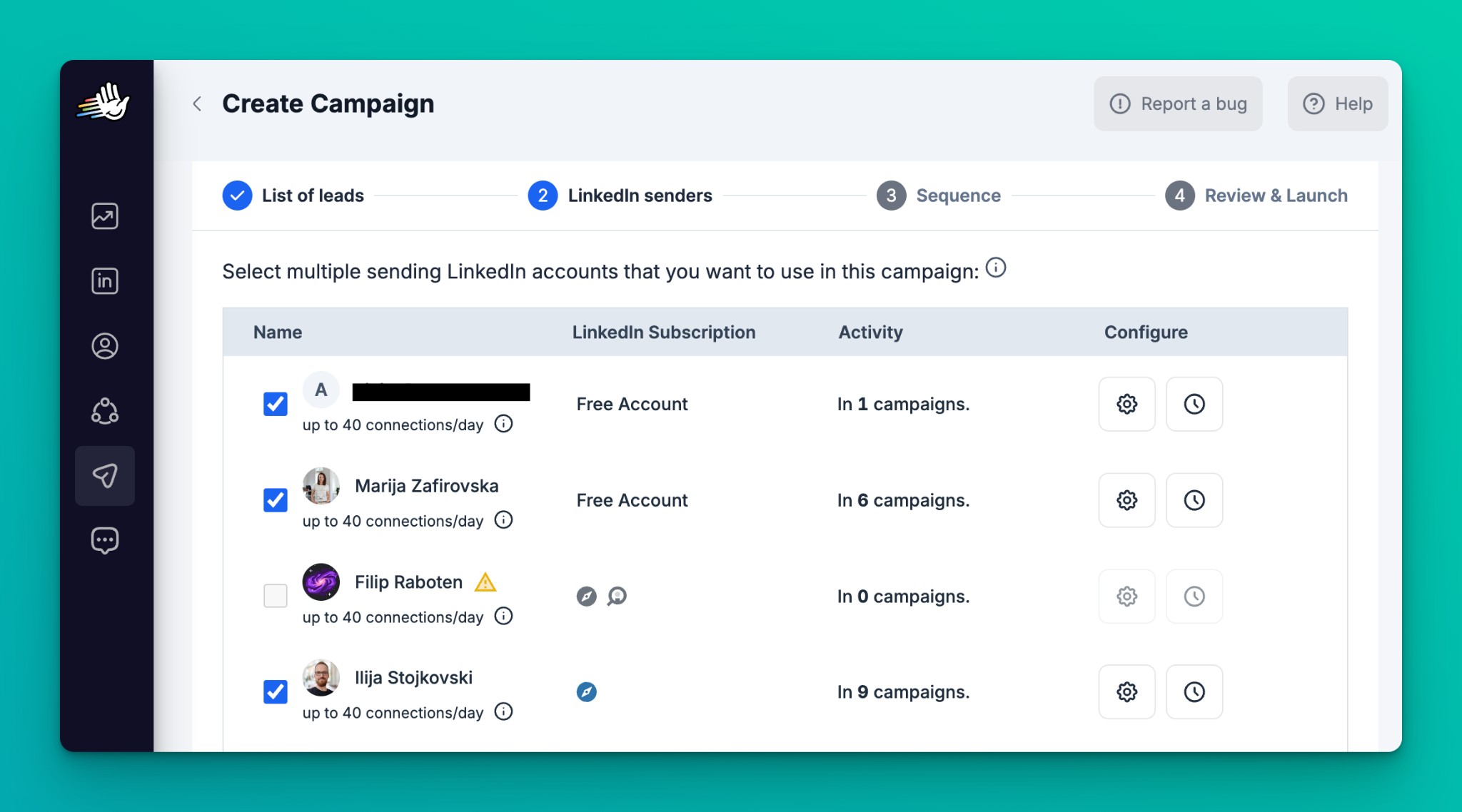
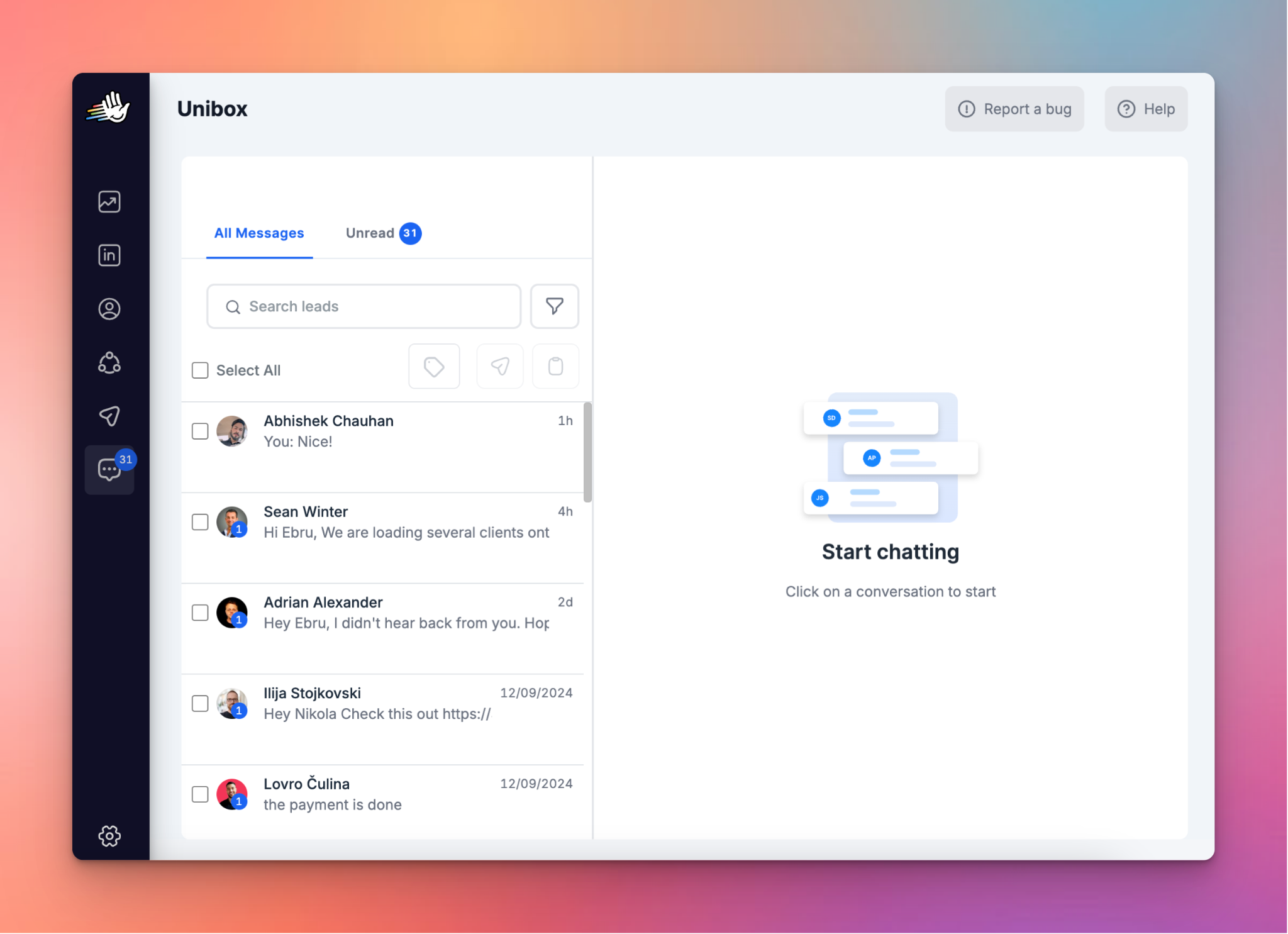
The second upgrade is inbox management. When you're running six senders across four clients, replies are coming into six different LinkedIn inboxes. Without a centralised view, you're context-switching constantly and missing replies that should have become meetings. HeyReach's Unibox consolidates all of this; every reply, from every sender account, in one place. Masterview gives you the cross-campaign performance view without bouncing between tabs.
This is also where you bring Clay into the workflow.
At Stage 1, HeyReach's built-in enriched email handles basic enrichment.
At Stage 2, you need more: custom signals, better contact data, persona-level personalisation variables.
Clay sits between your lead source and your HeyReach campaigns, connected via webhook to pass enriched data directly into custom fields.
One thing that gets skipped at this stage and costs agencies later: reporting discipline.
Build a per-client template now;
- weekly connection rate,
- acceptance rate,
- reply rate,
- meetings booked
- Pipeline influenced.
Not because you need it for internal ops, but because the habit of structured measurement is what makes upgrading to proper attribution at Stage 3 possible without starting from scratch.
Exit signal: You're ready for Stage 3 when managing sender accounts is a dedicated job in itself, and clients are asking for email as a second channel.
Stage 3: The outbound agency
You've added a second channel. Now the system has to coordinate, not just run.
Adding email to your LinkedIn outreach sounds like a straightforward expansion but it's not. LinkedIn and email have different mechanics, different warm-up requirements, and critically different roles in a sequence. When agencies treat them as two parallel channels targeting the same prospect at the same time, the results are reliably bad.
Multichannel isn’t about sending more. It’s about hitting the right channel at the right moment.
Sönke Venjacob, CEO from Platinum Agency describes what happens when you get this combination right:
“When someone gets a thoughtful cold email, then sees a LinkedIn connection request from the same person a few days later, recognition kicks in. It doesn't feel like spam anymore — it feels like this person is everywhere. That multichannel layering is what took our clients from 'we booked a few meetings this month' to 'we have a predictable flow of conversations every week.'” — Sönke Venjacob, Platinum Agency
What to build at Stage 3
Inside HeyReach, I recommend building sender pools: groups of three to five LinkedIn accounts that share volume across a campaign.
No single account carries more than its safe daily limit. Volume distributes automatically, so one sender approaching its threshold doesn't halt the campaign.

Clay is now fully embedded before any prospect enters HeyReach. This means you can get every lead processed first: verified email, personalisation variables, any signals relevant to the ICP. The enriched email address sits in a custom HeyReach field, ready to pass via webhook to your email tool when the 14-day acceptance window closes.
- In HeyReach, you set this up under campaign sequence settings and when the acceptance window expires without a response, a webhook fires to Instantly or Smartlead with the prospect's enriched email as the payload.
- In your CRM, you need a channel source field. Three values: LinkedIn-accepted, LinkedIn-email-fallback, email-only.
Every HeyReach campaign tag maps to one of these. When a deal closes, you can trace it back to the exact channel that initiated contact. This is how you prove to a client that LinkedIn is worth paying for even though it rarely closes deals directly.
Transition signal: You're ready for Stage 4 when attribution is clean, 8+ clients are running coordinated campaigns, and clients are asking why certain accounts convert faster than others. This is the point where agencies stop being ‘lead gen providers’ and start becoming ‘pipeline operators’. And that shift breaks a lot of teams.
Stage 4: The multichannel agency
You're not running campaigns anymore. You're running coordinated systems.
Ten to thirty clients. Channel specialists. LinkedIn, email, and optionally phone running as a coordinated system, not a collection of parallel campaigns someone hopes won't contradict each other. Retainers are larger because you can now show clients the full sequence of touches that produced each deal, not just a meeting count at the end of the month.
The services you're selling look different too. You're no longer just running outreach. You're defining ICP, building targeting strategy, delivering multi-touch attribution reporting, scoring leads by pipeline quality, and developing outbound playbooks per vertical. Lead generation is one component of a system you own end to end.
This is the stage where agencies that were content to generate leads realize that lead generation alone is not a durable business. Danilo Prelevikj perfectly describes the realization:
“We realized pretty fast that getting a reply or even booking a meeting doesn't mean much if the process isn't replicable and consistent. So we started building the full infrastructure around it in our clients' accounts. We now set up the entire go-to-market system — from mapping their total addressable market, to data enrichment and AI-driven qualification and tiering with tools like Clay, all the way through automated sequences, CRM sync, real-time analytics, and rep routing.” — Danilo Prelevikj, Viralnetix
What breaks at Stage 4
More channels means more touchpoints, and more touchpoints means more ways to overcontact a prospect. Without a global suppression list, a prospect in a tight B2B niche can receive eight to ten contacts across LinkedIn, email, and phone within two weeks. Word travels in small verticals. Brand reputation is fragile in ways that take months to repair.
The attribution failure is subtler and more damaging. Most agencies default to last-touch attribution in their CRM. LinkedIn almost never closes deals on its own, it opens them. A prospect might accept a connection, go quiet, see a LinkedIn ad, receive an email, and then book a call. Last-touch credits the email. The client sees email as the top performer, cuts the LinkedIn budget, and the pipeline drops 60 days later. Nobody connects the two events because the data never showed the full picture.
How to build the Stage 4 system in HeyReach
I suggest starting with master sequence templates per client vertical, and sharing that across the team. These templates define the exact role of each channel before anyone touches a campaign. If your team is building sequences from scratch per campaign without a shared template, channel cannibalization and contradictory messaging are already happening somewhere.
After that, create a global exclusion list per client. Anyone who has replied, unsubscribed, or been marked disqualified gets suppressed from every future campaign for that client automatically. No exceptions, no manual cleanup required.
Use HeyReach's CRM integration to log every LinkedIn touchpoint as a separate CRM activity; connection sent, accepted, message sent, reply received. This is the data layer that makes multi-touch attribution reporting possible. Without it, you would be flying blind on LinkedIn's actual contribution to the pipeline, and so would your client.
The governance document matters more than most agency founders expect. One page. Each channel has a documented trigger condition. When a new specialist joins the team, they read that document before they touch a campaign. That's the difference between a coordinated system and a pile of campaigns running in the same account.
Run quarterly sequence audits. Pull your HeyReach campaign data and map the average number of touchpoints before you get a meeting. Over six and your sequencing is over-engineered. Under two and you're under-nurturing. RAIN Group's research on sales prospecting puts the average at eight touches, so you can use that as your gut check.
Sönke Venjacob frames what happens when a Stage 4 agency gets the content layer right alongside outreach, and why the role of a lead gen agency expands beyond sequences:
“The compounding effect is what really makes it valuable. A founder who posts consistently starts getting inbound interest — people reaching out to them, commenting, sharing their content with colleagues. That inbound trickle doesn't replace outbound, but it supplements it. Now you have two engines running: outbound generating conversations proactively, and inbound pulling in people who are already warmed up. The cost per meeting drops, the quality of conversations goes up, and the whole pipeline becomes less fragile.” — Sönke Venjacob, Platinum Agency
Exit signal: You're ready for Stage 5 when your best-converting prospects seem already warm before you reach them; they've visited the pricing page, engaged with a LinkedIn post, or had a trigger event. You're doing good outbound. But you're leaving intent on the table.
Stage 5: The allbound agency
Outbound finds the prospect. Intent signals decide when to reach, and how urgent.
Allbound is not just a channel strategy. It's a targeting philosophy and a RevOps architecture.
The difference between Stage 4 and Stage 5 is how you decide who enters a sequence and when. Instead of treating all accounts on a list equally, Stage 5 agencies use real behavioral signals like job changes to prioritize which prospects get outreach and on what timeline.
Danilo Prelevikj explains how to build it:
“Inbound and outbound shouldn't live in separate tools with separate processes. They need to feed into the same enrichment, qualification, and routing system. For us, that means everything flows through Clay as the central intelligence layer and then into our clients' CRMs. Whether a lead comes in from a website form, a LinkedIn interaction, or we source them outbound — they go through the same enrichment, the same AI qualification, the same tiering. The only difference is the messaging strategy and the entry point.” — Danilo Prelevikj, Viralnetix
The signals that feed allbound sequences
The allbound tech architecture
Clay sits at the center. Input data flows in from LinkedIn Ads, website visitor identification tools like RB2B or Clearbit, and CRM history. Clay processes the signals, scores them, and passes enriched, prioritised leads to HeyReach for LinkedIn outreach or to Instantly or Smartlead for email. Make handles automation and routing between tools. Slack handles internal alerts when a lead hits a threshold that needs a human decision.
The HeyReach webhook layer is what makes the automation feel seamless. A signal crosses a threshold in your intent layer, a webhook fires, and the prospect is enrolled in the right campaign (cold track or warm track), without anyone on the team making a manual routing decision. The team manages conversations and strategy. The system manages everything else.
This architecture also changes the economics of the engagement. Danilo Prelevikj makes the point directly:
“An inbound-led outbound campaign with 500 leads will bring more results than a pure generic campaign with 10,000 leads. When you build the entire GTM system for a client, that becomes their infrastructure — and companies don't rip out infrastructure because of one bad month. This is mostly why we haven't lost a single client since we started working — 8 months ago till today.” — Danilo Prelevikj, Viralnetix
Allbound is the answer to a specific question: why do some prospects convert on first contact while others take twelve touches? The answer is timing, and allbound is the system that makes timing an input you control, not a variable you're at the mercy of.
Exit signal: There's no Stage 6. But there's a version of Stage 5 that keeps getting sharper as the signal layer learns, the lead scoring tightens, and the team gets better at acting on intent data quickly. The ceiling at Stage 5 is judgment, not infrastructure.
How to know when it's time to move
The transition signals aren't subtle once you know what to look for. They show up in three ways: you can't take on more clients without something breaking (capacity), results are plateauing despite good execution (performance), or clients are asking for things you can't currently deliver (revenue). Here's what those signals look like in practice across all four transitions:
John Karsant at LevelUp Leads has a sharp observation about the hidden bottleneck that prevents most agency founders from ever getting to Stage 3, let alone Stage 5:
“The biggest mistake I see is that agency founders can't get themselves out of delivering their service and can rarely scale the company past themselves. They end up not being able to focus on lead generation and sales for their own agency — and without someone dedicated to that, it's tough to continue to grow.” — John Karsant, LevelUp Leads
The infrastructure problem and the people problem compound each other. When the system is fragile, the founder stays in the weeds fixing it. When the founder stays in the weeds, nobody's selling the next stage of services. Both need to evolve simultaneously.
Scale the right way: build the system for your actual stage
Go back to that agency founder at client four. What would they do differently?
They'd set up Workspaces correctly on day one. They'd start enriching leads before they entered any sequence, even at Stage 1. They'd resist the urge to copy their Stage 1 setup onto every new client and instead build the infrastructure that could actually hold the weight of five, ten, twenty clients.
Danilo Prelevikj puts it plainly: more volume does not equal more results. The market has changed. Buyers are skeptical. Generic outreach at scale gets ignored. The lead generation agencies that grow don't scale by doing more. They scale by building the right system for the stage they're actually operating at, and upgrading it one stage at a time, before they need to, not after something breaks.
Figure out which stage you're in right now. Identify the one infrastructure gap between where you are and where you're going. Close that gap before you sign your next client.
Everything else is just doing the work.

Try it for free
Frequently Asked Questions
How do you scale a lead generation agency?
You scale a lead generation agency by upgrading your outreach infrastructure at each growth stage; from single-account LinkedIn outreach, to multi-sender operations with workspace isolation, to coordinated LinkedIn and email sequences, to governed multichannel outbound with multi-touch attribution, and finally to intent-triggered allbound systems. Services and infrastructure must evolve together. Add services without upgrading the system and you'll hit a delivery failure.
How do agencies manage LinkedIn outreach for multiple clients safely?
The essentials: a dedicated HeyReach Workspace per client from day one, dedicated sender accounts per client that are never shared, warm-up protocols starting at 10–15 requests per day for new accounts, a 14-day acceptance window before any follow-up fires, and active monitoring of daily limits. Moving LinkedIn accounts between workspaces later causes permanent data loss so I recommend getting the structure right from the start.
What's the right order to add channels when scaling?
Start with LinkedIn, stabilise it, then add email as a fallback channel, not a parallel one. Your LinkedIn sequence fires first. If no acceptance after 14 days, the lead hands off to email with enriched contact data already attached. Add phone only after LinkedIn and email attribution are both clean in your CRM. Each channel needs a defined role before it goes live.
What is allbound marketing for a lead generation agency?
Allbound is a revenue strategy for lead generation agencies that combines inbound (content, SEO, ads) and outbound (cold email, LinkedIn) efforts into one neat approach.
How many LinkedIn sender accounts does an agency need per client?
A minimum of two dedicated sender accounts per client at Stage 2 and above. For high-volume clients, a sender pool of three to five accounts is standard. This lets volume distribute safely across accounts within LinkedIn's daily limits and keeps campaigns running even if one account needs to rest. HeyReach manages this distribution automatically within each workspace.