Why do omnichannel lead generation strategies win?
Published:
March 26, 2026
Updated:
April 30, 2026
If your LinkedIn, email, and cold calling are running in silos, that’s a fast track to nowhere.
It’s time to bring that squad together.
You need to stop thinking about "channels" separately and start thinking about a unified front.
I’m breaking down how to bridge the gap between your channels so your outreach feels like a cohesive conversation instead of a series of disjointed pings.
What is omnichannel outbound lead generation?
At its core, omnichannel lead generation is the transition from activity to infrastructure.
Most teams do "multichannel" this way: they send some emails, then maybe a LinkedIn message, then a call. But those channels don't talk to each other.
Omnichannel is different. It’s a unified customer journey where each of the multiple touchpoints is aware of the last. If decision-makers accept your LinkedIn request but don't reply, your sequence should automatically pivot to mention the connection.
That is "contextual relevance," and it's the only way to nurture leads without getting lost in the clutter.
Practice: The trifecta of dominance
To build a winning omnichannel marketing strategy, you need to play to the strengths of each medium, but still maintain a consistent brand voice.
Basically, adapt the vibe to the platform, so your omnichannel approach feels native to the user.
- Email (the scale layer): Email is your "seed planter." It’s low-friction and stays in their inbox until they're ready to look.
- LinkedIn (the trust layer): This is where you prove you’re a human and build brand awareness. Your LinkedIn profile acts as a landing page. If they see mutual connections and high-value content (e.g. juicy snippets from your recent webinars), their guard drops.
- Cold calling (the closer): The phone is the only place you get real-time customer engagement. It’s where you handle objections and move leads through the sales funnel. The crucial moment to turn "maybe" into "Tuesday at 2:00 PM."
Execution: Scripts that don't suck
1. The low-friction phone script
Don’t ask "How are you today?". Use a pattern interrupt instead.
- Opener: "Hi {{First Name}}, this is {{Your Name}}. I’ll be brief. Did I catch you in the middle of a meeting, or do you have 30 seconds?"
- The reason: "I’m calling because I saw {{Company}} is scaling EMEA team. Usually, that means [Pain Point] is becoming a headache. I wanted to see how you're handling that?"
- The ask: "I don't want to pitch you now. Would you be open to a 15-minute chat on Thursday to see if we can shave 10 hours off your team's workflow?"
2. The "initial seed" email
Keep it under 75 words. No one reads essays from strangers.
Subject: Quick question, {{First Name}}
"Hi {{First Name}},
I noticed {{Company}}'s growth in [Niche] – impressive.
Quick question: How are you currently approaching [Pain Point]?
We help teams like yours tackle this by [1-sentence Value Prop].
Worth a 5-minute chat?
{{Your Name}}"
3. The LinkedIn protocol
Time for a short LinkedIn icebreaker:
"Hi {{First Name}}, Saw you’re leading growth at {{Company}}. I follow a lot of SaaS teams and would love to connect and stay in the loop. Cheers!"
The "SaaS crusher" 14-touch cadence
HeyReach data from over 96,000 campaigns shows that 90% of meetings happen after the 6th touch. If you stop at three, you’re just warming up the lead for your competitor to close.
Here is the blueprint for a high-intensity omnichannel cadence with thoughtful touches:
Phase 1: The "blitz" (Days 1–4)
🎯 Goal: Create immediate awareness across all three platforms.
- Day 1: Email (the seed) + LinkedIn (the face)
- Email: Short, problem-focused to establish your brand messaging. “Saw {{Company}} is scaling – usually that means [Pain] is a headache.”
- LinkedIn: View profile + Connection Request (No pitch). “Saw your post on [Topic], would love to stay in the loop.”
- Day 2: LinkedIn (the digital tap)
- Like or comment on a recent social media post or "Celebrate" a work anniversary. This puts you back in their notifications.
- Day 4: Phone (the pattern interrupt) + email (the bridge)
- Call 1: Use the 30-second opener. If no answer, do not leave a voicemail yet.
- Email 2: “Just tried your line—wanted to see if you’re handling [Pain] like most teams in [Industry] are right now.”
Phase 2: The "value drop" (Days 7–12)
🎯Goal: Prove you aren't just a solicitor; you're a resource.
- Day 7: LinkedIn (the social proof)
- Send a DM: “Saw {{Mutual Connection}} is in your network – we actually helped them solve [Pain] last quarter. Thought the timing might be right for you too.”
- Day 8: Phone (the first voicemail)
- Call 2: If no answer, leave a 20-second VM: “Hi {{Name}}, it’s {{Your Name}}. I’m sending over a 1-page breakdown of how we shaved 10 hours off [Competitor]’s workflow. Check your inbox for the subject line: ‘The 10-Hour Hack’.”
- Day 10: Email (the proof)
- Subject: The 10-Hour Hack. (Attach the resource or link a case study).
- Day 12: Phone (the live handle)
- Call 3: Aim for a "Pattern Interrupt" opener. “Hey {{Name}}, I’ve sent a few signals your way – have I become a total nuisance yet, or are you actually interested in [Value Prop]?”
Phase 3: The “final pivot” (Days 15–20)
🎯Goal: Call out the silence and offer a low-friction exit.
- Day 15: LinkedIn (the soft ask)
- “Hey {{Name}}, totally get it if [Pain] isn't a priority right now. Is there someone else on the team better suited to chat about this, or should I check back in six months?”
- Day 17: Email (the "permission to close")
- “I’m assuming [Pain] is handled for now. I'll stop the pings, but I'm leaving this [Specific Resource] here in case that changes.”
- Day 20: Phone/LinkedIn (the breakup)
- Final call: No voicemail.
- LinkedIn: Final profile view or "Endorsement" of one of their skills as a parting gift.
The tech stack: Building the machine
You can't manage complex cross-channel customer data on a spreadsheet. You need a stack that provides a personalized experience at scale:
- CRM: HubSpot or Salesforce. This is your "source of truth."
- Telephony & Conversation Intelligence: KrispCall for call management and Retell AI to act as a ai call center agents that handle initial qualification via AI calling.
- SMS and Texting Agents: Salesmsg for AI texting agents that respond to inbound leads, qualify contacts, and book meetings by text directly from your CRM.
- Email: Instantly or Smartlead for high-deliverability cold email campaigns.
- LinkedIn: HeyReach for multi-sender orchestration.
Instead of one account doing 100% of the work, with HeyReach you can rotate 5-10 accounts within a single campaign, plus:
- Safe automation: It mimics human behavior (random delays, "typing" states).
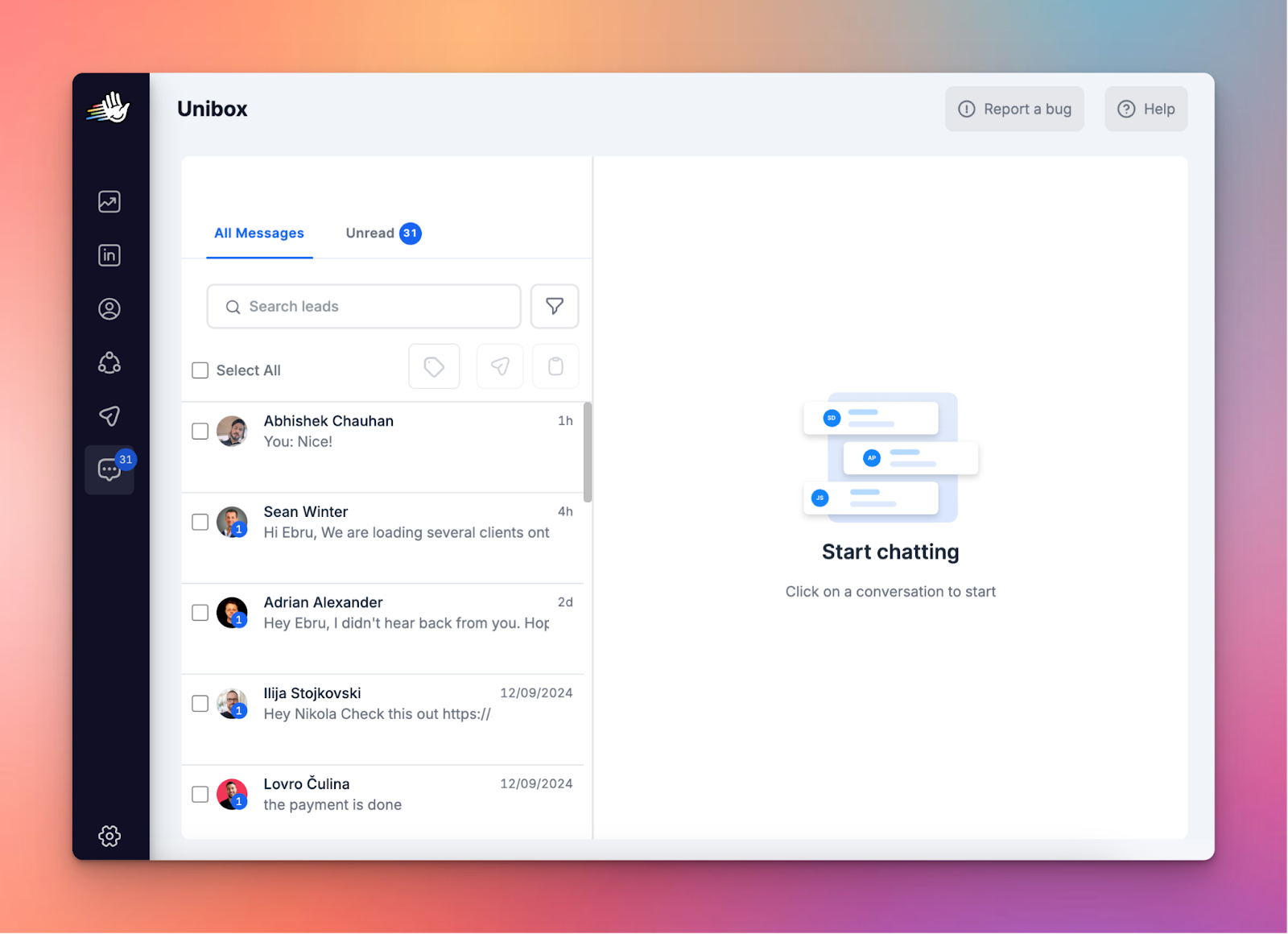
- The Unibox: You manage all 10 accounts’ replies in one single inbox and streamline your entire workflow.
Testing & optimizing your outreach
Track your KPIs across all channels to see where the qualified leads are coming from:
- Test email subject lines, LinkedIn message openings, and call scripts
- Rotate messaging themes every 4-6 weeks to avoid fatigue
- Analyze which customer interactions lead to the higher conversion rates.
☝🏼 Iterate constantly → even small tweaks in your multichannel lead generation strategy can lead to significant lift in conversion rates.
Measuring ROI and business impact
A robust omnichannel strategy should clearly connect your lead generation efforts to revenue and retention. Beyond engagement metrics, track:
- Cost per meeting
- Average deal size from omnichannel leads
- B2B sales cycle reduction
- Pipeline growth
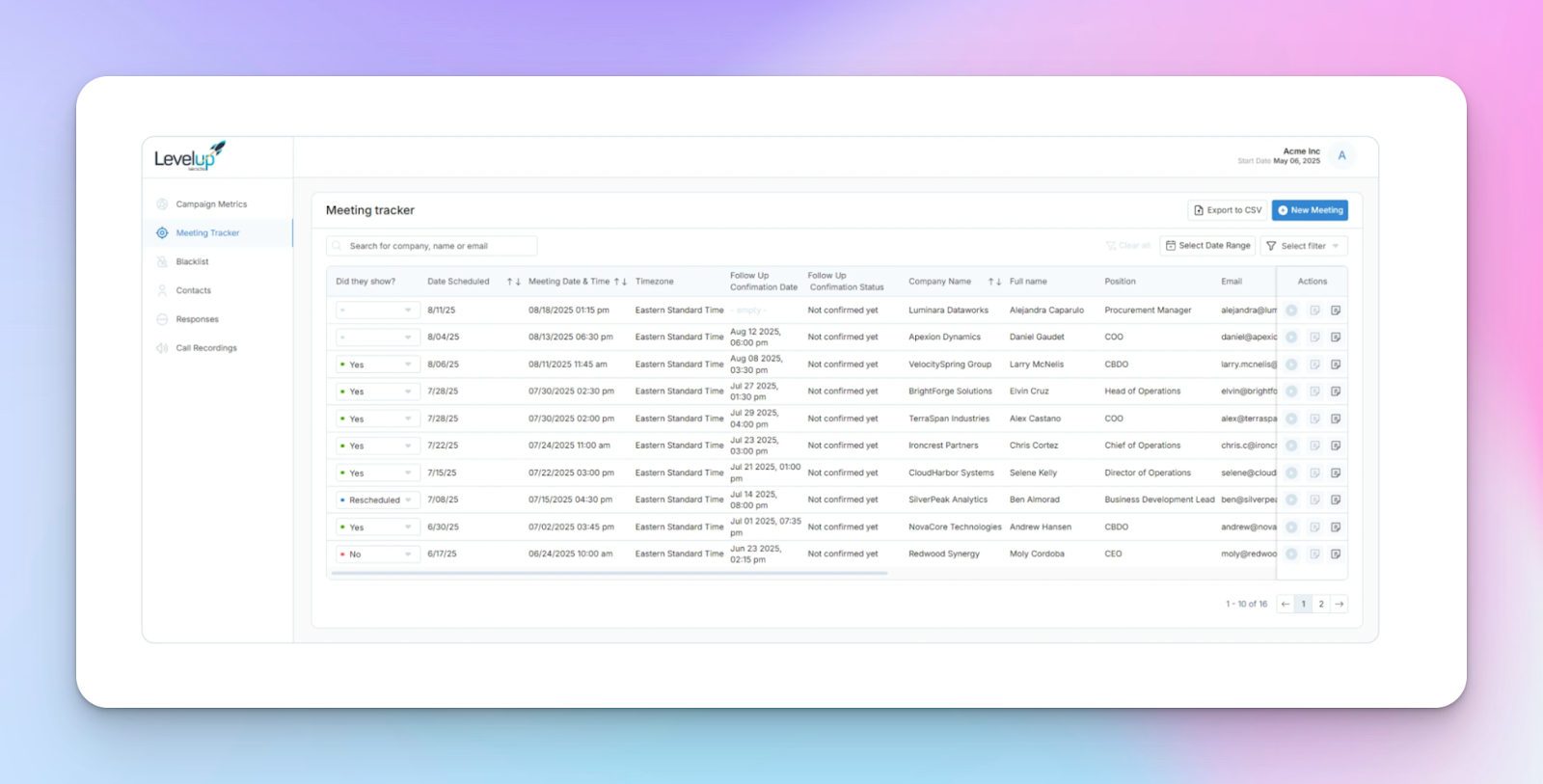
💡 B2B lead generation agencies like LevelUp Leads give you full visibility into the buyer’s journey with dashboards that track exactly how each channel is performing. This way, you can spot what’s working, optimize campaigns and make data-driven decisions that move the needle.
Handling common objections across channels
Even with the perfect cadence, prospects can push back. Prepare for common objections with quick, consistent personalized messaging across channels:
- Too busy / not interested: Acknowledge, then pivot: “Totally understand. Can I send you a 1-page insight that might save your team 10 hours next week?”
- Already have a solution: Highlight differentiators and success stories: “I get it – most companies we work with were using [competitor]. They saw a 20% increase in adoption in 3 months using our approach.”
- Need to consult others: Offer a low-commitment follow-up: “No problem. I can do a short session with your team next Tuesday to see if it fits your workflow.”
If you prepare for objections, you reduce friction and increase the odds of booking a meeting.
Check, sync, send.
Omnichannel doesn’t mean “being everywhere.” It means being only there where it actually matters.
Main things to remember:
- Coordinate all B2B marketing channels for a unified, smooth customer experience
- Personalize every touch with relevant, contextual and consistent messaging
- Track metrics and iterate constantly to optimize results
- Follow a structured cadence to move leads through the pipeline
- Use technology wisely to scale without losing the human touch
Set the rhythm, hit the right touchpoints, and watch your pipeline go from quiet to unstoppable.
Try it for free
Frequently Asked Questions
What is an omnichannel lead?
An omnichannel lead is a prospect engaged across multiple channels (email, LinkedIn, calls) where each touchpoint works together to create a cohesive, relevant experience that drives conversions.
How do you create an omnichannel strategy?
Start by identifying your target audience and the channels they use most. Map out a sequence of coordinated touchpoints, so each message builds on the last. Keep messaging consistent and relevant, track performance across all channels, and optimize based on what’s working.
Will my LinkedIn account be banned while doing omnichannel lead generation?
The volume spike is what gets you banned. HeyReach offers randomized pacing and account rotation. By spreading 50 tasks across 5 accounts rather than 50 tasks on one account, you stay well under LinkedIn's radar.
How long does it take to see a ROI from omnichannel lead generation?
Outbound is a lagging indicator: typically, the first 30 days are for calibration, where you test scripts and set up the technical infrastructure; the next 30 to 90 days mark "the build-up," as meetings begin hitting the calendar; and by day 180, you reach full pipeline velocity.
Can one SDR manage omnichannel lead generation effectively?
Only if they have a unified system. If an SDR has to log into 5 Chrome profiles and check 3 different tools, then they are essentially running five single-channel campaigns simultaneously. Omnichannel only works if the execution is "silent" and automated, allowing your team to scale their marketing efforts without burnout.