Why more LinkedIn volume doesn't work anymore
Published:
August 31, 2026
For years, the LinkedIn outreach formula was simple: more messages meant more meetings. Spray-and-pray was purely a numbers game, and pumping up volume was a reasonable response to a slow pipeline. That formula is breaking down, and most teams haven't noticed yet, because they keep reaching for the same lever.
Cheap data and AI writing tools made mass outreach easy for everyone at the same time. A few years ago, scraping LinkedIn activity or pulling hiring signals at scale took real effort. Now anyone can export a list of ten thousand people, drop it into an AI tool, describe their offer in a couple of sentences, and get a full sequence back in minutes.
That's genuinely useful, but it means every prospect's inbox filled up with the same signals and the same AI-generated structure at the same time. Reply rates dropped to a few percent industry-wide, and the instinctive response, for most teams, was still to just get another list of ten thousand and repeat the process. That doesn't fix anything. It just damages sender reputation and keeps the pipeline empty.
How to tell if you actually have a targeting problem
There's a simple diagnostic here. If a reasonable share of your connection requests get accepted, in the 10–20% range and sometimes higher, but almost nobody replies once connected, that's not a volume problem. It means one of two things: you're reaching the wrong person, or your message doesn't resonate with the right one. Usually it's both, and they need to be tested separately rather than assumed away.
A reply rate sitting well under what's typical for a healthy campaign is the clearest signal something upstream is broken, and that's a metric worth actually benchmarking against rather than guessing at. There's a useful breakdown of what a healthy reply-to-accept rate looks like across a large set of campaigns, which makes it easier to tell whether a given number is a real problem or just normal variance.
Beyond the number itself, there's a manual check worth doing before touching the messaging at all: pull fifty or a hundred people who accepted the connection request and actually look at their job titles and profiles.
Most LinkedIn databases return a wide spread of roles and sub-industries under a broad ICP label like "chief marketing officer," and a chunk of those accepted connections usually turn out to be a poor fit for the offer. A tighter ICP definition, something like CMOs at B2B SaaS companies that raised a Series A at least six months ago and are currently hiring SDRs, gives an AI tool something concrete to write against instead of a generic title.
Fix the list before the message
Everything else follows from picking the right accounts first. Instead of building a list of thousands of companies and dumping all of them into a sequence, it's worth narrowing to a few hundred accounts that show a real timing signal: a recent job change, a funding round, headcount growth in a specific department, or going through an accelerator.
These signals are common enough that a lot of other outreach will be chasing the same accounts at the same time, which is exactly why a genuinely relevant offer, not just a relevant signal, is what separates a message that gets a reply from one that gets ignored.
It also helps to score and validate that shorter list before writing a single message. A clean process for catching and scoring outbound signals before they decay keeps the list from turning into the same spray-and-pray problem in miniature, just with a smaller starting number. And going back to first principles on what actually counts as a usable ICP signal is worth doing before scaling any of this, since a vague definition of "who" will always need more messages to compensate for a weak "why now."
Reach more than one person, carefully
Once the account list is set, the next adjustment is who inside each company gets messaged. Most B2B purchases involve more than one person, a champion, a commercial buyer, sometimes an influencer, especially once the company is past a certain size.
Finding and reaching a few of these people in parallel, rather than betting everything on one contact who may never escalate internally, is the core idea behind account-based outreach: engaging the decision-maker and the champion at the same time instead of hoping one person forwards the message along.
That said, this isn't a reason to message everyone at a company. Reaching five people from the same account at once reads as spam even when each message is personalized. Two people, three at the absolute most, each chosen because there's a real reason they'd care, works better than trying to cover every plausible title. Where there's past CRM data on who actually converted from inbound, pulling those call transcripts and having AI summarize what those buyers cared about is a fast way to sanity-check which titles are worth the outreach in the first place.
Building the campaign end to end
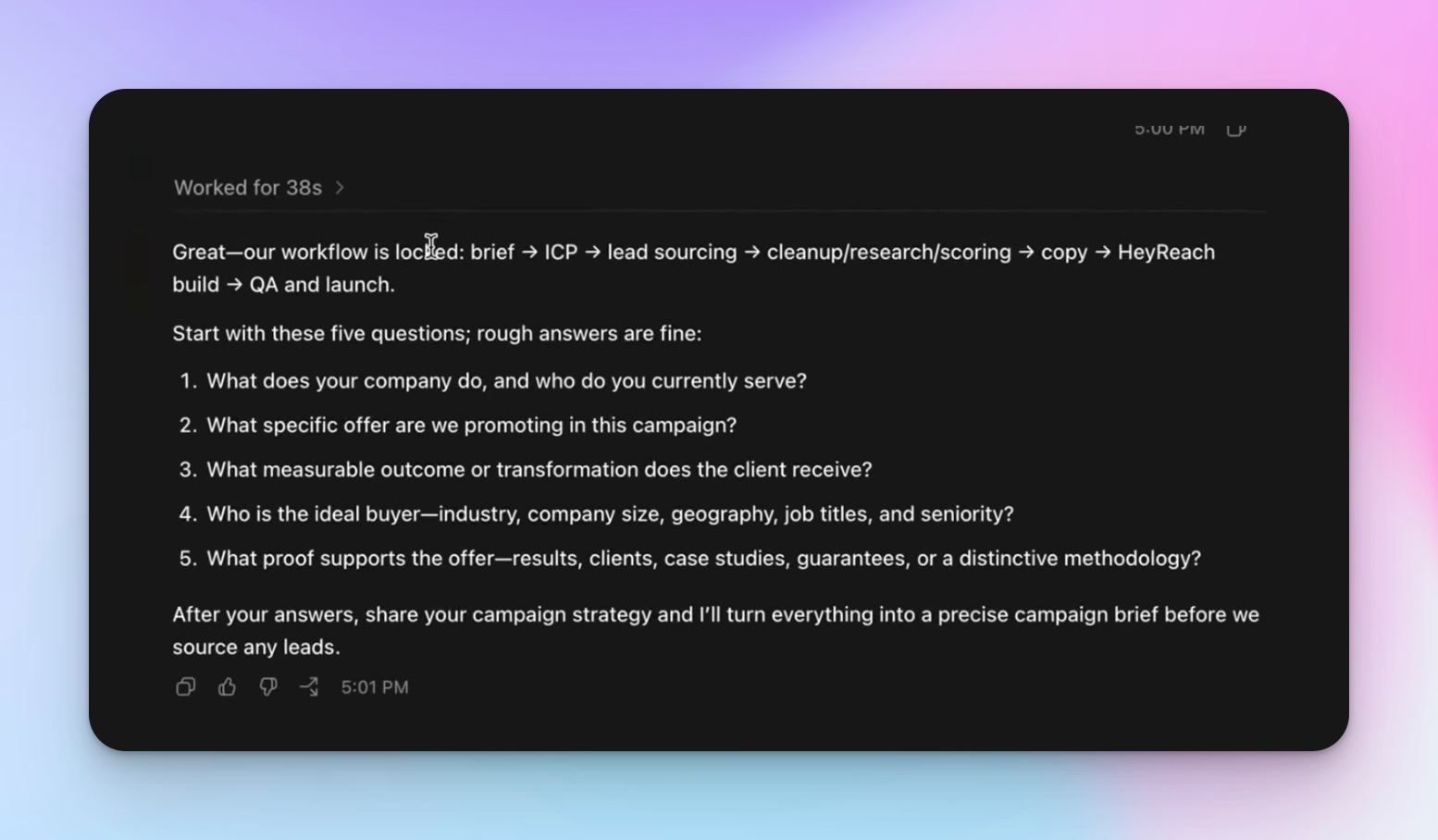
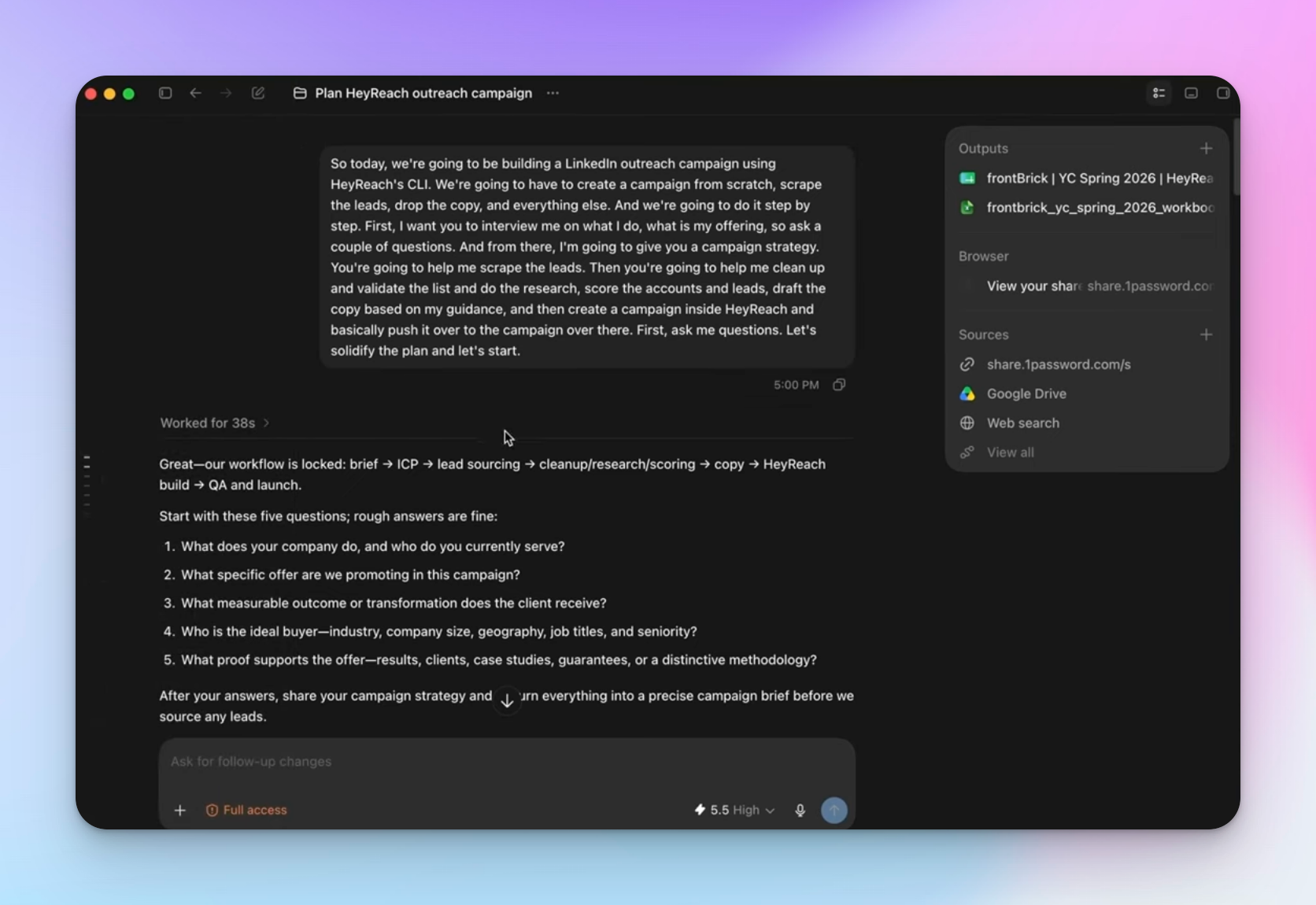
Here's roughly how this plays out as a workflow, using an AI coding tool connected directly to the outreach stack. The AI is given a short interview about the business: what the offer is, who the ideal buyer is, what the social proof looks like, and what tone the messaging should have. From there it drafts a targeting plan and a message sequence, but the actual list-building and enrichment happens through connected tools rather than manual copy-paste.
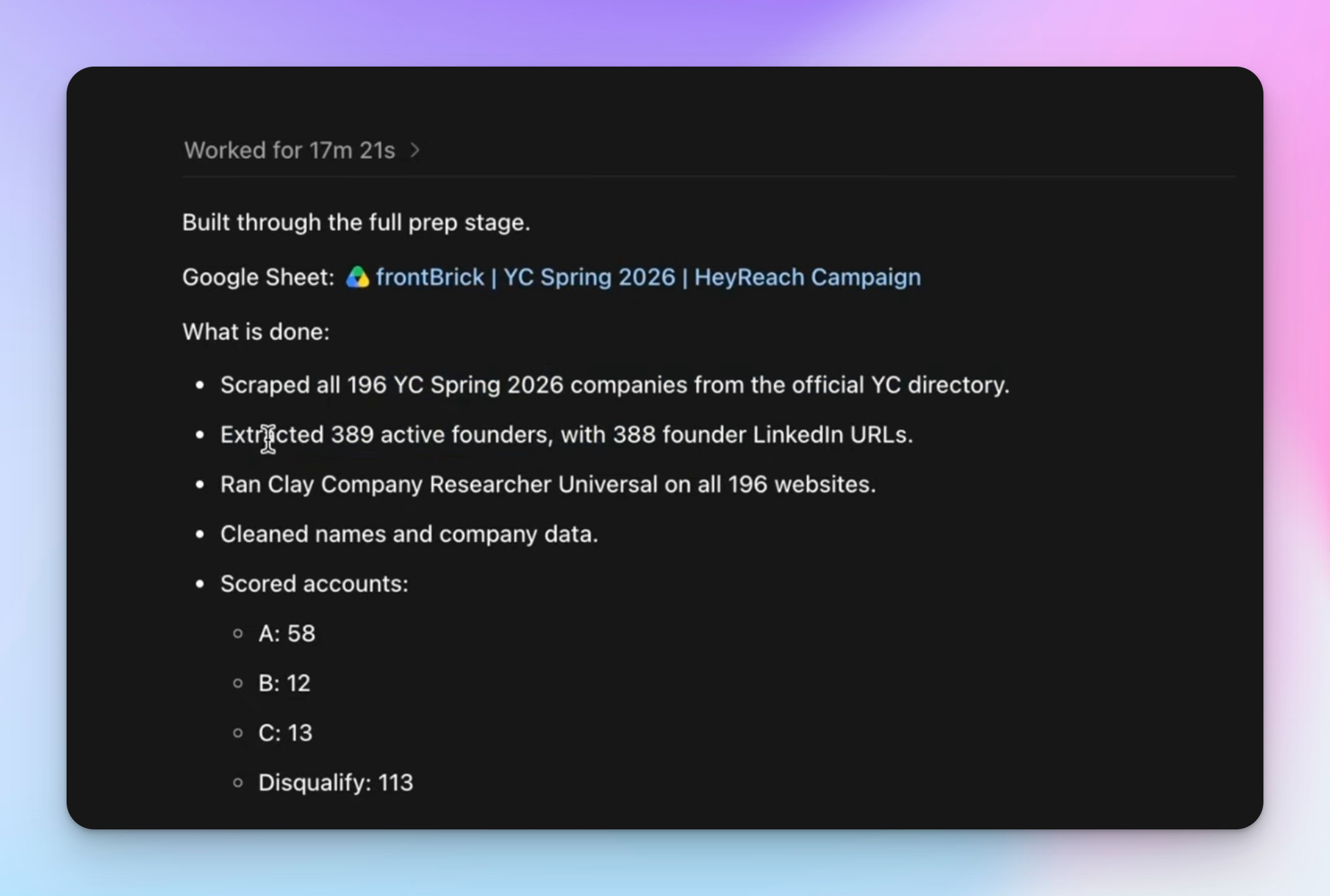
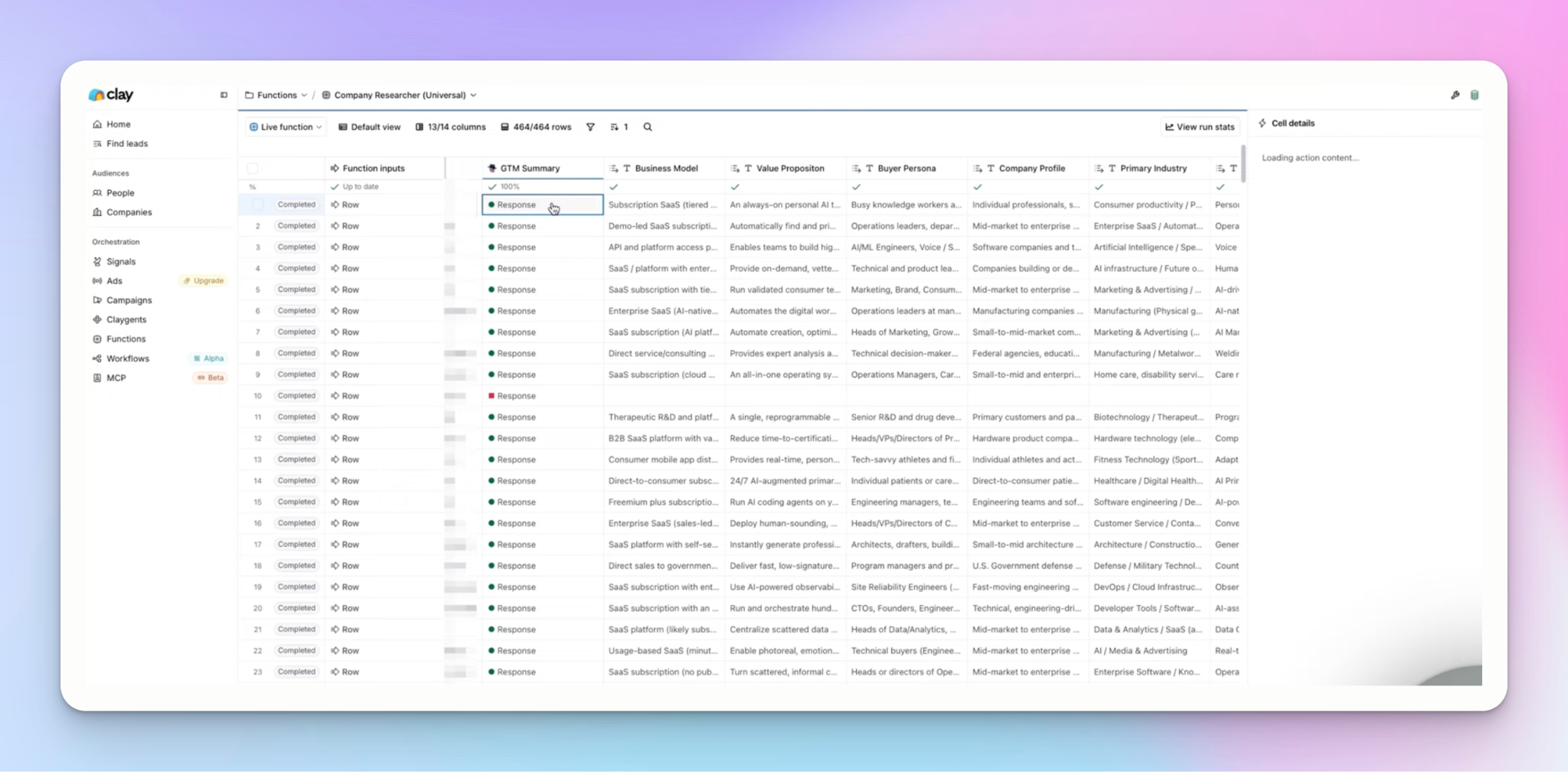
A source list, say every company and founder from a specific accelerator batch, gets pulled and then enriched: business model, ICP, value proposition, buyer personas, and product all filled in per company through a Clay-style enrichment step, then scored against the campaign's criteria so only the strongest-fit accounts move forward.
From there, the AI can push the shortlisted leads and message sequence straight into a live campaign using the HeyReach CLI connected to Claude, which turns campaign setup from a manual dashboard task into something that runs from a single instruction.
The resulting sequence tends to look simple on purpose: a blank connection request with no pitch, a short message a few hours after acceptance that references the specific reason for reaching out, and no more than three or four total touches. Long, feature-heavy sequences underperform short ones that stay anchored to one clear reason for the outreach.
Test smaller, side by side
Rather than launching one large campaign and hoping it performs, it's worth splitting outreach into a handful of smaller, distinct angles running at the same time, then doubling down on whichever one is actually converting. This is a different exercise from A/B testing a single message variant, though the same discipline applies: change one variable at a time and read results only once each version has enough volume behind it, which is the same principle behind running a clean, isolated split test inside one campaign rather than comparing across unrelated ones.
Structuring a full outreach strategy around segmentation rather than one blanket campaign is what keeps a system working past the first couple of weeks, instead of decaying the way single, undifferentiated blasts tend to.
Track positive replies, not just replies
A campaign can look fine on connection rate and still produce a pipeline of nothing if most of the replies aren't genuinely warm. Feeding reply sentiment back into a CRM automatically, rather than triaging every message by hand, keeps this visible without adding manual work, which is part of what a connected Clay, HeyReach, and automation stack is built to handle.
Finally, LinkedIn doesn't have to be the only channel in the sequence. For leads who don't accept the connection request or go quiet after connecting, finding a verified email address and continuing the sequence there, rather than giving up on the account entirely, extends the same targeted list further.

Try it for free
Frequently Asked Questions
Why is LinkedIn outreach volume not working as well as it used to?
More people have access to the same scraping and AI-writing tools, so prospects now receive far more generic, signal-based outreach than a few years ago. The same volume that used to stand out now blends in.
How do I know if my LinkedIn problem is targeting or messaging?
Check your connection acceptance rate against your reply rate. A healthy acceptance rate with very few replies usually points to the wrong audience, the wrong message, or both.
How many people from the same company should I reach out to?
Two is a reasonable default, three at most. Reaching more than that from one account tends to read as spam even with strong personalization.
What should I do if someone doesn't accept my LinkedIn connection request?
Consider finding their email address and continuing the sequence there instead of dropping the account, especially if it scored well on your original targeting criteria.
Is it better to run one big campaign or several smaller ones?
Several smaller campaigns testing different angles side by side make it easier to see what's actually working, rather than one large blast where a single strong or weak segment gets averaged out.