LinkedIn CEO outreach sequence templates: Copy, customize, convert
Published:
July 17, 2026
You’ve got a solid ICP, a decent message, and a LinkedIn CEO outreach sequence that looks fine on paper. You hit send. And then... nothing. A few accepted connections that ghost you. Maybe one reply asking to be removed.
So you tweak the copy. Try a different opener. Add another follow-up.
Still nothing.
Here’s the thing nobody wants to say out loud: most CEO outreach strategy fails because there was never a system behind it — just vibes and a LinkedIn premium account.
I’ve seen sales teams with genuinely good messaging get zero results because their execution was non-existent. Timing was random. Signals were ignored. Follow-ups happened when someone remembered to send them. Just “we sent some messages and LinkedIn didn’t work for us.”
CEOs and other high-level decision-makers, as a key part of LinkedIn’s user base, receive dozens of outreach messages a week. They’ve developed a sixth sense for generic.
You open your inbox, you see the pattern in 0.3 seconds — generic opener, unsolicited context dump, calendar link — and you close it without finishing the sentence.
CEOs do the same. Except faster, because they have less patience and more options.
CEO outreach is a signal, timing, and execution problem. If your message could be sent to anyone, doesn’t connect to something real, or takes effort to understand — it’s gone. No second chances.
Their inbox isn’t a discovery channel. It’s a filter. And right now, your message is probably getting filtered out.
Why most LinkedIn messages fail (even before they’re read)
When you're cold messaging a CEO, you're not just competing with other outreach. You're competing with a board update, a team crisis, a hiring decision, and seventeen other things that are actually on their radar.
If your message doesn't scream relevance in the first line — not "sounds interesting," actual relevance to a real problem they have right now — it's gone.
This is where most lead generation strategies fall apart. Not at the copy level. At the targeting level. CEOs don't respond to logic. They respond to relevance. There's a difference.
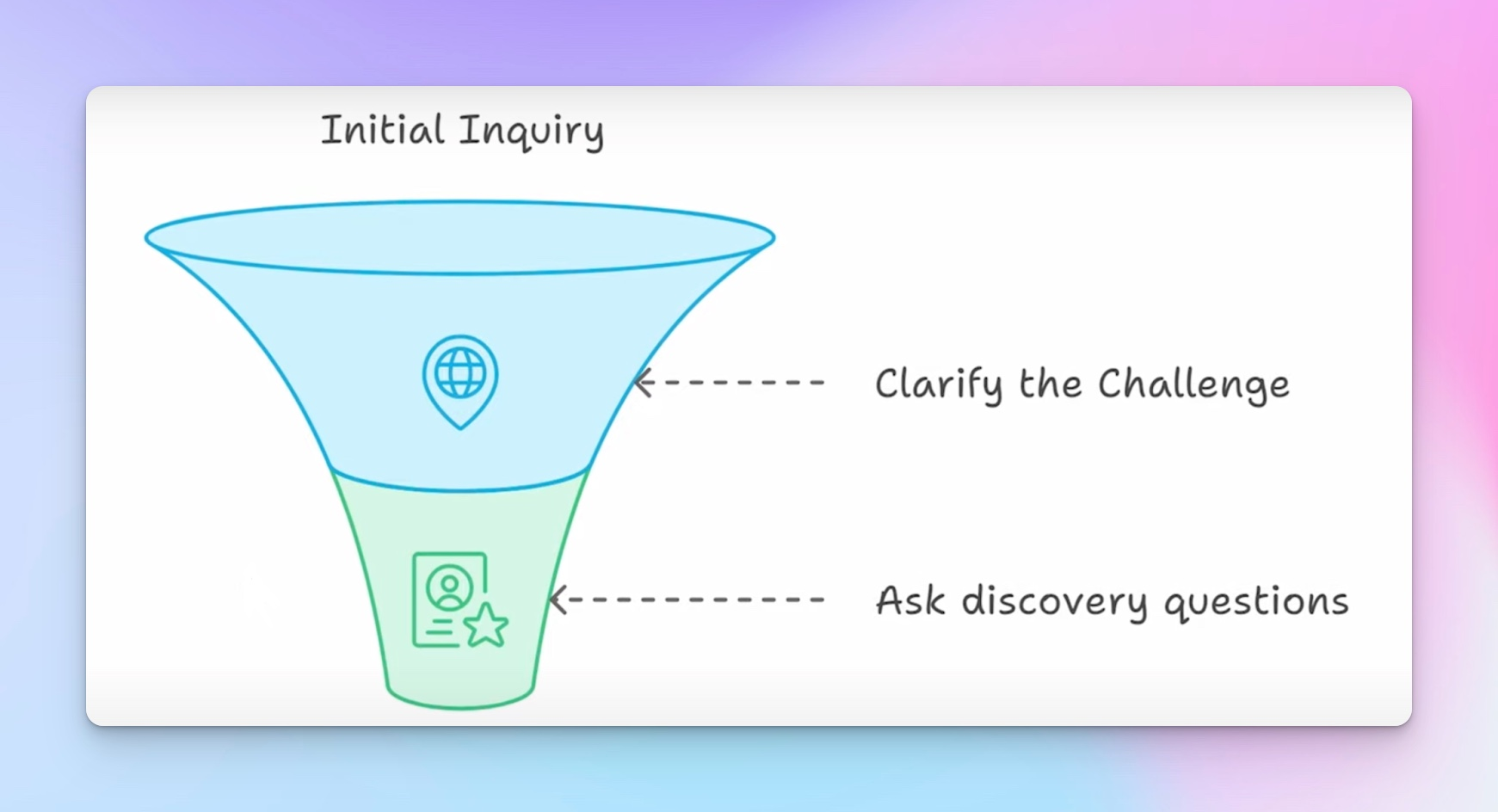
The system behind CEO outreach (what actually works)
Before you even think about templates, understand what you’re actually building.
It’s a system. And like any system, if one part breaks, the whole thing breaks.
Signal
Something has to change in your prospect’s world for your message to make sense right now. Hiring surge. New funding. Expansion into a new market. Without a signal, there’s no urgency — and without urgency, there’s no reply.
Routing
The same template does not work for every CEO. A founder dealing with post-Series A hiring pressure needs a completely different entry point than one who just hit a revenue wall. The structure stays similar. The angle has to change. Skip this step and you’ll wonder why your “personalized” messages feel generic.
Execution
This is where campaigns quietly die. Great opening message, wrong timing. Strong sequence, no follow-up discipline. Everything mapped out, nothing actually triggered. I’ve watched outreach campaigns that would’ve worked completely fall apart because the execution layer didn’t exist. If you’re running more than a handful of CEO sequences simultaneously, you need a sales orchestration layer sitting between your signals and your LinkedIn execution — otherwise you’re just hoping the right message reaches the right person at the right time. Spoiler: hope is not a strategy.
Feedback
If you’re not tracking acceptance rate, reply rate, and positive response rate — you’re not running outreach. You’re running a lottery. The data tells you exactly what’s broken.
Miss any of these and you’ll be back here in six months asking why LinkedIn doesn’t work.
Anatomy of a LinkedIn CEO outreach sequence
Four steps. That’s the sweet spot.
I know, I know — more steps feel like more control. They’re not. Every extra touchpoint is another chance to lose someone before they reply.
A connection request that creates context (not a pitch), an opening message within 24 to 48 hours, a follow-up message that adds a new angle instead of repeating the same one, and a soft close that makes it easy to say yes or no.
Each step has exactly one job.
- Connection request: get accepted.
- Opening message: create relevance.
- Follow-up: move the conversation forward.
- Soft close: get a response — not a booked meeting, just a response.
The moment one step tries to do everything, it stops doing anything well. This is not complicated. Most people just refuse to resist the urge to over-engineer it.
The role of the LinkedIn connection request
The connection request is not where you sell.
It’s where you earn the right to send a message. That’s it. Full stop.
A good connection request creates just enough context for the other person to accept without thinking. Low friction. No pitch. No explanation of what your company does. One to two sentences max — if you need more to explain it, the message isn't ready.
On the note vs. no note debate: for C-suite, a short curiosity-driven intro often outperforms a note that tries to say too much. Test both. Don’t assume.
What this looks like in a real campaign
There’s a clearly defined ICP and target audience — not “B2B SaaS companies,” an actual person with actual problems. Pain points are mapped to business outcomes, not assumed. Signals are used to time outreach, not just decorate it.
Without this, outreach is random. You send messages, get sporadic replies, hope something converts. With it, patterns emerge fast. You see which persona responds, which message angle moves the needle, where conversations drop off. You stop guessing and start to optimize your entire outreach engine.
That’s the difference between a full pipeline of qualified leads and a spreadsheet full of contacts that went absolutely nowhere.
The templates: Copy, customize, send
Connection request templates
Template A: Mutual connection / shared context angle
Hey {{first_name}} — {{mutual_connection}} mentioned it would be great to talk to you about {{relevant topic}.
Template B: Relevant trigger (funding, hire, content they posted)
Noticed {{company_name}} is on a hiring spree — interesting timing. Happy to connect.
Template C: Direct and curiosity-led (no context needed)
Hey {{first_name}} — following what you're building at {{company_name}}. Would love to connect.
Low friction. No pitch. That’s the whole strategy.
Opening message templates
Template A: Problem-led opener
Most {{industry}} CEOs I talk to are dealing with {{specific problem}} right now. Is that something you're navigating at {{company_name}}, or is it not on the radar yet?
Template B: Social proof + specific outcome
We helped a {{industry}} company at a similar stage {{specific outcome — e.g. "go from 200 to 800 outbound touches a week without adding headcount"}} in {{timeframe}}. Curious if {{specific challenge}} is something you're running into at {{company_name}} right now.
Template C: Short insight relevant to their business
Noticed something interesting in {{industry}} last week — {{specific observation}}. Are you seeing the same at {{company_name}}?
Cold outreach messages often fail even when they sound good. Why? Because they’re irrelevant. No connection to a real pain point, no timing, no reason for that specific person to care.
High-quality personalized outreach needs one relevant observation and one clear connection to a business outcome. Everything else is noise.

These are starting points. Every SDR worth their quota and every founder who’s actually closed deals will tweak based on what they know — a recent hire, a product launch, a market shift. That one tweak is often the whole difference between ignored and replied to.
Follow-up templates
The biggest drop in reply rates? After the first follow-up.
Because most follow-ups are just the same message in a slightly different outfit. And from the receiver’s side, that reads as desperation, not persistence.
A follow-up that works introduces something new — a different angle, a relevant data point, a case study that reframes the problem. Not “just checking in” (please, never “just checking in”). Something that gives them a reason to respond that they didn’t have before.
Template A: Value-add (resource, data point, relevant case study)
Hey {{first_name}} — put together something short on how {{industry}} companies at your stage are handling {{specific problem}}. Worth a look, or completely off base?
Template B: Bump with a different angle
Hey — came across {{relevant data point or trend}} last week and it made me think of {{company_name}}. Curious to hear your thoughts.
Template C: The honest “closing the loop” message
Closing the loop here — if the timing is off, I totally get it. If it makes more sense to revisit this in a month or two, just say the word.
Soft CTA templates
This is where most sequences go to die.
Not because the conversation was bad. Because someone got greedy and asked for too much too soon.
“Let’s hop on a 30-minute call this week” after two messages to a CEO you’ve never met before is the outreach equivalent of proposing on the first date. You might technically get a yes. You probably won’t.
A soft call-to-action works because it removes pressure. You’re not closing. You’re opening a door and leaving it wide enough for them to walk through without feeling cornered.
Template A: Low-commitment ask (quick question vs. meeting)
What do you think — worth a quick conversation, or not the right moment?
Template B: Specific and time-bound
If this is relevant — happy to share how we approached it. Let me know.
Template C: Referral ask (if they’re not the right person)
One last check-in — if you’re not the right person for this, who should I be talking to?
One sentence. Binary answer. No calendar link. No “feel free to book a slot.” Just a question that’s genuinely easy to respond to.
How to personalize at scale (without sounding fake)
Hot take: most "personalization" in cold outreach isn't personalization. It's decoration.
"Hey, I loved your recent post about [vague topic]" — that's not personalization. That's a template with a thin layer of research painted over it. CEOs see through it immediately, and honestly, they should.
Real personalization is signal matching. It's connecting a specific thing happening in their world to a specific outcome you can deliver. A message that references a recent LinkedIn post moves nothing. A message that connects a hiring surge to outbound pressure, or a funding round to scaling challenges, creates immediate context.
This is where Clay earns its keep. Pull signals — funding rounds, hiring trends, tech stack changes — push them into HeyReach as custom variables: {{recent_hire}}, {{funding_round}}, {{tech_stack}}. Personalized message, scalable process. That's the setup.
There's a framework worth internalizing here — call it the 3-layer personalization model:
- Industry — What's true for everyone in their space right now. Market pressure, regulatory shifts, a trend that's hitting the whole sector.
- Company — What's specific to their stage, growth trajectory, or recent moves. A funding round, a hiring surge, a product launch.
- Individual — What's unique to this person's role, recent content, or public activity. Something they posted, a talk they gave, a position they've taken.
Jump straight to the individual layer and it will feel forced. Instead, start broader, then narrow. The individual detail lands harder when it's sitting on top of two layers of context that are already relevant.
Research worth your time: recent funding, hiring trends, tech stack changes, and anything they've posted or been quoted on in the last 30 days. Everything else — their entire LinkedIn history, their company's About page, anything that requires more than five minutes to find — isn't a personalization signal. It’s just a background check.
Mapping custom variables inside HeyReach
Once your data is enriched in Clay and pushed to HeyReach, the variable setup is straightforward. In the message editor, manually type each custom variable — {{recent_post}}, {{funding_round}}, {{tech_stack}}, whatever signals you're using — exactly as you've named them in Clay, making sure the names match exactly. HeyReach pulls the value for each lead individually when the message sends.
Fallback values live in the same editor, next to each variable. If the data field is empty for a specific lead, HeyReach uses the fallback instead of sending a broken message. For something like {{recent_post}}, a fallback of “your recent activity on LinkedIn” keeps the message readable even when the specific data isn’t there. It’s not ideal — but it’s infinitely better than “Hey {{first_name}}, I noticed {{recent_post}}...” landing in a CEO’s inbox.
Rule of thumb: if you wouldn’t send the message without the variable filled in, set a fallback that makes the sentence work regardless. A broken variable means you skipped QA. Don’t be that person.
Timing and cadence: When to send, when to stop
There’s no magic send time for CEO outreach. Anyone who tells you “Tuesday at 10am is optimal” is selling you something — probably a $997 course.
What actually matters is cadence logic: opening message within 24 to 48 hours of connection acceptance — don’t wait three days, the context has already faded. Follow-ups spaced a few days apart. Sequence short enough that it doesn’t become harassment before it becomes a conversation.
Consistency beats perfection here. The campaigns that fail aren’t the ones with slightly off timing. They’re the ones where follow-up number two never went out because someone forgot, the tool wasn’t set up right, or the sequence just... stopped.
Knowing when to stop is just as important as knowing when to follow up. Three to four touchpoints with no response is a signal — not an invitation to keep going. Call the sequence done, mark the lead for re-engagement in 60 to 90 days, and move on. Pushing past that doesn't show persistence. It burns the lead and your sender account's reputation along with it.
Re-engagement (when sequences go cold)
Pushing harder inside the same sequence when someone’s gone cold almost always signals desperation more than persistence. Instead: pause, wait, come back with a fresh angle — a new signal, a different pain point, a case study that wasn’t relevant three months ago but is now. Treat it as a new conversation, not a continuation of a dead thread.
Running CEO sequences at scale with HeyReach
Automation gets a bad reputation. Mostly deserved — because most people use it to scale outreach that was already bad. Automate a bad message and you send more bad messages, faster.
Use a LinkedIn connection automation tool to automate a well-structured sequence with real personalization and signal-based targeting — that's where the leverage is. AI outreach agents can handle the decision layer too: which leads to prioritize, when to follow up, which angle to use. What you never automate is judgment. That stays with you.
Manual outreach scales to about 20 or 30 leads before it starts quietly falling apart. Follow-ups get missed. Sequences lose structure. Timing slips. And suddenly “we’re doing outreach” becomes “we occasionally send messages when we remember to.”This is a well-documented problem in LinkedIn outreach — the moment volume picks up, manual execution quietly falls apart. At scale, the right messaging tool is what keeps sequences running even when your team is stretched thin.
HeyReach is built for exactly that moment. Here’s how to set it up:
Step 1: Set your lead list
Go to Campaigns → New Campaign, name it, and select your lead list. You can pull leads from a LinkedIn Sales Navigator search URL, a regular LinkedIn search URL, or set your targeting parameters directly inside HeyReach — no copy-pasting required. CSV import is also available if that's what your workflow calls for. This is also where you set exclusion filters — leads already messaged, existing first-degree connections, leads without profile pictures. Clean list in, clean campaign out.
Step 2: Select your sender accounts and configure limits
Choose one or more LinkedIn sender accounts for this campaign. If you're running multi-sender rotation — which you should be at any real volume — select multiple accounts here and HeyReach distributes sends across them automatically. Configure daily limits per sender by clicking the icon next to each account. Don't max them out on day one, especially on accounts that aren't fully warmed up. Start conservative, ramp gradually, watch acceptance rates before scaling volume.
Step 3: Build your sequence.
Add action steps — connection request, message, follow-up, soft close — and set delays between each step. The delay logic matters: 24 to 48 hours between connection and first message, a few days between follow-ups. Don't compress the timeline because you're impatient. You can build from scratch or import from HeyReach's proven templates.
Step 4: Map your custom variables and set fallback values.
In the message editor, map each variable — {{first_name}}, {{company_name}}, {{recent_hire}}, {{funding_round}}, {{tech_stack}} — to the corresponding field from your lead data. Then set a fallback value for every single variable. A broken variable means you didn't QA your sequence. Fix that before you launch.
Step 5: Review and launch
Check that the right lead list and right sender accounts are selected, then hit launch.
Multi-sender rotation: how it actually works
When you connect multiple LinkedIn accounts to a single campaign, HeyReach rotates sends across them automatically. No single account absorbs the full send volume — which is how you run CEO outreach at scale without triggering LinkedIn’s per-account limits.
The math is simple: one account handles a limited number of connection requests per day. Three accounts in rotation triples that capacity without tripling the risk. Ten accounts and you’re running a proper outbound engine. And if one account gets restricted — at scale, it happens — the campaign doesn’t die. The other senders keep running while you sort it out.
Account warm-up: don’t skip this
A brand new LinkedIn account has zero trust with the algorithm. Launch a CEO campaign on a cold account and you’re essentially walking up to LinkedIn’s bouncer and asking to cut the line. It ends predictably.
Warm-up means gradual ramp: start with 5 to 10 connection requests per day, normal LinkedIn profile activity, some engagement on posts. Increase volume slowly over two to four weeks. By the time you launch your CEO sequence, the account looks like a real human who’s been on LinkedIn for a while — because as far as the algorithm is concerned, it has been.
Unified Inbox: why it matters more than you think
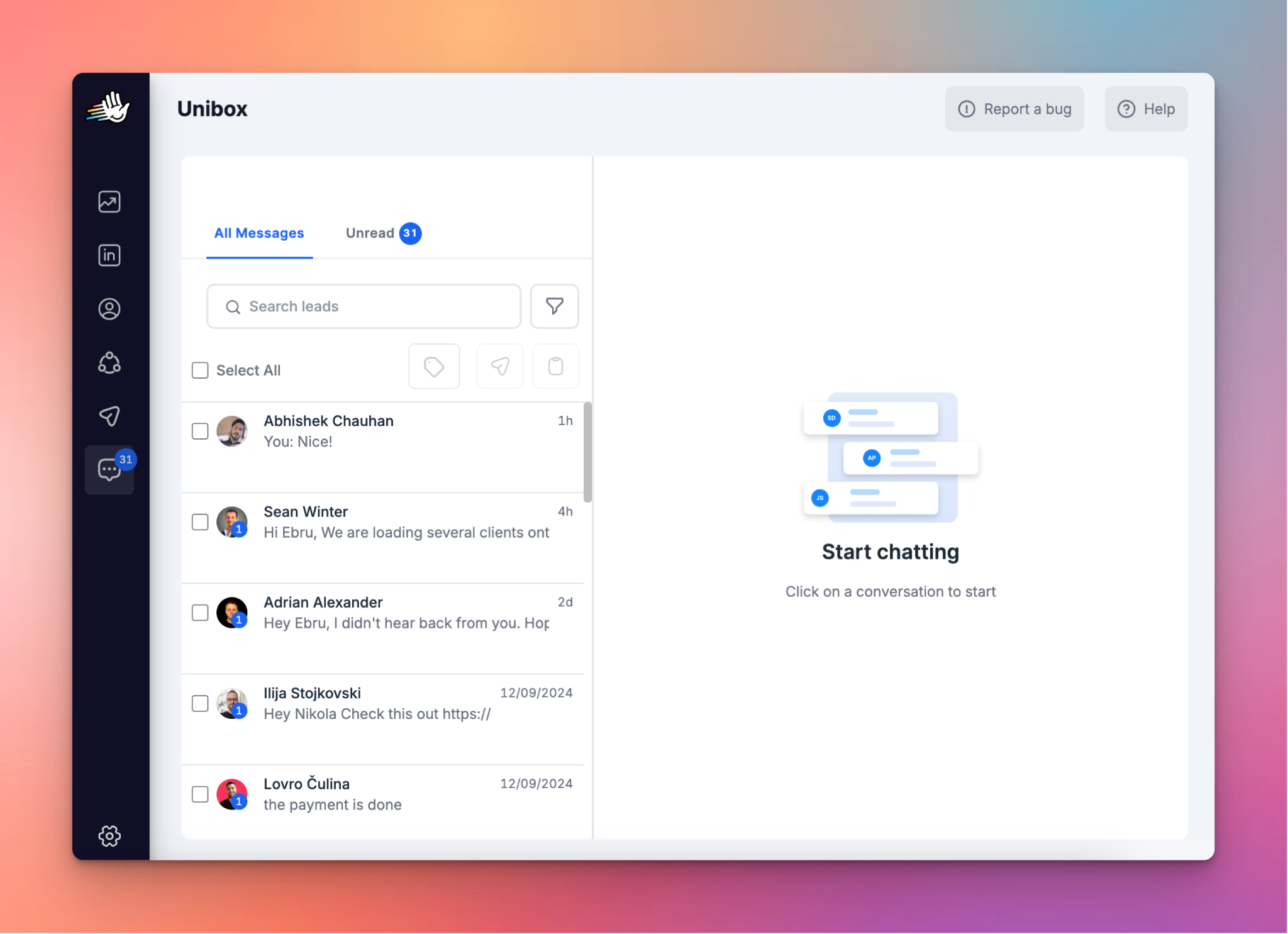
When three SDRs and two founders are running parallel CEO sequences across eight LinkedIn accounts, replies come in from everywhere. Without centralization, a hot reply sits unread in an account nobody checked. A CEO who responded positively gets no follow-up for four days and moves on. The Unibox means one view, all replies, full context — so whoever is managing responses can act immediately, which is exactly when it matters most.
Tracking what matters inside HeyReach’s dashboard
Four numbers tell you whether your CEO outreach is actually working:
- Connection acceptance rate — below 25% means something's off with your targeting or the request itself.
- Reply rate — if people are accepting but not replying, the problem is in step two, not step one.
- Positive reply rate — solid reply rates with mostly 'not interested' responses means your targeting needs work, not your copy.
- And qualified leads moving to next steps is the only metric that ultimately matters — if the system is working, this number moves. If it's not, everything else is just noise dressed up as data.
HeyReach shows you connections accepted, message replies, InMail replies, and meetings booked natively in the dashboard. Check them at the campaign level — patterns across campaigns tell you more than any single data point ever will.
8 mistakes that kill CEO outreach
- Opening with a pitch before earning any trust.
- Messages generic enough to apply to literally anyone.
- Targeting the wrong persona entirely and wondering why no one's buying.
- Following up the next day, or three times in a week — some call it persistence, I call it noise.
- Asking for too much too soon — a 45-minute demo call after two messages is not a soft ask, it's a red flag.
- Not tracking anything and therefore improving nothing.
- Avoiding the pricing conversation when a CEO is clearly in evaluation mode — they know you have pricing. Just be a human about it.
- Running the same sequence for a VP and a CEO — and expecting the same results. They're not the same person. A VP is evaluating options based on their job title. A CEO is deciding whether the problem is even worth their attention. Different stakes, different entry points, different messaging entirely.
None of these require a new tool, a better list, or a bigger budget. They just require you to slow down before you hit send.
SDR and founder playbooks: How to use these templates
Same system. Different leverage.
SDRs: You own sequence integrity and follow-up consistency — even when everything else is on fire.
Before launching any CEO sequence, check if that account is already in an active deal cycle. A cold touch landing in a CEO's inbox while their VP is mid-negotiation with your AE doesn't just create awkwardness, it can kill the deal. Five minutes of checking saves relationships.
Flag active accounts before adding them to sequences. If you’re not sure, ask. And if your LinkedIn CEO outreach sequence gets no response, a coordinated follow-up via another channel gives relevance one more shot — that's the whole point of multichannel outreach.
Founders: Founder outreach hits differently because of perceived stakes.
When a founder reaches out, the other CEO picks up on it immediately — this person built something, has skin in the game, isn't running a script. That credibility is invisible in the message but felt instantly. It lets you be direct about your journey, your mistakes, your lessons — and reach out as a peer, not a vendor.
The fundamentals still apply. Signal, timing, a clear ask. "I'm a founder" isn't a pass to skip structure — it's an additional layer of credibility on top of it.
If a CEO has seen your name before, you're not cold anymore. Build that intentionally. And early on, an unpolished direct message often outperforms a polished outreach sequence — because the story is real, the stakes are visible, and the ask feels human.
Templates are the starting point, not the finish line
Good templates with bad targeting still fail. Every time.
I’ve seen teams with genuinely sharp messaging — tight copy, relevant angles, proper sequence structure — get mediocre results because they were sending to the wrong people. The CEO who doesn’t have the problem you solve. The company that’s not at the right stage. The account that’s already mid-deal with a competitor.
Templates are a tool. Targeting is the strategy. Confusing the two is how you end up optimizing copy on a campaign that was never going to work.
The compounding effect of sequencing + signal-based targeting
Combine a properly structured sequence with signal-based targeting.
A relevant signal makes your connection request more likely to get accepted. A higher acceptance rate means more people enter your sequence. A sequence that lands in the right context gets more replies. More replies mean more conversations. More conversations mean more qualified leads in the pipeline.
None of these steps are dramatic on their own. A 10% lift in acceptance rate doesn’t feel like much. But compound it across every step and the difference between “LinkedIn doesn’t work” and “LinkedIn is our best pipeline source” is often just that — better targeting at the top of the funnel, cascading down through every step.
That’s the real reason precision beats volume. Pure math, not philosophy.
Final takeaway: Precision > volume
You don’t need more outreach. You need better execution. Start small. One ICP, one sequence, one clear signal. Run it properly. Track what breaks. Then scale.
The teams that figure this out stop asking “why doesn’t LinkedIn work” and start booking meetings with people they actually want to work with.

Try it for free
Frequently Asked Questions
How many messages should a LinkedIn CEO outreach sequence have?
Three to four. Any more and you’re not being persistent — you’re being annoying.
Should I combine LinkedIn outreach with cold email?
Yes. A coordinated multichannel outreach approach improves consistency and response rates. LinkedIn builds context, email outreach with strong subject lines extends the conversation when there’s no reply. Just make sure each channel has a distinct job — don’t send the same message twice with a different logo.
How important is ICP definition?
It’s everything. Without it, even strong messaging won’t convert because you’re sending the right message to the wrong people. Strong messaging sent to the wrong people is a targeting problem, full stop."
How do I build trust in cold outreach?
Be relevant, be specific, be honest. Lead with a clear value proposition, make it easy to respond, and let the conversation develop at their pace. Trust isn’t built in one message — it’s built across a sequence that respects their time.
How do startups approach CEO outreach differently?
Use your size. A founder-to-founder message from an early-stage company hits differently than a polished SDR sequence — it’s direct, it has stakes, it doesn’t feel manufactured. Lean into that. But don’t use it as an excuse to skip structure. Even casual outreach needs a clear point and a clear ask.