The hallucination problem: QA-ing AI-personalized messages before they torch trust at scale
Published:
August 31, 2026
Personalization used to mean a rep skimmed a profile for ninety seconds before writing one line. Now a model reads the profile, the recent posts, the company page, and every enrichment field you've fed it, and writes that line in the time it takes the next lead to load. That's the pitch. The part that doesn't make the pitch deck: the model writes it with exactly the same confidence whether the fact underneath it is true or invented. It has no internal flag for “I'm guessing here.” At send volume, neither do you — until a prospect notices for you.
Here you don’t have a prompting problem you fix with a stricter system prompt. It's a quality assurance problem, the same category of problem a QA team solves by catching a bug before a release, not by asking developers to write more careful code. The fix looks less like “better AI” and more like a checklist, a review tier, and someone whose job is to read messages before they ship — which is a strange thing to build around a tool that was supposed to remove exactly that step.
What a hallucinated line actually looks like
“Hallucination” sounds dramatic, like the model inventing someone's entire career. In outreach, it's quieter than that, and more damaging, because it's almost right.
A model told to personalize a message from a LinkedIn profile and a CRM record will happily reference a funding round that closed eighteen months ago, congratulate someone on a promotion that was actually a lateral move, or mention “your recent post about pipeline coverage” when the last post on that profile is nine months old and about something else entirely. None of these are wild guesses. They're the model pattern-matching what a plausible personalized line looks like for someone at that seniority, in that industry, at that company size — and filling the blank with the most statistically likely detail instead of the true one.
The tell doesn’t mean that the message is wrong. It's that it's specific and wrong.
A generic line (“hope business is going well”) can't be caught out, because it doesn't claim anything. A specific one (“congrats on the Series B”) can be checked in the ten seconds it takes to glance at the company page — and the moment it fails that check, the prospect doesn't read it as an honest mistake. They read it as being addressed by something pretending to know them, which is a worse first impression than sending nothing personalized at all.
Why one bad line becomes a scale problem
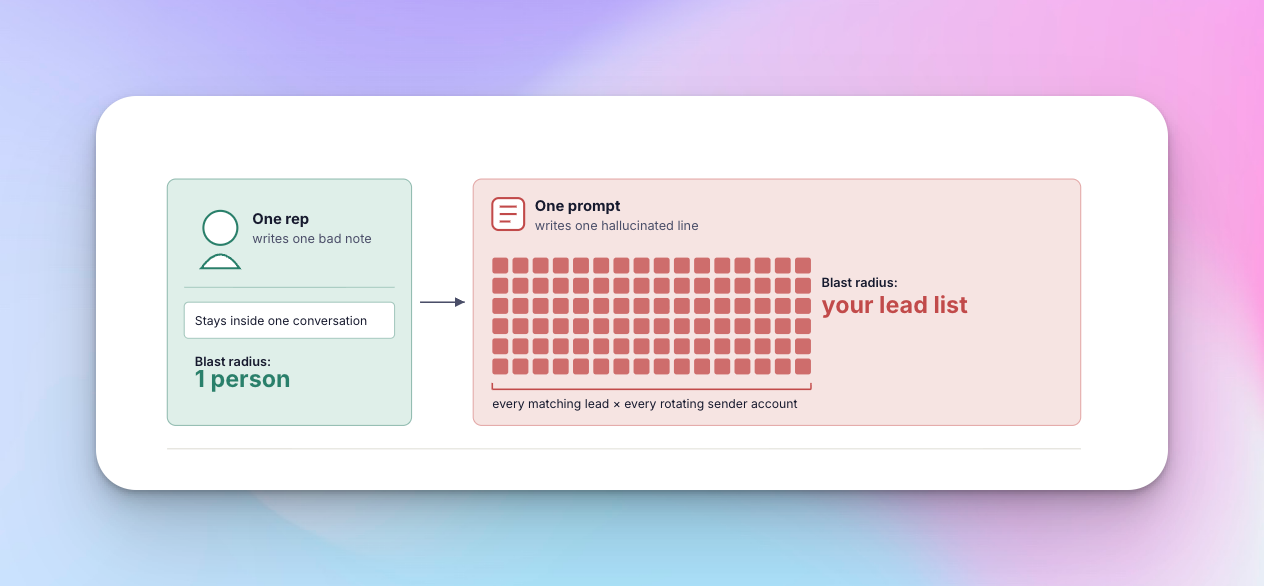
A rep who writes one bad manual note embarrasses themselves once. A hallucinated line baked into a personalization prompt gets sent with the exact same confident phrasing to every lead who matches that segment, across every sender account rotating through the campaign. The error doesn't happen once — it happens at the size of your lead list.
That's what makes this different from a weak subject line or a flat opener. A generic message costs you a reply. A fabricated detail costs you the prospect's trust in the rest of the message, and because AI-personalized outreach at scale usually runs across multiple sender accounts built to look like independent human outreach, it can cost you the credibility of the whole campaign the moment two prospects compare notes on the same fabricated claim.
It's also a failure that's easy to miss internally, because the metrics most teams watch don't flag it directly. Automated outbound workflows that looked fine in testing tend to fail quietly, not loudly — reply rates drift down over a few weeks, and it's rarely obvious the cause is a hallucinated variable sitting three steps back in the pipeline.
Where hallucinations actually enter the pipeline
Hallucination usually come from a specific, findable gap in the pipeline, and the same three gaps show up over and over.
- The first is enrichment data with holes in it. When a field from Clay or Sales Navigator comes back empty or stale, and the prompt says “personalize using their recent activity,” the model doesn't return an empty string — it returns its best guess at what recent activity for someone like that would plausibly look like. An empty field quietly becomes a confident sentence.
- The second is a grounding instruction that's too broad. Phrasing like “write something personal based on their profile” hands the model discretion it shouldn't have. Without a hard rule that every specific claim must trace back to a named field, the model treats plausibility as a stand-in for accuracy, because that's all it has to work with.
- The third, and the fastest-growing one as outreach agents take on more of the pipeline, is chaining. When one step enriches the lead, a second drafts the message, and a third personalizes the opener, each step assumes the one before it was already checked. None of them were. Stacking agents into a workflow multiplies speed and multiplies unverified assumptions at the same rate — and the same discipline a signal-based routing system applies to deciding when a lead is ready, by validating buying intent signals before they trigger outreach, has to apply to what the message actually says once it fires.
The QA checklist that actually catches this
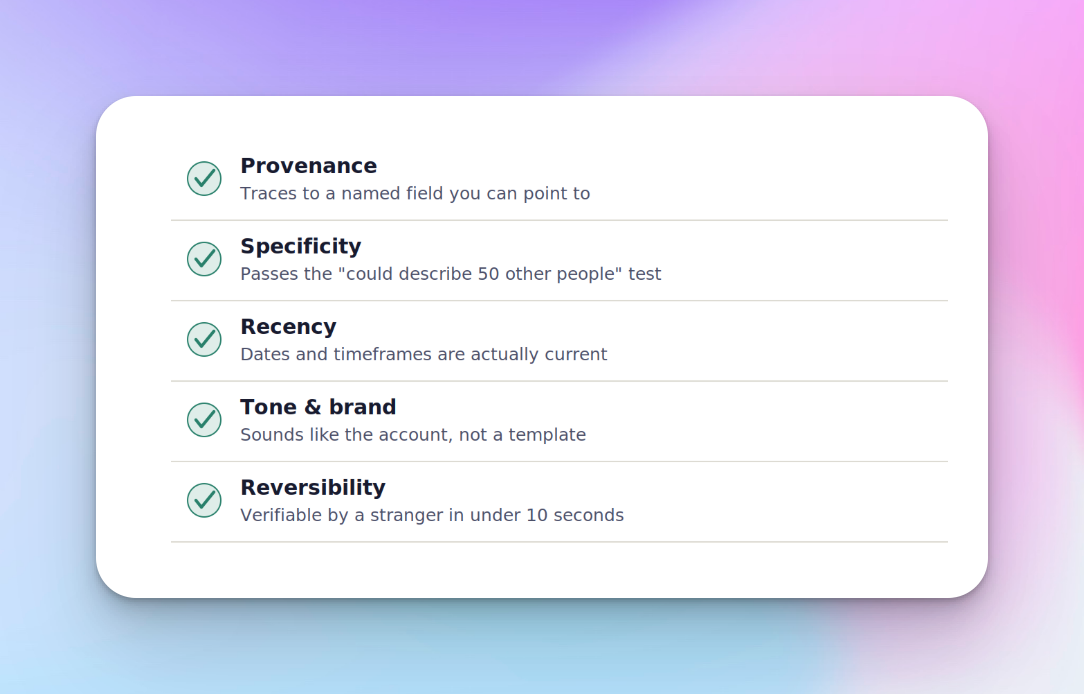
Catching hallucinations before send doesn't require a second AI model watching the first one. It requires five checks a person, or a simple rules layer, can run in under ten seconds per message.
- Provenance. Every specific claim in the message should trace to a field you can point to. If you can't name the CRM column or LinkedIn field a fact came from, it doesn't ship.
- Specificity. Run the “could this describe fifty other people” test. Real personalization gets more specific, not less. A hallucinated line often sounds specific but is a generic template wearing a name.
- Recency. Dates and timeframes are where models drift most. A “recent” milestone that's fourteen months old reads as either lazy research or fabricated research, and the prospect has no way to tell which.
- Tone and brand. Separate from accuracy, but worth the same pass — does the line sound like how the account actually talks, or like a message market fit framework applied without the judgment behind it.
- Reversibility. Can someone unfamiliar with the lead verify the claim in under ten seconds, looking at the same profile the model saw? If verifying takes longer than writing did, the check isn't actually happening.
Building review in without losing the speed you bought AI for
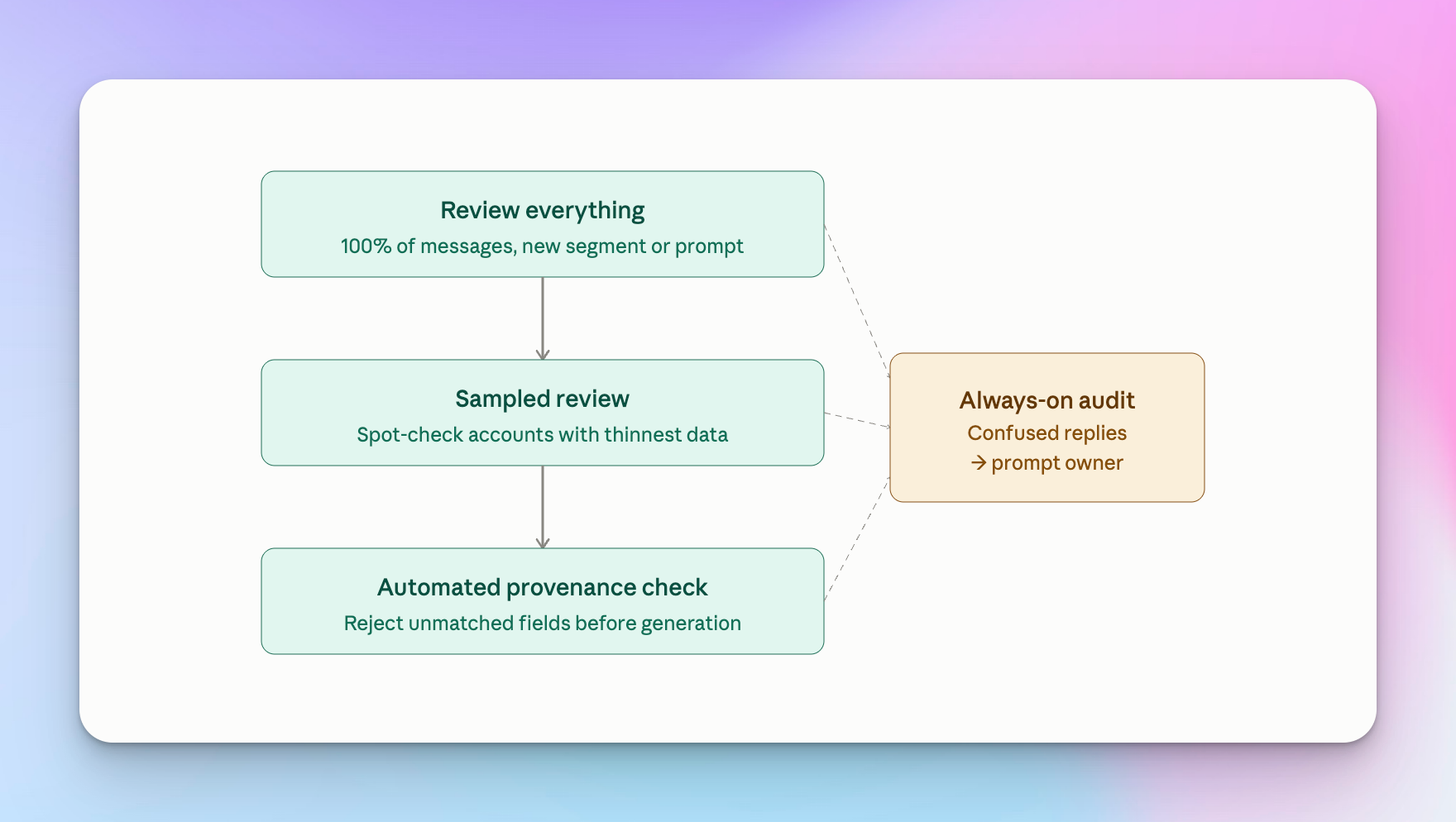
The honest objection here is that manual review defeats the point of automating personalization. It doesn't, if the review tier scales down as confidence goes up.
For a new segment or a new prompt, review everything. The first batch against any new data source or new personalization instruction should get eyes on 100% of messages — the same discipline as actually running an outreach experiment instead of trusting a hunch about what's working.
Once a pattern holds — same fields, same prompt, several hundred sends without a flagged claim — move to sampled review. Spot-check a fixed share of every batch, weighted toward the accounts and segments where profile history or source data is thinnest, since that's where enrichment gaps are most likely to get quietly papered over by the model.
At full scale, automate the provenance check itself: a rules layer that rejects any personalization variable without a matching non-empty source field, before generation even happens, is cheaper and faster than reviewing the output after the fact. Keep one manual loop running permanently regardless of scale: audit negative or confused replies. “I don't think we've spoken before” or “not sure where you got that” is a hallucination self-reporting. Route those back to whoever owns the prompt, not just to whoever owns the follow-up.
Where the damage shows up in your numbers
Hallucinations rarely show up as an obvious spike in complaints. They show up as a quiet shift in the ratio between the metrics you're already tracking.
Acceptance rate is usually untouched — a typical connection request lands around 21% acceptance, per HeyReach's benchmark report across 96,000+ campaigns — and a prospect accepts before reading a word of the follow-up, so a bad personalized line has no chance to hurt this number directly.
Reply rate is where it starts to bite. A strong campaign clears 33%+ replies, and a fabricated detail in the opening line is exactly the kind of thing that turns a would-be reply into a scroll-past, because it breaks the “this person actually looked at my profile” signal the whole message depends on.
Reply-to-acceptance conversion — replies divided by accepted connections — is the number worth watching most closely, since a weak result sits below 10%.
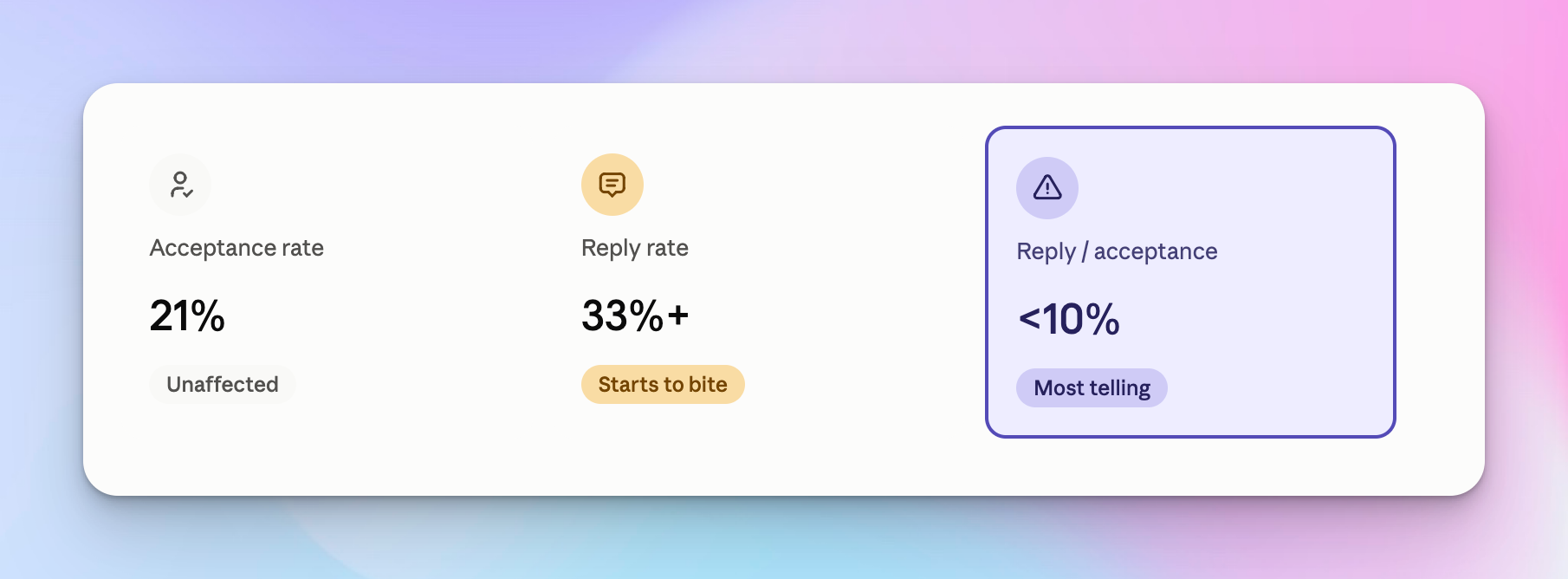
If acceptance is healthy and this ratio is weak, the leak usually isn't your offer or your targeting. It's what happens the moment someone actually reads the personalized line, which is precisely the moment a hallucination gets tested against reality.
AI personalization is a force multiplier, and force multipliers don't care which direction they're pointed. The same system that lets one account sound like it spent an hour researching every lead is the system that can ship a fabricated Series B to a thousand inboxes before lunch.
A growth strategy built on real campaign data already assumes you're tracking acceptance, replies, and conversion, the same way a reply-rate playbook assumes the message behind the number is sound. Add one line item before you scale the next AI-personalized sequence: whether anyone actually checked what it says.

Try it for free
Frequently Asked Questions
What's the difference between a hallucination and just a generic personalization line?
A generic line is vague on purpose and can't be checked (“hope things are going well”). A hallucination is specific and false — it makes a claim that turns out not to be true. Generic lines cost you engagement. Hallucinated ones cost you trust, which is much harder to rebuild inside a single message.
Can I just tell the model not to hallucinate in the prompt?
Instructions like “only use verified facts” reduce how often it happens but don't remove it, because the model still can't distinguish a fact it retrieved from a fact it inferred. Prompting helps; it isn't a QA layer on its own. The fields still need enforced provenance behind them.
Does this only apply to LinkedIn, or does it show up in email personalization too?
Same failure mode, same fix, in both channels. It surfaces faster on LinkedIn, because the prospect can check your claim against their own profile in the same window they're reading the message.
How much of the QA process can actually be automated?
The provenance check — does this claim map to a real, non-empty source field — can be enforced with rules before generation even happens. Specificity, tone, and reversibility checks still benefit from a human pass, at least until sampled review shows a given pattern is consistently safe.
How do I know if hallucinations are already hurting a live campaign?
Watch reply-to-acceptance conversion, not just reply rate on its own. A campaign with solid acceptance and reasonable reply rate elsewhere in the funnel, but a stalled reply-to-acceptance ratio right after you introduced a new personalization variable, is worth a manual review pass before you scale it further.