How to run a LinkedIn outreach experiment properly (and why most A/B tests are meaningless)
Published:
August 4, 2026
Most LinkedIn A/B tests aren't tests. Yep, you read it right. A team changes the opening line, sends it to 50 people, sees a slightly better reply rate, and calls it a winner. I wouldn't call that an experiment. It's more like a coin flip wearing a lab coat.
Real testing means enough volume to trust the result, one variable changed at a time, and a system for recording what was learned so it doesn't vanish the moment a rep moves on. This guide covers how to size a test properly, what's actually worth testing, how to isolate variables across sender accounts, and how to read the results without fooling yourself, the missing discipline behind most outreach strategies that stall out after an initial burst of good replies.
What a real test actually requires
Changing a line, sending it to a handful of leads, and eyeballing the reply rate isn't testing, it's guessing with extra steps. A real test starts with a hypothesis, sizes the sample properly, isolates one variable, and only gets trusted once it clears a significance threshold set in advance, before anyone's looked at the numbers.
"Does this feel better" is not the same question as "is this actually better." Only one of those holds up when the same test gets run again next month.
Why most LinkedIn A/B tests are meaningless
- The sample size problem: Fifty replies isn't a result, it's noise with a narrative attached.
- The multi-variable trap: Changing the opener, the CTA, and the message length all at once means you can't attribute any lift to anything specific.
- The single-sender bias: Testing variant A on one sender account and variant B on another lets account-level reputation and reach skew the outcome before the copy ever gets a fair shot.
- The survivorship trap: Only looking at the replies you got, and ignoring the leads who never responded, quietly inflates what "winning" looks like.
- The vanishing knowledge problem: A rep runs a solid test, learns something real, then leaves the team, and the insight leaves with them.
How to calculate statistical significance without a statistics degree
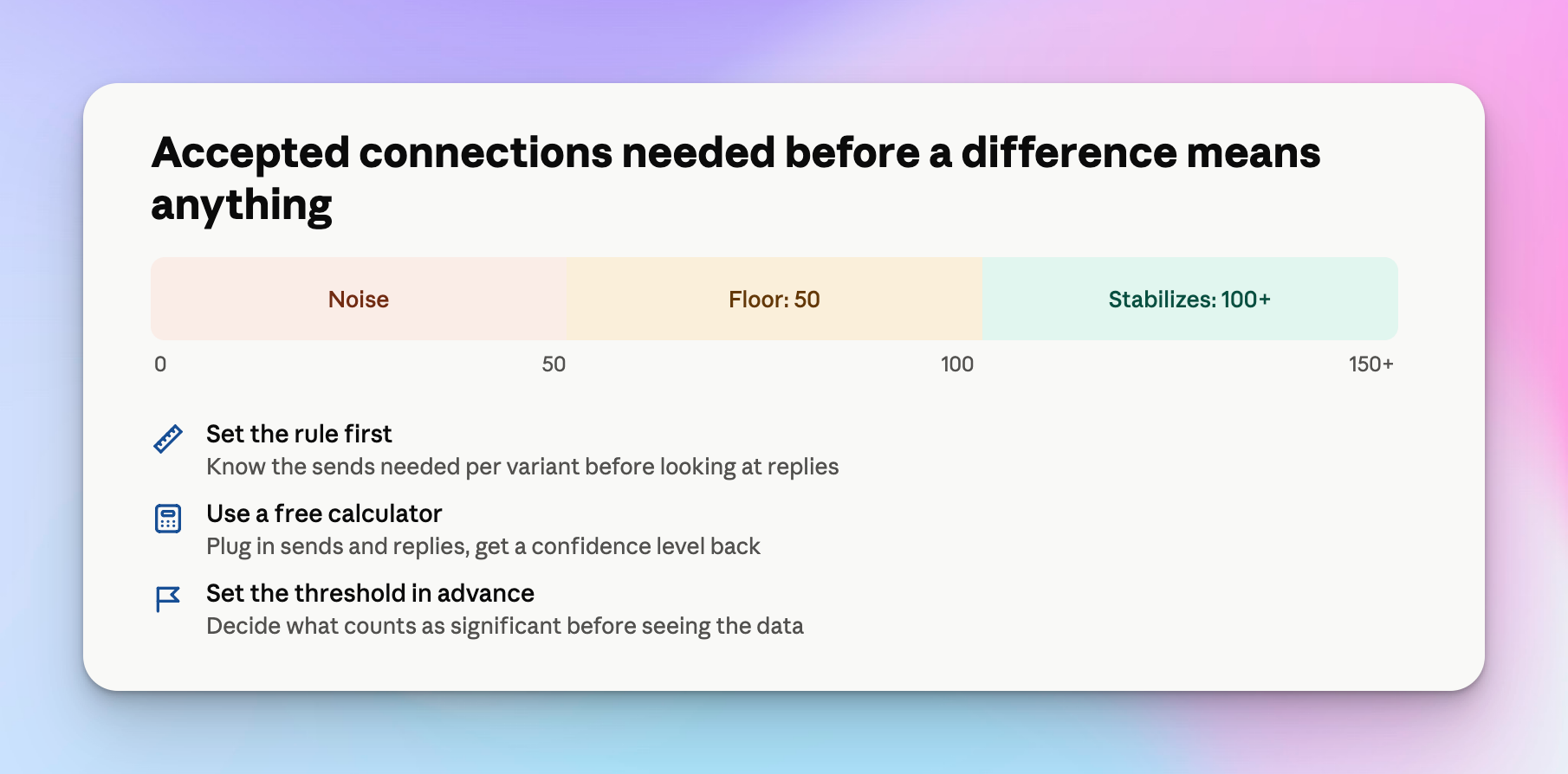
You don't need a background in statistics to run this correctly, you need a rule and the discipline to follow it. In HeyReach, we looked at reply rate patterns across thousands of campaigns and found that directional patterns only start to stabilize around 100 accepted connections per campaign, with roughly 50 accepted connections per variation being the floor for a result worth reading at all. Below that threshold, you're reading randomness, not signal.
- The simple version: Before you look at a single reply, know how many sends per variation you need before a difference means anything.
- Using free calculators: Plug in sends and replies per variant into a free significance calculator and get a confidence level back, no formulas required on your end.
- Setting a threshold in advance: Decide what confidence level counts as "significant" before you look at the data, not after. Deciding this after seeing the numbers is how teams talk themselves into results they want to see.
Designing a test that isolates one variable
This is where most tests fall apart before they even launch, and it's the same discipline behind any solid automated LinkedIn messaging setup: control what you can, and only ever change one thing.
Picking what to test: Opener, CTA, connection note versus no note, message length. Pick one, not all four at once. Common starting points, like playful versus formal tone or longer versus shorter copy, show up repeatedly across any solid LinkedIn lead generation strategy.
Isolating across senders: Split variants evenly across the same pool of sender accounts so no single profile's reach or reputation skews the result. Running both versions inside a single campaign, using a native message variation feature rather than two separate campaigns, is the cleanest way to satisfy this condition, since both versions reach the same audience pool at the same time.
Controlling the audience: Make sure both variants go out to comparably qualified leads. Testing one variant on a clean, well-scored high-intent lead segment and the other on a messier list isn't a fair test, it's a rigged one. The same logic applies if you're running tests inside a signal-based outbound program, since testing across mismatched buyer intent signals will produce a result that says more about targeting than about the message.
Reading the results: winner, false positive, or too early to tell
- When a winning variant is worth scaling: Clear statistical significance, a consistent lift across multiple sender accounts, and a sample size that holds up under scrutiny.
- When it's a false positive: A small sample, borderline significance, or a lift that traces back to one unusually well-performing sender account rather than the message itself.
- What to do when it's inconclusive: Extend the test instead of forcing a decision on partial data. A test that hasn't reached its threshold isn't a failed test, it's an unfinished one.
Reading reply rate alone can also be misleading. Looking at reply-to-acceptance rate per campaign, rather than one blended number, separates whether a low reply rate is a targeting problem or a messaging problem, which changes what you should even be testing next.
Building a test log so learnings don't disappear
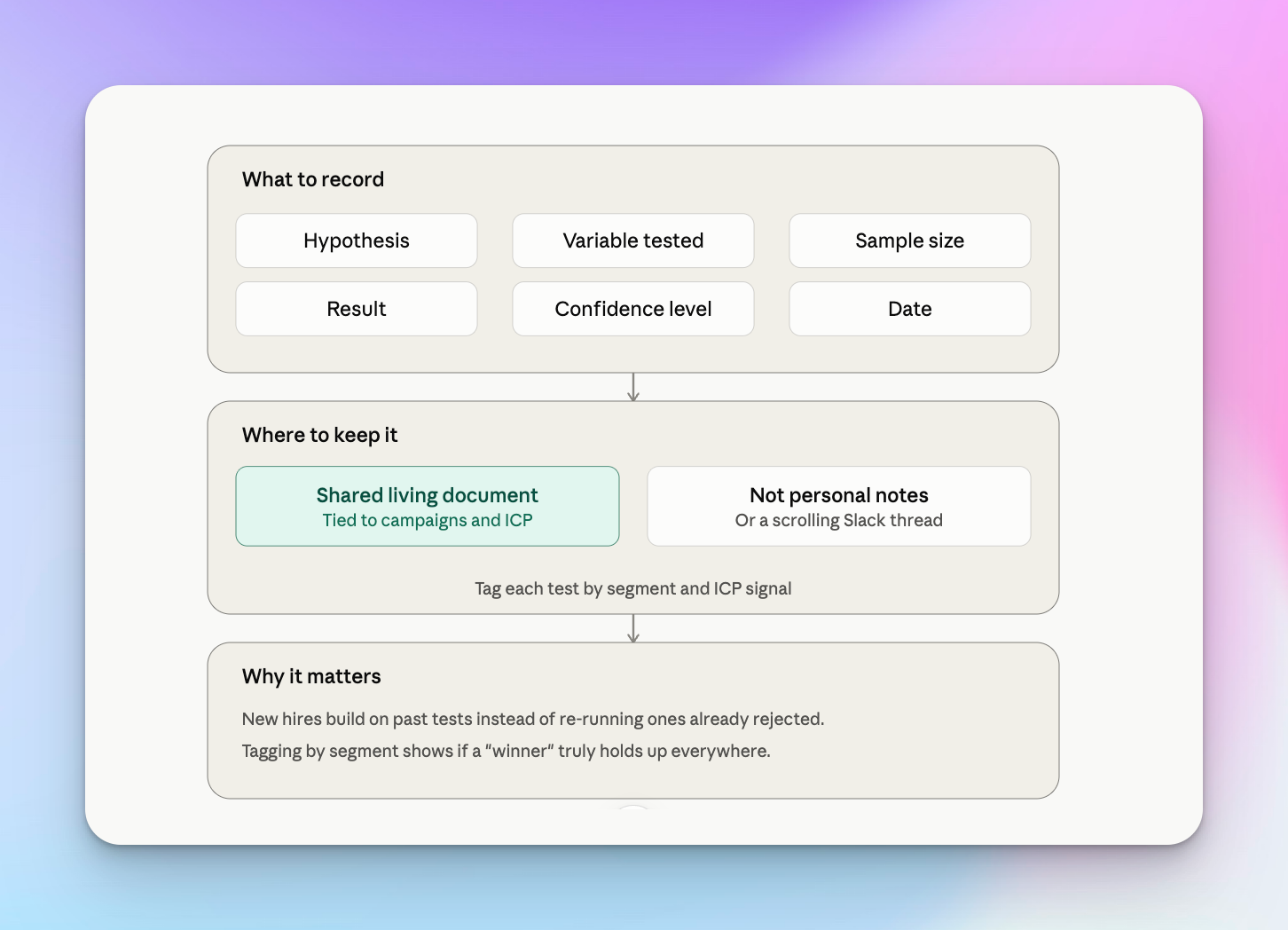
What to record: Hypothesis, variable tested, sample size, result, confidence level, and date.
Where to keep it: A shared, living document tied to campaigns and lead prioritization logic, not a rep's personal notes or a Slack thread that scrolls out of view. Tying results back to the customer segmentation or outbound ICP signals each test ran against also makes it obvious later whether a "winner" actually holds up across every segment, or only the one it happened to be tested on.
Turning a winning test into a campaign template
Standardizing the winner: Once a variant clears your threshold, make it the new default across every relevant sales sequence, not just the campaign it was tested in.
Rolling it out safely: Apply the change gradually across sender accounts rather than all at once, so you can catch any unexpected drop in acceptance or deliverability before it spreads everywhere. If you're already syncing replies to your CRM through an n8n workflow, that same pipeline makes it easy to watch downstream reply sentiment shift the moment the new template goes live, not just the raw reply count.
Documenting the change: Update the test log so the new baseline is clear for the next round of testing, and so the team isn't testing against a version that's already been retired.
Why winning messages have a shelf life
Fatigue and saturation: A message that converted well six months ago can go stale as the same audience sees variations of it repeatedly across their network.
Re-testing cadence: Revisit even a "winning" template every few months, and watch for early signs like declining positive reply rates as a cue that it's time sooner than planned.
Treating testing as ongoing: The strongest outbound teams don't stop testing once they find a winner, they keep testing to extend what's already working and catch the drop-off before it shows up in pipeline. Some teams now lean on an AI outreach agent to flag that decline automatically rather than waiting for a rep to notice, and the same re-testing discipline is exactly what keeps a re-engagement sequence from going stale the second time around.
A properly run test beats a gut feeling every time, because a gut feeling doesn't survive being run again next quarter. The discipline of isolating variables, sizing samples correctly, and logging what you learn compounds into something a hunch never can: a measurable, repeatable edge in what actually gets replies.

Try it for free
Frequently Asked Questions
What is A/B testing in LinkedIn outreach?
It's the practice of sending two or more variations of a message to comparable audiences, at the same time, in order to measure which one performs better on a specific metric like reply rate or acceptance rate.
How many leads do you need for a statistically significant LinkedIn test?
As a rule of thumb, aim for at least 50 accepted connections per variation before reading a directional result, and closer to 100 per campaign before treating a pattern as stable.
What should you test first in a LinkedIn outreach sequence?
Start with the connection note or opening line, since it has the most direct effect on acceptance and reply rate, before moving on to CTA phrasing or message length.
How do you avoid bias when testing across multiple sender accounts?
Split both variants evenly across the same pool of senders, and use a native message variation feature so both versions run inside the same campaign and reach the same audience pool simultaneously.
How often should you re-test a winning message?
Revisit winning templates every few months, or sooner if reply rates or positive reply tagging start trending down, since audience fatigue sets in even on messages that once performed well.