Semantic deduplication: Stopping the same prospect from getting hit by 3 different AI sequences
Published:
August 31, 2026
Monday, Sarah gets a connection request from your SDR's account. Wednesday, a different account opens with a “following up” message from your PLG sequence. Friday, a third account writes “saw you're leading platform infra at Acme” — except Sarah left Acme four months ago, and this is the third time this week your company has shown up in her notifications.
She doesn't reply to any of them. She screenshots message three and drops it in a Slack channel full of other VPs of Engineering, captioned “these guys again.”
Nothing here is technically broken. Three campaigns ran exactly as configured. Three lists exported clean. Three AI sequences did exactly what they were built to do. The problem is that all three jobs were, semantically, the same person — and nothing in your stack was built to notice.
MY RULE Exact-match dedup catches records that are identical. Semantic dedup catches records that are the same person. Most outbound stacks only have the first one, which is why this keeps happening even to teams who think they're “already deduping.”
This isn't the same problem as “we're sending too much outbound.” Frequency caps and cadence rules solve for volume from a single sequence. They do nothing when three separate, well-behaved sequences each think they're the only one talking to this person. You can have perfect cadence discipline inside every individual campaign and still hit the same prospect three times in a week, because the discipline never had visibility across campaigns in the first place.
Why exact-match dedup stops working the moment you add AI sequences
A single list from a single source barely needs deduping — one export, one cleanup pass, done. That's not the stack anymore.
The moment you're running more than one AI-driven motion — a cold sequence, a buying intent trigger, a product-led growth play, a re-engagement workflow for closed-lost deals — you've got multiple systems independently deciding a lead is worth messaging, on their own schedule, off their own enrichment. None of them are wrong on their own. None of them know about each other.
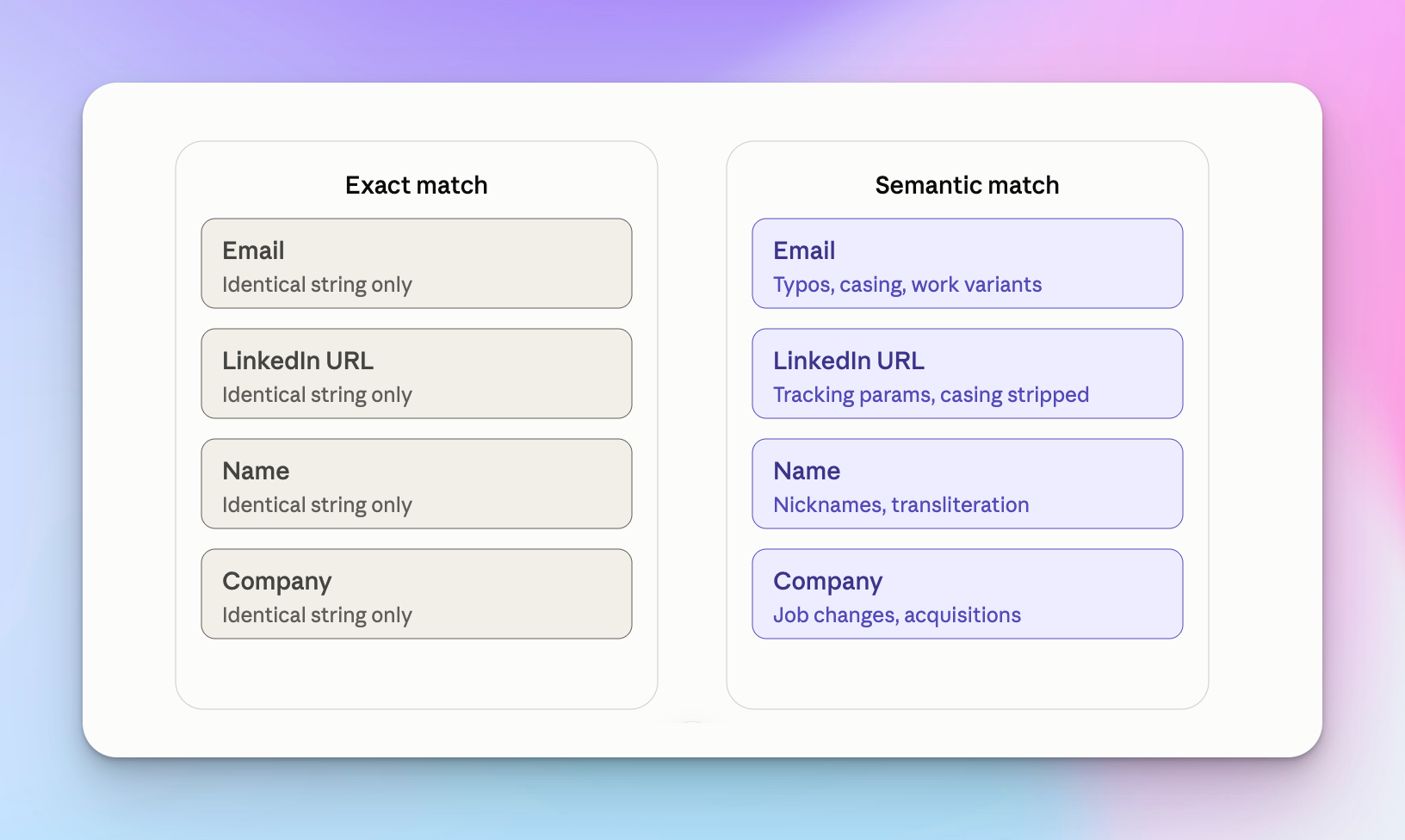
Exact-match dedup checks one field — usually email or LinkedIn URL — and calls it done. It misses:
- The same person with a personal email in one list and a work email in another
- A LinkedIn URL with different tracking parameters or a public-id casing change
- A name typed “Rob” in one CRM field and “Robert” in another
- The exact same person, at a new company, three months after your CRM's last enrichment sync
None of these look like duplicates to a system doing string matching. They all look like duplicates to the person who gets three sequences in one week.
Where the duplicate entries actually get created
I've traced this back with a few teams now, and it's almost always one of three points. AI outbound workflows degrade the same way — quietly, upstream of wherever you're currently looking.
- Sourcing layer. Three lists get built independently — a Clay table for one segment, a Sales Navigator search for another, a CRM re-engagement export for a third. Each one is clean on its own. None of them get checked against the other two before they're enrolled.
- Orchestration layer. This is where agents stacked into a workflow or an outreach agent making its own calls enrolls a lead the moment a trigger fires. A signal-based system sees intent and pulls the trigger without checking whether that person is already three days into a different sequence somewhere else in the org.
- Execution layer. Multiple sender accounts — sometimes across a whole set of LinkedIn profiles managed for scale — fire independently because there's no shared suppression list between campaigns, only a per-campaign one.

None of these layers is misconfigured. Each one is doing exactly what it was told. The gap sits between them, not inside any one of them.
Exact match vs. semantic match
If your dedup logic only clears the left column below, you're running exact-match dedup with a semantic-match problem sitting on top of it.
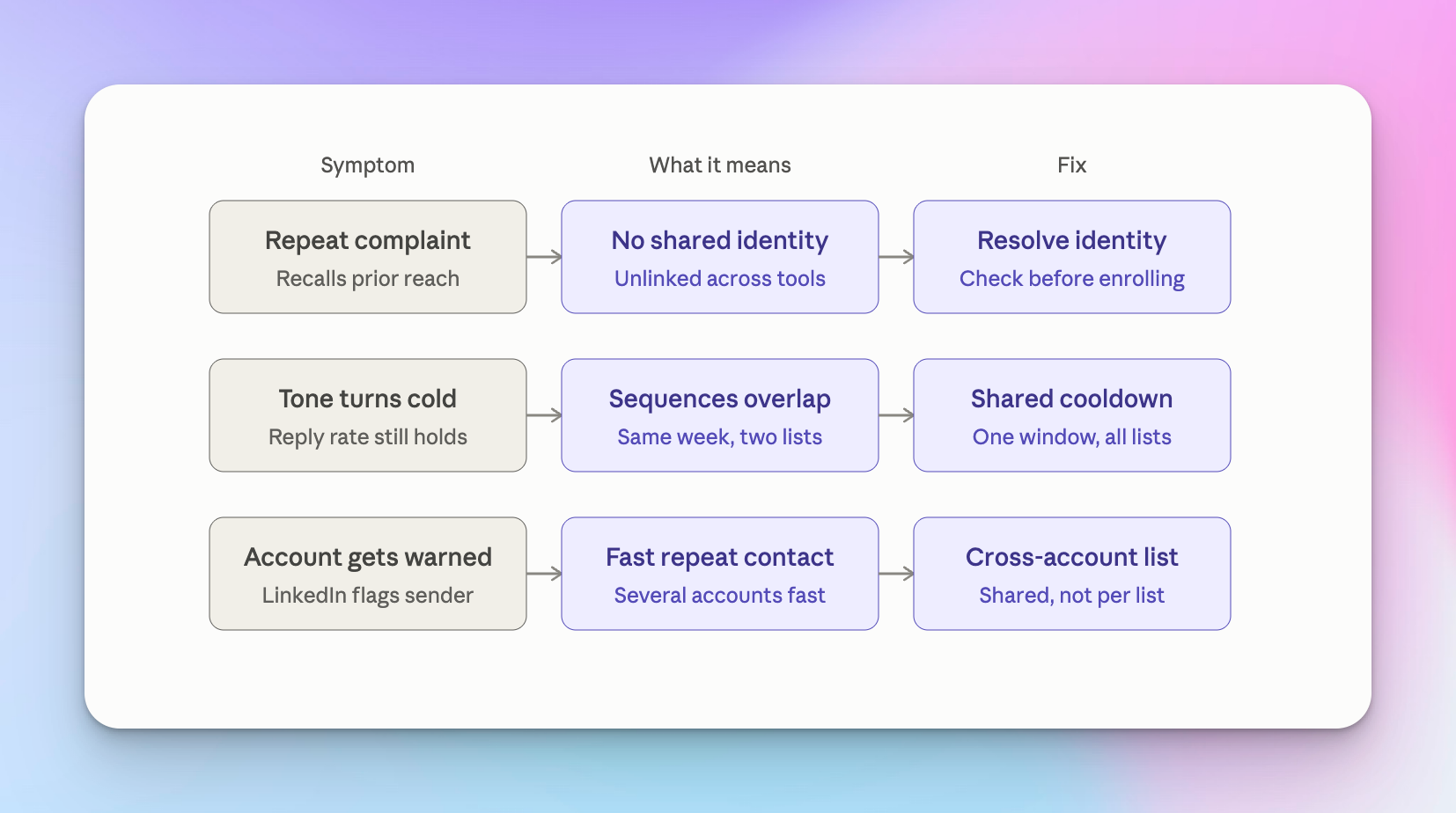
Map the symptom to the layer, not to the copy
Same principle as diagnosing any outbound workflow that degrades post-launch: the symptom tells you what to check, not what to fix directly. Don't touch messaging until you've ruled out identity.
How to actually build semantic dedup
None of this needs to be a platform purchase. It's four rules, applied consistently, at the one point in the pipeline where they actually matter — before a lead gets added to anything.
- Pick a canonical key, not a canonical field. Normalize name + company domain (not company display name) + a stripped LinkedIn public identifier. Fuzzy-match on that combination, not any single field alone.
- Merge at the enrollment point, not the reporting point. Checking for duplicates in a weekly report tells you what already went out. The check has to sit between “lead qualifies for a sequence” and “lead gets enrolled” — same discipline as any campaign audit framework that catches problems before they compound, not after.
- Share the suppression list across every sequence and every sender account. A single inbox view helps you see the collision after the fact. What actually prevents it is a suppression list every trigger checks before it fires — whether that trigger came from buying intent, a product usage signal, or lead scoring automation deciding a lead just crossed a threshold.
- Give re-engagement a cooldown, not just a rule. A closed-lost lead re-entering pipeline through a re-engagement workflow six weeks after a cold sequence ended isn't a duplicate by any technical definition. It still needs a minimum cooldown window, because the prospect doesn't experience your org chart — they just see the same company messaging them again.
Duplicate collisions don't show up as a spike. They show up as replies that read cold or annoyed for no obvious reason, in campaigns where nothing about the message itself changed.
None of this requires ripping out your stack. It requires one canonical identity check sitting in front of every sequence that's allowed to enroll a lead, treated with the same seriousness as the targeting layer in any outbound workflow you're already auditing. Add it once, and three well-run sequences stop quietly conspiring to make you look like you don't know who your own prospect is.

Try it for free
Frequently Asked Questions
What's the difference between exact-match and semantic deduplication?
Exact-match dedup compares two records and flags them only when a chosen field is identical, character for character. Semantic dedup asks a different question: is this the same real person, even if the email, LinkedIn URL, or company field don't match exactly. Most CRMs and outbound tools ship with exact-match dedup only, which is why duplicates keep leaking through even after a “dedup” step already ran.
Where should the dedup check actually happen?
At enrollment, not in reporting. A weekly dedup report tells you what already went wrong. The check needs to sit between a lead qualifying for a sequence and that lead actually being added to it, across every trigger that can enroll someone — signal-based, manual, or scored.
Does this only matter for teams running multiple tools?
It shows up faster with multiple tools, but a single platform running several campaigns has the same problem if those campaigns don't share a suppression list. The number of tools isn't the variable — the number of independent decision points that can enroll a lead is.
How do you build a canonical key without over-engineering it?
Start with three fields: normalized name, company domain (not display name), and a stripped LinkedIn public identifier. Fuzzy-match on the combination, not any single field. That catches the majority of real-world duplicates without needing a full identity-resolution platform.
What's a reasonable cooldown window between sequences?
There's no universal number, but it should be longer than your longest single sequence, not just longer than the gap between two campaign launches. A lead finishing a three-week sequence needs a buffer measured from the last touch, not from when the next campaign happened to start.